Han Dynasty Seismograph
Interactive passage with audio narration, comprehension questions, and printable PDF.
By completing this purchase you agree to our Terms of Use and Privacy Policy. Your subscription renews automatically until you cancel. You can cancel anytime from your account settings. All sales are final and non-refundable. Digital content is available for download in your account immediately upon purchase.
What's included
Han Dynasty Seismograph preview and details
About this printable Han Dynasty Seismograph reading passage (Grades 6-8)
Sample passage and quiz from Han Dynasty Seismograph
Reading passage and comprehension quiz preview
Han Dynasty Seismograph
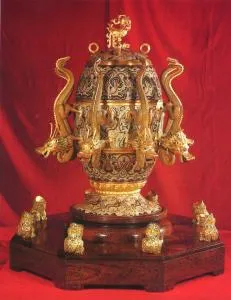
"Sismografo chang heng" /
Source: Wikimedia Commons (Public domain).
The Han dynasty (206 BCE–220 CE) in ancient China was a period of great scientific achievement. One of the most remarkable inventions from this era was the seismograph, a device designed to detect earthquakes. This invention was created in 132 CE by the renowned scholar Zhang Heng in the Han capital of Luoyang. Earthquakes were a major concern in China, as they could destroy crops, buildings, and even whole cities. The seismograph allowed the Han government to respond more quickly to disasters, which helped protect people and maintain order throughout the empire.
The seismograph invented by Zhang Heng was a large bronze vessel, decorated with eight dragon heads facing the eight main directions. Inside the vessel was a pendulum-like mechanism that could sense tremors. When an earthquake struck anywhere in the vast Han empire, the device would cause a ball to drop from a dragon’s mouth into the open mouth of a toad below, showing the direction of the quake. This early technology was so sensitive that it detected an earthquake hundreds of miles away, even when people nearby felt nothing. Historical records from the Book of Later Han describe how the device reported an earthquake in the northwest. The court was skeptical until messengers confirmed the report days later, providing important evidence of the seismograph’s accuracy.
Zhang Heng’s seismograph was not only a scientific innovation but also a tool for the Han government to strengthen its control over the vast empire. By knowing exactly where natural disasters struck, officials could send aid, organize repairs, and support local communities. The invention demonstrated the importance of technology in solving real-world problems and reflected the Han dynasty’s belief in using knowledge to improve society. The seismograph’s success encouraged further experimentation and invention in ancient China.
The development of the seismograph highlights the relationship between geography and human activity. China’s location along tectonic plate boundaries made it vulnerable to earthquakes, and the Han dynasty’s centralized government was able to use new methods to protect its people. Socially, the invention showed that scholars and inventors could have an important role in daily life, not just in the royal court but throughout society. While the exact mechanism of Zhang Heng’s seismograph remains debated among historians, archaeological finds and ancient texts confirm its influence on later technologies and its place in the history of science.
In summary, the Han dynasty’s seismograph was a breakthrough that combined scientific curiosity, practical need, and government support. It set the stage for future advancements in earthquake detection and remains a symbol of ancient China’s ingenuity. The story of the seismograph connects to broader themes of innovation, adaptation, and the ways in which societies respond to natural challenges.
Interesting Fact: The word “seismograph” comes from the Greek words for “earthquake” and “to write,” but Zhang Heng’s device did not record waves on paper—it showed the direction of the quake instead.
Comprehension quiz (8 questions)
1. Who invented the seismograph?
2. When was the seismograph invented?
3. What did the Han seismograph detect?
4. How did the seismograph show earthquake direction?
5. Why was detecting earthquakes important for Han rulers?
6. What role did geography play?
7. The Han dynasty invented the first seismograph. (True/False)
8. What does 'innovation' mean in the passage?
Perfect for the way you teach
- Build comprehension skills
- Auto-graded quiz
- Differentiated reading
- Read together at home
- Improve fluency
- Quiet reading time
- Reading curriculum support
- Independent practice
- Track Lexile growth