Photosynthesis
Interactive passage with audio narration, comprehension questions, and printable PDF.
By completing this purchase you agree to our Terms of Use and Privacy Policy. Your subscription renews automatically until you cancel. You can cancel anytime from your account settings. All sales are final and non-refundable. Digital content is available for download in your account immediately upon purchase.
What's included
Photosynthesis preview and details
About this printable Photosynthesis science reading passage, NGSS-aligned (Grades 5-8)
Sample passage and quiz from Photosynthesis
Reading passage and comprehension quiz preview
Photosynthesis
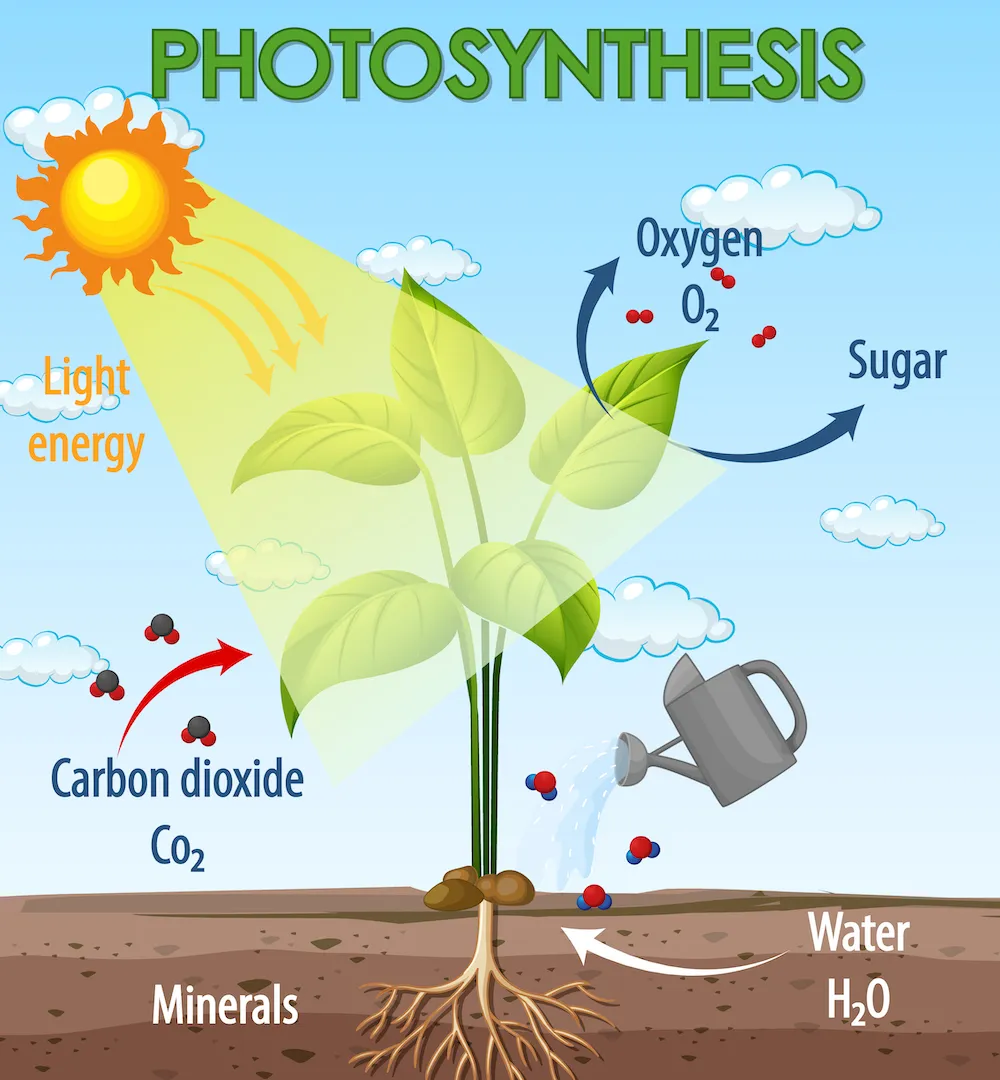
Photosynthesis is the fundamental process that transforms solar energy into chemical energy in ecosystems. This process occurs in the leaves of plants, enabling them to create their own food and release oxygen into the air. Without photosynthesis, most living organisms would not have the food or oxygen they need to survive. Understanding how photosynthesis works helps scientists explain the flow of energy through living systems and its impact on the environment.
How Photosynthesis Works
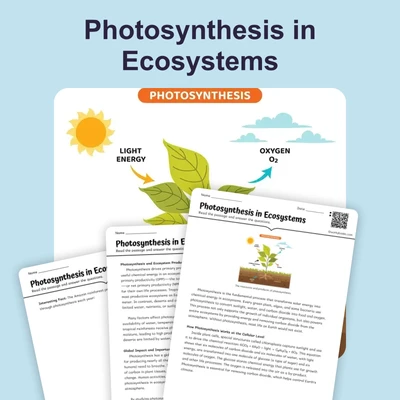
Photosynthesis takes place in special cell structures called chloroplasts, found mainly in leaf cells. Plants use three main inputs: carbon dioxide from the air, water absorbed by roots, and sunlight. The overall chemical equation for photosynthesis is 6CO2 + 6H2O + light energy → C6H12O6 + 6O2. In this reaction, six molecules of carbon dioxide and six molecules of water, using light energy, are converted into one molecule of glucose (a type of sugar) and six molecules of oxygen. Photosynthesis happens in two main stages: the light reactions and the Calvin cycle. In the light reactions, chloroplasts capture sunlight and use its energy to split water molecules, releasing oxygen and producing energy-rich molecules. The Calvin cycle uses these molecules to combine carbon dioxide into glucose. Both stages are essential for plants to store solar energy as food.
Interconnected Systems and Real-World Examples
Photosynthesis is not only vital for plants but also for almost all life on Earth. For example, forests absorb about 30% of the carbon dioxide produced by human activities, helping to slow climate change. Even underwater, algae perform photosynthesis, producing oxygen for aquatic animals. When light, carbon dioxide, or water is limited, the rate of photosynthesis drops. Farmers take advantage of this knowledge by providing extra carbon dioxide or artificial light in greenhouses to increase plant growth. Scientists use special sensors to measure the rate of photosynthesis in different environments and track how it changes with seasons.
Factors Affecting Photosynthesis
The rate of photosynthesis can change depending on environmental factors. More intense sunlight usually increases the rate, up to a certain point. Increasing carbon dioxide levels can also speed up the process, but only if enough water and light are present. Temperature is important, too: photosynthesis works best within a certain range, usually between 15°C and 35°C. If it gets too hot or too cold, the process slows down or stops. These relationships show how living systems and their environments are strongly connected.
Plants, algae, and some bacteria use photosynthesis to produce food and oxygen, supporting nearly all life on Earth. This process is a key example of energy flow and matter cycling within biological systems, connecting physical, chemical, and life sciences.
Interesting Fact: Over 70% of the oxygen in Earth's atmosphere comes from photosynthetic organisms in the ocean, like algae and cyanobacteria!
Comprehension quiz (10 questions)
1. What is the main purpose of photosynthesis?
2. Where does photosynthesis mainly take place in plants?
3. Which three inputs are needed for photosynthesis?
4. According to the passage, what is the chemical equation for photosynthesis?
5. What does the word 'glossary-word Calvin cycle' mean as used in the passage?
6. What is meant by the term 'light reactions' in the context of photosynthesis?
7. How do farmers use knowledge of photosynthesis to help their crops grow?
8. Why does the rate of photosynthesis slow down if it gets too hot or too cold?
9. True or False: More than 70% of Earth's oxygen comes from photosynthetic organisms in the ocean.
10. True or False: Photosynthesis requires oxygen as an input for the process.
Perfect for the way you teach
- Build comprehension skills
- Auto-graded quiz
- Differentiated reading
- Read together at home
- Improve fluency
- Quiet reading time
- Reading curriculum support
- Independent practice
- Track Lexile growth