Photosynthesis in Ecosystems
Interactive passage with audio narration, comprehension questions, and printable PDF.
By completing this purchase you agree to our Terms of Use and Privacy Policy. Your subscription renews automatically until you cancel. You can cancel anytime from your account settings. All sales are final and non-refundable. Digital content is available for download in your account immediately upon purchase.
What's included
Photosynthesis in Ecosystems preview and details
About this printable Photosynthesis in Ecosystems science reading passage, NGSS-aligned (Grades 5-8)
Sample passage and quiz from Photosynthesis in Ecosystems
Reading passage and comprehension quiz preview
Photosynthesis in Ecosystems
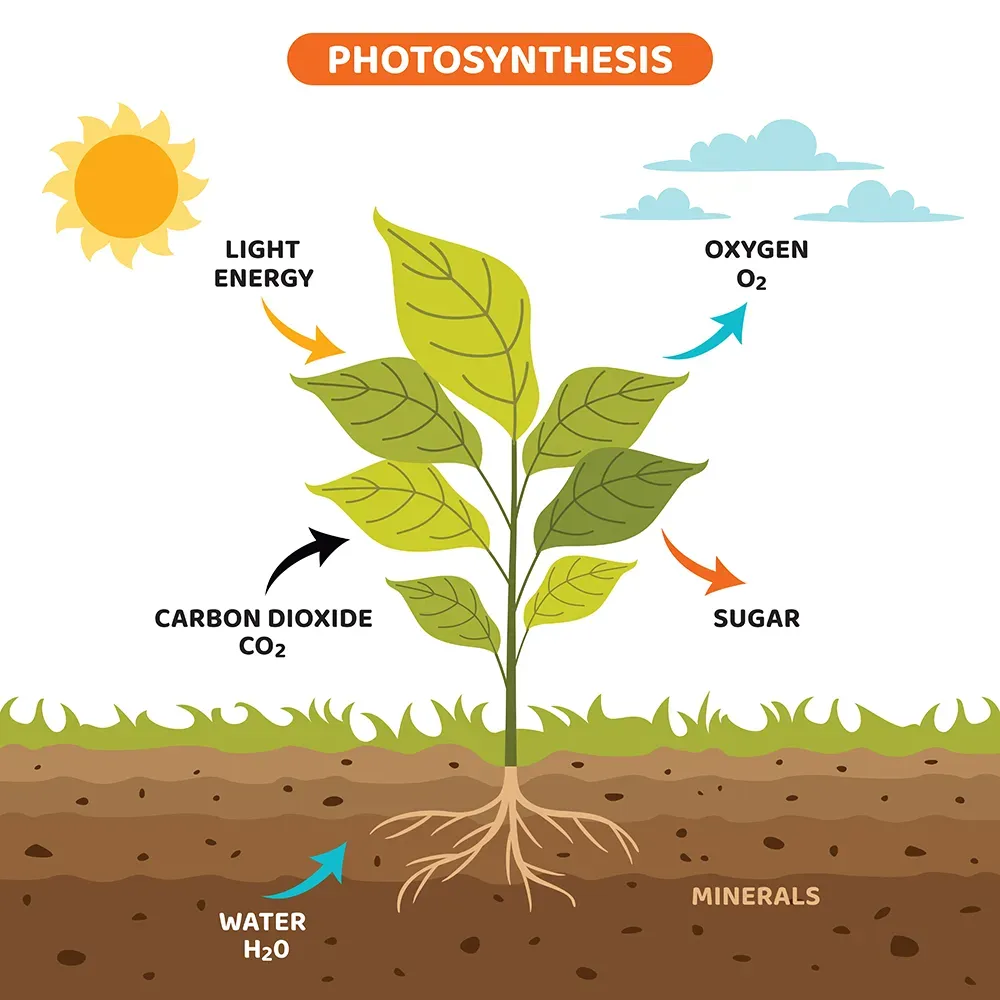
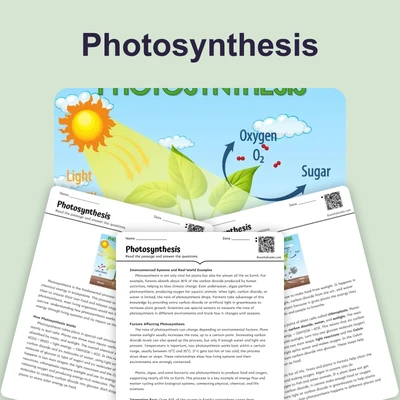
Photosynthesis is the fundamental process that transforms solar energy into chemical energy in ecosystems. Every green plant, algae, and some bacteria use photosynthesis to convert sunlight, water, and carbon dioxide into food and oxygen. This process not only supports the growth of individual organisms, but also powers entire ecosystems by providing energy and removing carbon dioxide from the atmosphere. Without photosynthesis, most life on Earth would not exist.
How Photosynthesis Works at the Cellular Level
Inside plant cells, special structures called chloroplasts capture sunlight and use it to drive the chemical reaction: 6CO₂ + 6H₂O + light → C₆H₁₂O₆ + 6O₂. This equation shows that six molecules of carbon dioxide and six molecules of water, with light energy, are transformed into one molecule of glucose (a type of sugar) and six molecules of oxygen. The glucose stores chemical energy that plants use for growth and other life processes. The oxygen is released into the air as a by-product. Photosynthesis is essential for removing carbon dioxide, which helps control Earth's climate.
Photosynthesis and Ecosystem Productivity
Photosynthesis drives primary productivity—the rate at which plants produce useful chemical energy in an ecosystem. Scientists measure this as either gross primary productivity (GPP)—the total amount of energy captured by photosynthesis—or net primary productivity (NPP)—the energy remaining after plants use some for their own life processes. Tropical rainforests, coral reefs, and estuaries are the most productive ecosystems on Earth, with high rates of photosynthesis per square meter. In contrast, deserts and open oceans have much lower productivity due to limited water, nutrients, or sunlight.
Many factors affect photosynthesis and productivity: the amount of sunlight, the availability of water, temperature, and nutrients in the soil or water. For example, tropical rainforests receive plenty of sunlight, warm temperatures, and abundant moisture, leading to high productivity. In contrast, extreme environments like deserts are limited by water, and polar regions are limited by temperature and light.
Global Impact and Importance
Photosynthesis has a global impact far beyond individual plants. It is responsible for producing nearly all the oxygen in Earth's atmosphere, which animals (including humans) need to breathe. It also acts as a major carbon sink by storing vast amounts of carbon in plant tissues, helping to balance Earth’s carbon cycle and slow climate change. Human activities, such as deforestation and pollution, can reduce photosynthesis in ecosystems, leading to higher carbon dioxide levels in the atmosphere.
By studying photosynthesis at both the cellular and ecosystem levels, scientists can better understand how energy flows through living systems and how environmental changes affect life on Earth. Ongoing research explores how to protect or even increase photosynthesis in threatened ecosystems to support a healthy, balanced planet for future generations.
Interesting Fact: The Amazon rainforest produces about 20% of the world’s oxygen through photosynthesis each year!
Comprehension quiz (10 questions)
1. What is the main function of photosynthesis in ecosystems?
2. Which structures in plant cells capture sunlight for photosynthesis?
3. According to the passage, what does the photosynthesis equation show?
4. What is one reason tropical rainforests have high productivity?
5. What does 'net primary productivity' mean in the context of ecosystems?
6. What does the word 'carbon sink' mean as used in the passage?
7. If a forest is cut down, how might that affect the global carbon cycle?
8. Why is photosynthesis important for maintaining Earth's climate?
9. True or False: Photosynthesis is responsible for almost all the oxygen in Earth's atmosphere.
10. True or False: Only tropical rainforests perform photosynthesis.
Perfect for the way you teach
- Build comprehension skills
- Auto-graded quiz
- Differentiated reading
- Read together at home
- Improve fluency
- Quiet reading time
- Reading curriculum support
- Independent practice
- Track Lexile growth