Photosynthesis and Respiration Connection
Interactive passage with audio narration, comprehension questions, and printable PDF.
By completing this purchase you agree to our Terms of Use and Privacy Policy. Your subscription renews automatically until you cancel. You can cancel anytime from your account settings. All sales are final and non-refundable. Digital content is available for download in your account immediately upon purchase.
What's included
Photosynthesis and Respiration Connection preview and details
About this printable Photosynthesis and Respiration Connection science reading passage, NGSS-aligned (Grades 5-8)
Sample passage and quiz from Photosynthesis and Respiration Connection
Reading passage and comprehension quiz preview
Photosynthesis and Respiration Connection

Photosynthesis is the fundamental process that transforms solar energy into chemical energy in ecosystems. This process allows plants, algae, and some bacteria to capture sunlight and convert it into glucose, a type of sugar that stores energy. In contrast, cellular respiration is how living organisms, including plants and animals, release energy from glucose to power life activities. Together, these two processes form a cycle that moves carbon, oxygen, and energy through all living things. Their connection is essential for maintaining the balance of matter and energy in the biosphere.
How Photosynthesis and Respiration Work
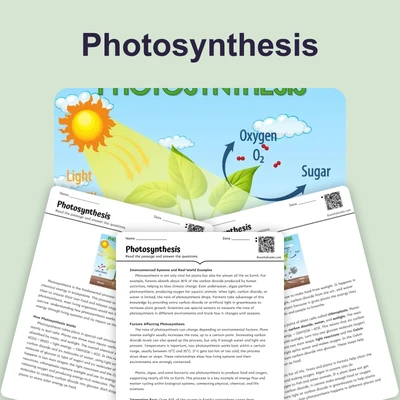
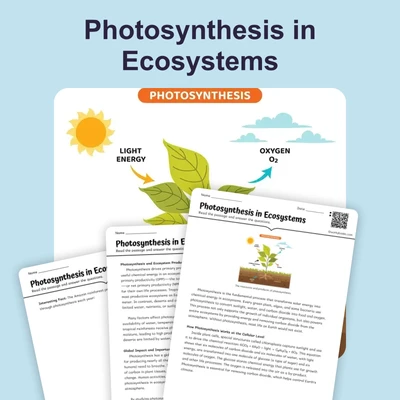
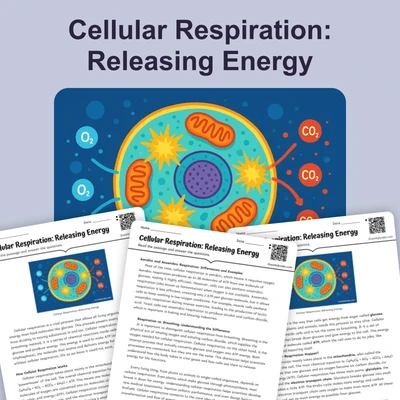
Photosynthesis occurs mainly in the leaves of plants, within structures called chloroplasts. Using sunlight, plants take in carbon dioxide (CO₂) from the air and water (H₂O) from the soil. Through a series of chemical reactions, they produce glucose and release oxygen (O₂) as a byproduct. The simplified equation is: 6CO₂ + 6H₂O + sunlight → C₆H₁₂O₆ + 6O₂. Cellular respiration, on the other hand, happens in the mitochondria of cells. Organisms use oxygen to break down glucose, releasing energy, carbon dioxide, and water. Its equation is almost the reverse: C₆H₁₂O₆ + 6O₂ → 6CO₂ + 6H₂O + energy (ATP). Thus, the outputs of photosynthesis—oxygen and glucose—become the inputs for respiration, and vice versa.
The Cycle of Matter and Energy
This connection creates a powerful cycle. During the day, plants perform photosynthesis, absorbing CO₂ and releasing O₂. At night, when sunlight is unavailable, plants and other organisms rely on respiration, which uses O₂ and releases CO₂. For example, in a forest, the large number of trees help reduce atmospheric CO₂ and increase O₂ during the day. At the same time, animals breathe in O₂ and exhale CO₂, which plants can use again. This cycling of gases helps regulate Earth's atmosphere and supports diverse life forms. Studies show that about 70% of Earth's oxygen comes from photosynthetic organisms in oceans, especially algae.
Real-World Implications and Broader Principles
Understanding the link between photosynthesis and respiration reveals how tightly life on Earth is interconnected. Disruptions to this cycle, such as deforestation or burning fossil fuels, can lead to imbalances in carbon and oxygen levels, affecting climate and health. Scientists use this knowledge to develop technologies like artificial photosynthesis and to guide conservation efforts. The relationship between these processes exemplifies the scientific principle that matter and energy are continuously cycled and transformed within ecosystems, supporting all living things.
Interesting Fact: More than 50% of the oxygen you breathe is produced by microscopic algae in the ocean, not by land plants!
Comprehension quiz (10 questions)
1. What is the main function of photosynthesis in ecosystems?
2. Where does photosynthesis mainly occur in plants?
3. What gas is produced during photosynthesis and used in cellular respiration?
4. According to the passage, what are the inputs of cellular respiration?
5. What is one major result of the cycling of photosynthesis and respiration?
6. What does the word 'chloroplasts' mean as used in the passage?
7. Based on the passage, why is photosynthesis important for animals?
8. If deforestation increases, what is likely to happen to atmospheric carbon dioxide?
9. True or False: The outputs of photosynthesis become the inputs for cellular respiration.
10. True or False: Only plants, not animals, perform cellular respiration.
Perfect for the way you teach
- Build comprehension skills
- Auto-graded quiz
- Differentiated reading
- Read together at home
- Improve fluency
- Quiet reading time
- Reading curriculum support
- Independent practice
- Track Lexile growth