Routes to California
Interactive passage with audio narration, comprehension questions, and printable PDF.
By completing this purchase you agree to our Terms of Use and Privacy Policy. Your subscription renews automatically until you cancel. You can cancel anytime from your account settings. All sales are final and non-refundable. Digital content is available for download in your account immediately upon purchase.
What's included
Part of this bundle

Routes to California preview and details
About this printable Routes to California reading passage (Grades 3-5)
Sample passage and quiz from Routes to California
Reading passage and comprehension quiz preview
Routes to California
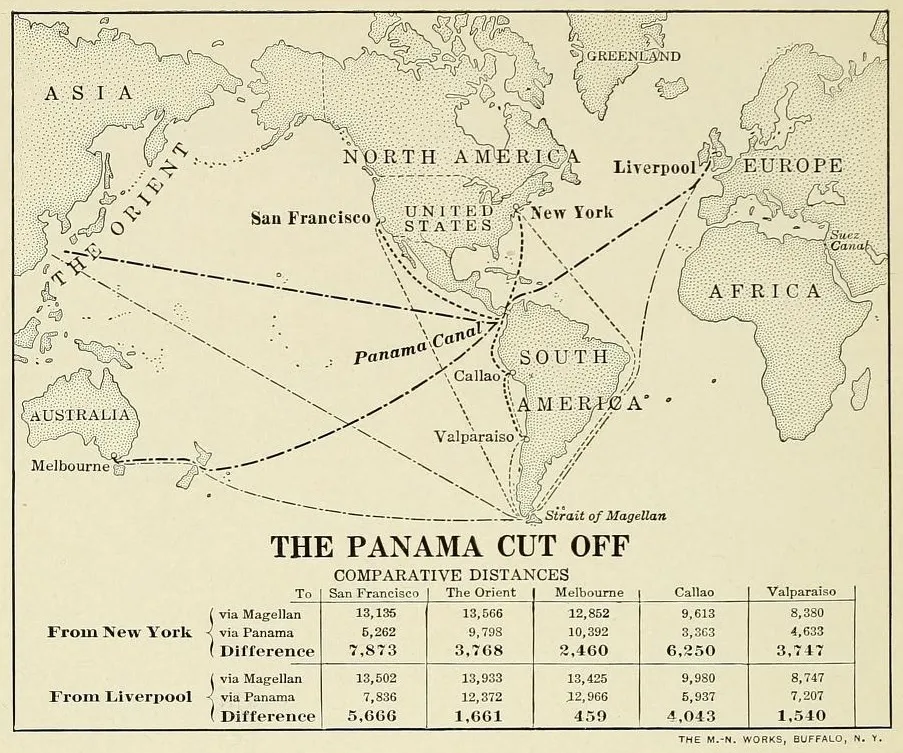
"The Panama route" / Wikimedia Commons (Public domain).
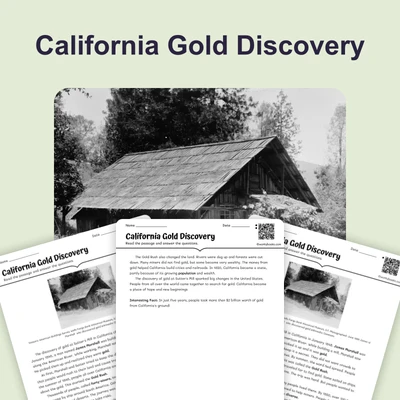
The California Gold Rush began in 1848, when gold was discovered at Sutter’s Mill. Soon, thousands of people wanted to travel to California to search for gold. There were three main routes to reach California: overland trails, sailing around Cape Horn, and crossing the Isthmus of Panama.
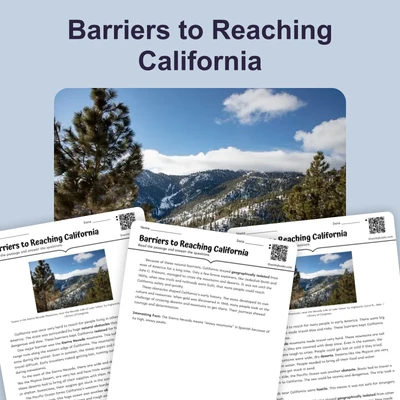
The overland trail was the most common way for families and groups to travel. People loaded their wagons with supplies and followed trails such as the Oregon Trail and California Trail. The journey covered nearly 2,000 miles and could take four to six months. Travelers faced dangers like rough rivers, mountain passes, and bad weather. Food and water were sometimes hard to find. Many became sick from diseases like cholera. Still, this route was cheaper than the others, and people could travel with family and friends.
Another way to reach California was by sea. Some gold seekers sailed all the way around South America’s Cape Horn. This journey was very long, sometimes taking six months or more. Ships had to pass through dangerous storms and rough seas. Travelers had to pay a lot of money for the trip. Some became seasick or ran out of food. However, they did not have to cross deserts or mountains, and ships could carry heavy supplies.
The third route was to cross the Isthmus of Panama. People sailed to the east coast of Panama, traveled across the land by foot or mule, and then took another ship to California. This route was faster, taking about two months, but it had its own dangers. Travelers risked catching tropical diseases like malaria. The land crossing was hard and muddy, and many became sick. Tickets for ships were expensive, and there were not enough boats for everyone. Still, many chose this way because it was quicker than the other routes.
Each route had different dangers and costs. People had to decide which was best for them based on their money, health, and how quickly they wanted to reach California. The Gold Rush changed the country by bringing people from all over the world to California.
Interesting Fact: Some people made more money selling supplies to gold seekers than by finding gold themselves!
Comprehension quiz (8 questions)
1. What began in 1848 in California?
2. Which was the most common route?
3. What did travelers risk in Panama?
4. Why did some choose the Panama route?
5. What was a danger on the overland trail?
6. Why did some people get seasick?
7. The trip around Cape Horn was the fastest route. (True/False)
8. What does 'cost' mean in the passage?
Perfect for the way you teach
- Build comprehension skills
- Auto-graded quiz
- Differentiated reading
- Read together at home
- Improve fluency
- Quiet reading time
- Reading curriculum support
- Independent practice
- Track Lexile growth