This learning resource is available in interactive and printable formats. The interactive worksheet can be played online and assigned to students. The Printable PDF version can be downloaded and printed for completion by hand.
This history reading passage explores the 1869 Golden Spike event that marked the completion of America's Transcontinental Railroad at Promontory Summit, Utah. Students will learn how the joining of the Central Pacific and Union Pacific railroads connected the East and West coasts, greatly changing travel and trade across the nation. The passage highlights key people, challenges, and the importance of the Golden Spike as a symbol of national unity and progress. Glossary terms support vocabulary development, and students can access a Spanish translation of the passage. Engaging activities include a timeline, graphic organizers, multiple choice questions, and writing prompts. This resource aligns with HSS 4.4.1 and RH.6-8.1 standards. Read aloud audio and a Spanish version make the passage accessible for all learners, supporting both history content and literacy skills.
CONTENT PREVIEW
Expand content preview
[Driving of the Golden Spike at Promontory Pt., Utah - May 10, 1869]. Source: Library of Congress
On May 10, 1869, the Transcontinental Railroad was completed at Promontory Summit, Utah. This event was called the Golden Spike ceremony. It marked the first time a railroad connected the East and West coasts of the United States.
Before the railroad, travel across the country was very difficult and slow. People had to travel by wagon, horseback, or ship. Journeys could take months and were often dangerous. The government wanted a faster and safer way to cross the country. In 1862, the Pacific Railway Act was passed. This law gave two companies, the Union Pacific and the Central Pacific, the job of building the railroad.
The Union Pacific started building from Omaha, Nebraska, heading west. The Central Pacific began in Sacramento, California, and worked east. Workers faced many obstacles. They had to cross mountains, deserts, and rivers. They used dynamite to blast tunnels through the Sierra Nevada mountains. Many workers were immigrants from China and Ireland. Their hard work and bravery made the railroad possible.
After years of building, the two railroads finally met at Promontory Summit. On May 10, 1869, leaders from both companies and many workers gathered for a special celebration. A gold spike, called the Golden Spike, was hammered into the final rail. This spike was not just a piece of metal. It became a symbol of unity and progress for the country.
The completion of the Transcontinental Railroad changed America. People and goods could now travel coast to coast in just days, not months. The railroad helped towns grow, created new jobs, and brought people together. It also made it easier to send mail and supplies.
The Golden Spike ceremony was a national celebration. Newspapers wrote about it, and people across the country cheered. The event showed what Americans could do by working together. The railroad remains an important part of U.S. history. The Golden Spike is still remembered today as a sign of what the country can achieve.
Interesting Fact: The real Golden Spike was made of solid gold and is now kept in a museum at Stanford University.
Where was the Golden Spike ceremony?
Promontory Summit, UtahSacramento, CaliforniaOmaha, NebraskaSan Francisco, California
What year was the railroad completed?
1869177618621849
Which two companies built the railroad?
Union Pacific and Central PacificSanta Fe and AmtrakUnion Pacific and Santa FeCentral Pacific and BNSF
Why was the Golden Spike important?
It symbolized national unityIt was the first spike everIt was made of silverIt was the largest spike
What was a main obstacle for workers?
Mountains and desertsCrowded citiesLack of waterNo tools
How did the railroad change America?
Made travel fasterMade travel slowerStopped mail deliveryEnded all jobs
The Golden Spike was made of iron. True or false?
TrueFalse
What does 'symbol' mean in the passage?
Stands for an ideaA kind of foodA train partA company name
Perfect For:
👩🏫 Teachers
• Reading comprehension practice
• Auto-graded assessments
• Literacy skill development
👨👩👧👦 Parents
• Reading practice at home
• Comprehension improvement
• Educational reading time
🏠 Homeschoolers
• Reading curriculum support
• Independent reading practice
• Progress monitoring
Reading Features:
📖
Reading Passage
Engaging fiction or nonfiction text
❓
Comprehension Quiz
Auto-graded questions
📊
Instant Feedback
Immediate results and scoring
📄
Printable Version
Download for offline reading
🔊
Read Aloud
Voice-over with word highlighting
Reviews & Ratings
No reviews yet. Be the first to share your experience!
Related Content
Routes to California
This reading passage explores the three main routes people took to reach California during the Gold Rush: overland trail...
HSS 4.4.1RH.6-8.3
Transcontinental Railroad
This reading passage explores the history and importance of the Transcontinental Railroad, which was completed in 1869. ...
HSS 4.4.1RH.6-8.2
Africans and Filipinos in Early California
This history reading passage explores the important role of Africans and Filipinos in early California. Long before the ...
HSS 4.2.1RH.6-8.1
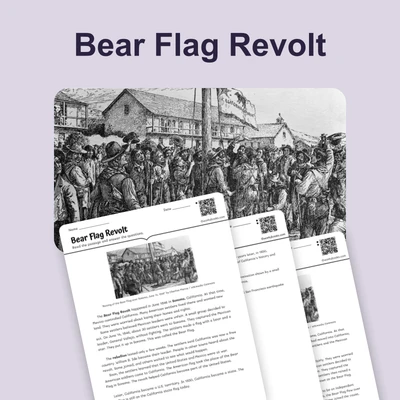
Bear Flag Revolt
This engaging history reading passage covers the Bear Flag Revolt, a pivotal moment during Westward Expansion when Ameri...
HSS 4.3.5RH.6-8.1
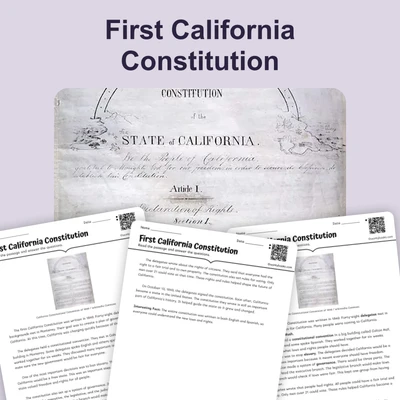
First California Constitution
This engaging history reading passage explores the creation of the First California Constitution in 1849, a pivotal even...
HSS 4.3.5RH.6-8.1
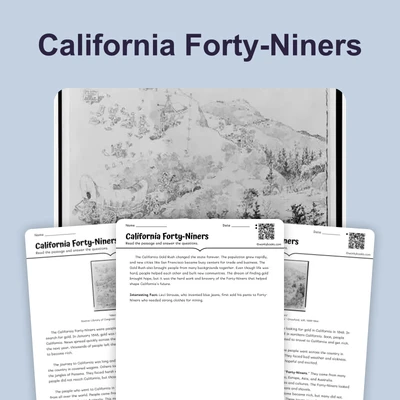
California Forty-Niners
This history reading passage explores the story of the California Forty-Niners, who rushed to California in 1849 in sear...
HSS 4.4.2RH.6-8.1
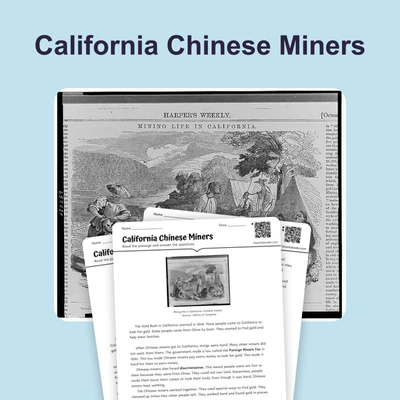
California Chinese Miners
This engaging history reading passage explores the experiences of Chinese miners during the California Gold Rush and Wes...
HSS 4.4.3RH.6-8.1
Effects of the Gold Rush
This engaging U.S. History reading passage explores the effects of the Gold Rush on California and the United States. Al...
HSS 4.4.4RH.6-8.1
Meroë: Capital of Kush
This passage explores the rise and significance of Meroë, once the capital of the Kingdom of Kush in ancient Africa. Loc...
CA HSS 6.2.6RH.6-8.1RH.6-8.2WHST.6-8.2
Egypt Kush Trade
This engaging history reading passage explores the complex trade networks that connected Ancient Egypt, Kush, and region...
6.2.3RH.6-8.1RH.6-8.4RH.6-8.7
First Humans
This engaging history reading passage explores the evolution of early humans, tracing the journey from the earliest homi...
CA HSS 6.1RH.6-8.1RH.6-8.2W.6.2
Ancient Egyptian Afterlife
This engaging history reading passage explores ancient Egyptian beliefs about the afterlife and the construction of the ...
CA HSS 6.2RH.6-8.1RH.6-8.4
Han Dynasty: Seismograph
Discover the groundbreaking invention of the seismograph during the Han dynasty in ancient China in this engaging histor...
HSS 6.6.7RH.6-8.1RH.6-8.2WHST.6-8.2
Paleolithic Migration by Land and Sea
This passage explores the migration of Paleolithic humans from Africa to the rest of the world, focusing on the routes t...
6.1RH.6-8.1RH.6-8.2RH.6-8.4
Origins of Social Classes
This engaging history reading passage explores how the rise of farming and the spread of pastoral nomads across the Eura...