This learning resource is available in interactive and printable formats. The interactive worksheet can be played online and assigned to students. The Printable PDF version can be downloaded and printed for completion by hand.
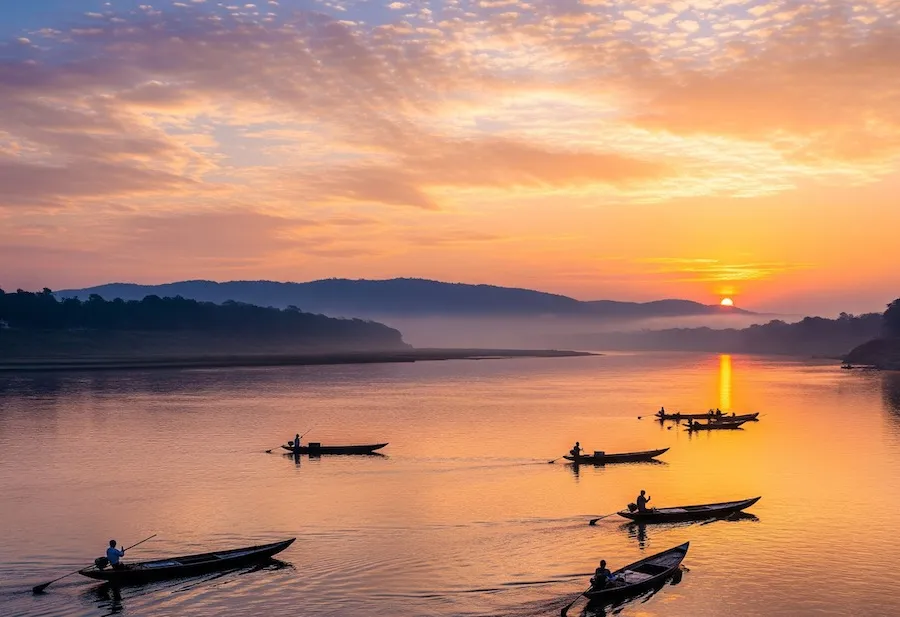
The Brahmaputra River originates in the Himalayas and flows 1,800 miles through China, India, and Bangladesh, joining the Ganges River before emptying into the Bay of Bengal. Known for seasonal flooding and fertile soil, it supports agriculture and wildlife, including the endangered Ganges river dolphin. The river also exhibits a rare tidal bore phenomenon, where waves travel upstream against the current.
CONTENT PREVIEW
Expand content preview
The Brahmaputra River is a major river in South Asia, flowing through China, India, and Bangladesh. It originates in the Himalayas in Tibet, where it is known as the Yarlung Tsangpo, and travels approximately 1,800 miles (2,900 kilometers) before joining the Ganges River in Bangladesh and emptying into the Bay of Bengal.
The Brahmaputra River is known for its powerful flow and seasonal flooding, which enriches the soil in the surrounding plains, making it a vital region for agriculture. The river supports millions of people and is home to diverse wildlife, including the endangered Ganges river dolphin.
However, the Brahmaputra River faces challenges such as erosion, flooding, and water disputes between countries. Efforts to address these issues include flood control measures and international agreements on water sharing.
Fun fact: The Brahmaputra River is one of the few rivers in the world that exhibits a rare phenomenon called a "tidal bore," where tidal waves travel upstream against the river’s current!
How long is the Brahmaputra River?
1,000 miles1,800 miles2,500 miles3,000 miles
Where does the Brahmaputra River originate?
Himalayas in TibetRocky MountainsAndes MountainsAtlantic Ocean
What is the Brahmaputra River known for?
Seasonal flooding and fertile soilBeing the shortest river in the worldHaving no wildlifeFlowing through only one country
What is one challenge facing the Brahmaputra River?
Reduced water levelsErosion and floodingIncreased rainfallImproved water quality
What is the fun fact about the Brahmaputra River?
It is the longest river in the worldIt exhibits a tidal bore phenomenonIt has no fish speciesIt flows through only one country
Which endangered species is found in the Brahmaputra River?
Amazon River dolphinGanges river dolphinMekong giant catfishPink river dolphin
Which river does the Brahmaputra join before emptying into the Bay of Bengal?
Ganges RiverMekong RiverAmazon RiverMississippi River
What is a rare phenomenon exhibited by the Brahmaputra River?
It freezes completely in winterIt has tidal bores where waves travel upstreamIt disappears undergroundIt flows backward
Perfect For:
👩🏫 Teachers
• Reading comprehension practice
• Auto-graded assessments
• Literacy skill development
👨👩👧👦 Parents
• Reading practice at home
• Comprehension improvement
• Educational reading time
🏠 Homeschoolers
• Reading curriculum support
• Independent reading practice
• Progress monitoring
Reading Features:
📖
Reading Passage
Engaging fiction or nonfiction text
❓
Comprehension Quiz
Auto-graded questions
📊
Instant Feedback
Immediate results and scoring
📄
Printable Version
Download for offline reading
🔊
Read Aloud
Voice-over with word highlighting
Reviews & Ratings
No reviews yet. Be the first to share your experience!
Related Content
The Life and Legacy of Mahatma Gandhi
RF.5.4.ARF.5.4.BW.5.2L.5.6
Mesopotamia—Informatonal Text
This informational text on Mesopotamia is a great way to practice reading comprehension. Students will read the text the...
RI.5.3RI.5.10
The Role of Pollinators in Nature
Learn about the fascinating world of pollinators and discover their crucial role in the reproductive process of flowerin...
RI.4.2RI.4.3RI.4.4RI.5.1
Pollination: A Crucial Ecosystem Service
Explore the vital role of pollination beyond plant reproduction, as it sustains ecosystems by ensuring food security, pr...
RI.4.2RI.4.3RI.4.4RI.5.1
Seed Dispersal: How Plants Travel
Plants may seem stationary, but their seeds have amazing ways to travel! Explore the fascinating world of seed dispersal...
RI.4.2RI.4.3RI.4.4RI.5.1
The States of Matter: Solid
Discover the differences between solids, liquids and gases by exploring how their particles are arranged and move. This ...
RI.4.2RI.4.3RI.4.4RI.5.1
What is a Simple Machine
Discover the power of simple machines! This informational text explores how basic tools like levers, pulleys and incline...
RI.4.2RI.4.3RI.4.4RI.5.1
Elevation: A Key Factor Affecting Climate
Elevation influences climate by causing temperatures to drop as altitude increases. High-elevation areas receive more so...
RI.5.3
Composition of the Ocean
The ocean is made up of water, dissolved salts, gases, and organic matter. Its composition varies with depth and influen...
RI.5.3
What is Deforestation?
Deforestation is the large-scale removal of forests, primarily caused by human activities like agriculture, logging, and...
RI.5.3RI.6.3RI.7.3
Cold Fronts and Warm Fronts: A Comparison
Cold fronts bring thunderstorms and cooler temperatures, while warm fronts bring light rain and warmer temperatures. Bot...
7.RI.7.3RI.5.3RI.5.5RI.6.9
Vegetation: A Key Factor Affecting Climate
Vegetation influences climate by cooling temperatures, increasing humidity, and supporting rainfall. Forests also preven...
RI.5.3
The Great Pacific Garbage Patch
The Great Pacific Garbage Patch is a massive collection of plastic waste in the North Pacific Ocean. It harms marine lif...
RI.5.3RI.6.3RI.7.3
Surface Water Runoff
Surface water runoff replenishes rivers and lakes but can cause flooding and pollution. Solutions like rain gardens and ...
RI.5.3RI.6.3RI.7.3
The Mississippi River
The Mississippi River is one of the longest rivers in North America, stretching 2,340 miles from Lake Itasca to the Gulf...
RI.5.3RI.6.3RI.7.3
The Mekong River
The Mekong River flows 2,700 miles through six countries in Southeast Asia, ending in the fertile Mekong Delta. It suppo...
RI.5.3RI.6.3RI.7.3
Freshwater and Its Sources
Freshwater is a limited resource, with most stored in glaciers and aquifers. Rivers, lakes, and groundwater are key sour...
RI.5.3RI.6.3RI.7.3
Difference Between a Rock and a Mineral
Rocks are mixtures of minerals, while minerals are naturally occurring, inorganic solids with a specific composition and...
RI.5.3RI.6.3RI.7.3
Runoff from Precipitation
Runoff from precipitation replenishes rivers and lakes but can cause flooding and pollution. Solutions like rain gardens...
RI.5.3RI.6.3RI.7.3
Large Streams of Moving Water
Large streams of moving water, like rivers and creeks, shape landscapes, support ecosystems, and provide freshwater for ...