This learning resource is available in interactive and printable formats. The interactive worksheet can be played online and assigned to students. The Printable PDF version can be downloaded and printed for completion by hand.
Sunspots are fascinating dark patches on the Sun's surface caused by intense magnetic activity that lowers the temperature in these regions. Despite appearing dark, sunspots are extremely hot, with temperatures of around 4,000°C (7,232°F), compared to the surrounding areas that reach 5,500°C (9,932°F). Sunspots often occur in pairs or groups and are closely linked to the Sun’s 11-year solar cycle. During the solar maximum, the number of sunspots increases, while during the solar minimum, they become less frequent. These magnetic phenomena can influence Earth by causing minor disruptions in radio signals and navigation systems. They are also responsible for creating stunning auroras, like the Northern and Southern Lights, near Earth’s poles. Understanding sunspots not only helps us learn about solar activity but also allows scientists to predict its effects on technology and the environment. This topic aligns with Common Core standards by integrating scientific knowledge and Earth-space concepts, encouraging students to explore connections between celestial phenomena and everyday life.
CONTENT PREVIEW
Expand content preview
What Are Sunspots?
Sunspots are dark patches on the Sun’s surface called the photosphere. These spots look like freckles, but they are actually areas that are cooler than the rest of the Sun. The Sun’s surface is about 10,000°F (5,500°C), but sunspots are cooler—around 6,500°F (3,600°C). Even though they are cooler, sunspots are still extremely hot! They look dark only because the surrounding parts of the Sun are much brighter and hotter. Some sunspots can be bigger than Earth, and a group of sunspots can cover a huge area.
Why Do Sunspots Form?
Sunspots form because the Sun has powerful magnetic fields. Sometimes, these magnetic fields get twisted and tangled. When this happens, they block heat from rising to the surface. The blocked areas become cooler and appear as dark spots. Think of it like a hot frying pan with a few cool spots—those spots look darker even though the whole pan is still hot.
The Sunspot Cycle
Sunspots do not always stay the same. They increase and decrease in number over about 11 years. When there are lots of sunspots, it’s called a solar maximum. When there are few or no sunspots, it’s called a solar minimum. Scientists have watched this solar cycle for over 400 years!
Galileo and Sunspots
In the early 1600s, the scientist Galileo was one of the first people to observe sunspots using a telescope. His work helped us learn more about the Sun and how it changes.
Why Do Sunspots Matter?
Sunspots are important because they are linked to space weather and solar flares. These can affect satellites, radio signals, and even power grids on Earth. By studying sunspots, scientists can better understand how the Sun works and how it affects our planet.
Safety Warning! Never look directly at the Sun—it can blind you instantly. Scientists use special filters and equipment to study the Sun safely.
Interesting Fact: Some sunspots are so large that several Earths could fit inside one!
What are sunspots?
Cool dark patches on the SunBright spots on the MoonStars far from EarthPlanets in space
What causes sunspots to form?
Twisted magnetic fieldsEarth’s gravityRain on the SunMoons blocking sunlight
How hot is the Sun’s surface?
About 10,000°FAbout 1,000°FFreezing cold500,000°F
What is the solar cycle?
Change in sunspots over 11 yearsEarth’s orbit around SunGrowth of plantsMoon’s phases
Why should you never look at the Sun directly?
It can blind youIt is boringIt is coldIt is far away
How are sunspots like cool spots on a hot pan?
Both are cooler than surroundingsBoth are planetsBoth are made of waterBoth are always cold
Sunspots are bigger than Earth. True or false?
TrueFalse
What does 'photosphere' mean?
Sun's visible surfaceEarth's coreMoon's surfaceA type of telescope
Perfect For:
👩🏫 Teachers
• Reading comprehension practice
• Auto-graded assessments
• Literacy skill development
👨👩👧👦 Parents
• Reading practice at home
• Comprehension improvement
• Educational reading time
🏠 Homeschoolers
• Reading curriculum support
• Independent reading practice
• Progress monitoring
Reading Features:
📖
Reading Passage
Engaging fiction or nonfiction text
❓
Comprehension Quiz
Auto-graded questions
📊
Instant Feedback
Immediate results and scoring
📄
Printable Version
Download for offline reading
🔊
Read Aloud
Voice-over with word highlighting
Reviews & Ratings
No reviews yet. Be the first to share your experience!
Related Content
Earth: Our Home in Space
This engaging Grade 4-5 science passage, aligned to NGSS, introduces students to Earth's special place in the solar syst...
Earth's Place in the Universe
This reading passage explains Earth's place in the universe, supporting NGSS 1-ESS1-1. It describes how Earth is one of ...
1-ESS1-1
Tools and Technology in Earth Science
This middle school science reading passage explores the wide range of tools and technologies used in Earth science, from...
MS-ESS2-2MS-ESS3-2MS-ETS1-1MS-PS4-3
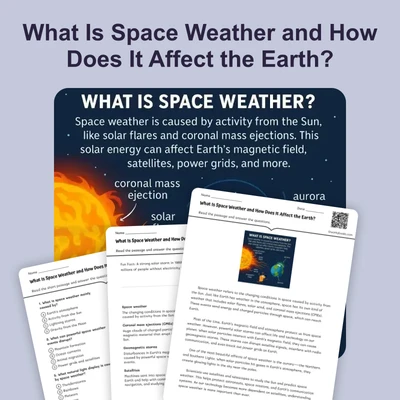
What Is Space Weather and How Does It Affect the Earth?
This NGSS-aligned science passage for middle school explains what space weather is and how it affects Earth. Students le...
MS-ESS2-2
Scientific Inquiry in Earth Science
This passage explores scientific inquiry in Earth science for grades 6-8, aligned with NGSS standards MS-ESS1-4, MS-ESS2...
MS-ESS1-4MS-ESS2-1MS-ESS3-5SEP
The Space Needle
Students read a passage about the history and features of Seattle's Space Needle, then answer comprehension questions to...
RI.4.2
Space Stations
This informational science reading passage for grades 6-8 explores the complex systems and technology behind space stati...
MS-ESS1-3MS-ETS1-1
Reading Comprehension— Storms
Practie summarizing paragraphs with this fun science informational text on storms! Students will give the main idea of t...
RI.2.2RF.2.4.ARF.2.4RI.2.10
Interpreting visual information on Layers of the Earth
This informational text on the layers of the earth is a great way to practice using images during reading. Students will...
RI.1.7RI.10RF.1.4.ARF.1.4
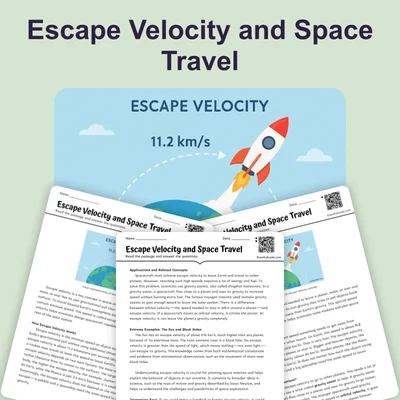
Escape Velocity and Space Travel
This middle school science passage introduces students to the concept of escape velocity—the minimum speed required to b...
MS-ESS1-2MS-PS2-4
The Space Garden
This innovative passage combines plant science with space exploration, aligning with NGSS standards for life sciences an...
RL.3.1RL.2.1RL.4.9
What Is Earth Science?
This engaging middle school science passage introduces students to the field of Earth science, aligning with NGSS standa...
MS-ESS1MS-ESS2MS-ESS3SEP
Reading Comprehension - Science and Social Studies
RI.2.10RI.2.1RI.2.2RI.2.4
Reading Comprehension: The Grand Canyon
This informational text on the Grand Canyon will teach your students all about this incredible wonder of the world! Free...
RI.3.1RI.3.10RI.3.4RF.3.4
Facts About Earth
This engaging science reading passage introduces Grade 4 and 5 students to Earth, our home planet. Aligned with NGSS sta...
Earth: Our Home Planet
This comprehensive science passage for grades 6-8 explores Earth’s unique characteristics and the interconnected systems...
MS-ESS1-2
Meteorite Impacts on Earth
This engaging science reading passage for Grades 4-5 explores meteorite impacts on Earth, aligning with NGSS standards. ...
The Diameter of Earth
This science reading passage explains the diameter of Earth, describing it as about 12,742 kilometers or 7,918 miles acr...
5-PS2-1
Measuring Distances in Space
This middle school science passage explores how astronomers measure the vast distances in space, aligning with NGSS stan...
MS-ESS1-3
Informational Text — Habitats
This short informational text on habitats will teach your students what a habitat is, as well as provide some examples o...