Reading PassagePremium

What Causes a Heatwave?

Interactive passage with audio narration, comprehension questions, and printable PDF.

No ratings yet
Grade 6ScienceEnglish · SpanishInteractive · Printable
Just this resource
$1.50
One-time purchase
Best value
Unlock everything
$49.99$29.99/yr
40% off until Aug 1 — 10,000+ resources
Renews at $49.99/year.
Unlock above to use these actions

What's included

Reading passage
Audio narration
Comprehension quiz
Writing activity
Glossary & flashcards
Differentiated version
Spanish translation

What Causes a Heatwave? preview and details

About this printable What Causes a Heatwave? science reading passage, NGSS-aligned (Grade 6)

This engaging educational resource, 'What Causes a Heatwave?', offers an insightful reading passage designed for Grade 6 students. It delves into the scientific principles behind heatwaves, focusing on concepts like air masses, high-pressure systems, and atmospheric conditions that lead to extreme heat events. The passage defines key terms, making complex ideas accessible, and is complemented by a variety of activities including multiple-choice questions, a glossary, and short answer questions. These activities reinforce understanding of weather changes and how air masses interact, aligning directly with NGSS standard MS-ESS2-5. The content is audio integrated to support diverse learning styles and enhance comprehension of weather phenomena and climate science.
Written by Workybooks TeamPublished by Workybooks
Preview

Sample passage and quiz from What Causes a Heatwave?

Reading passage and comprehension quiz preview

What Causes a Heatwave?
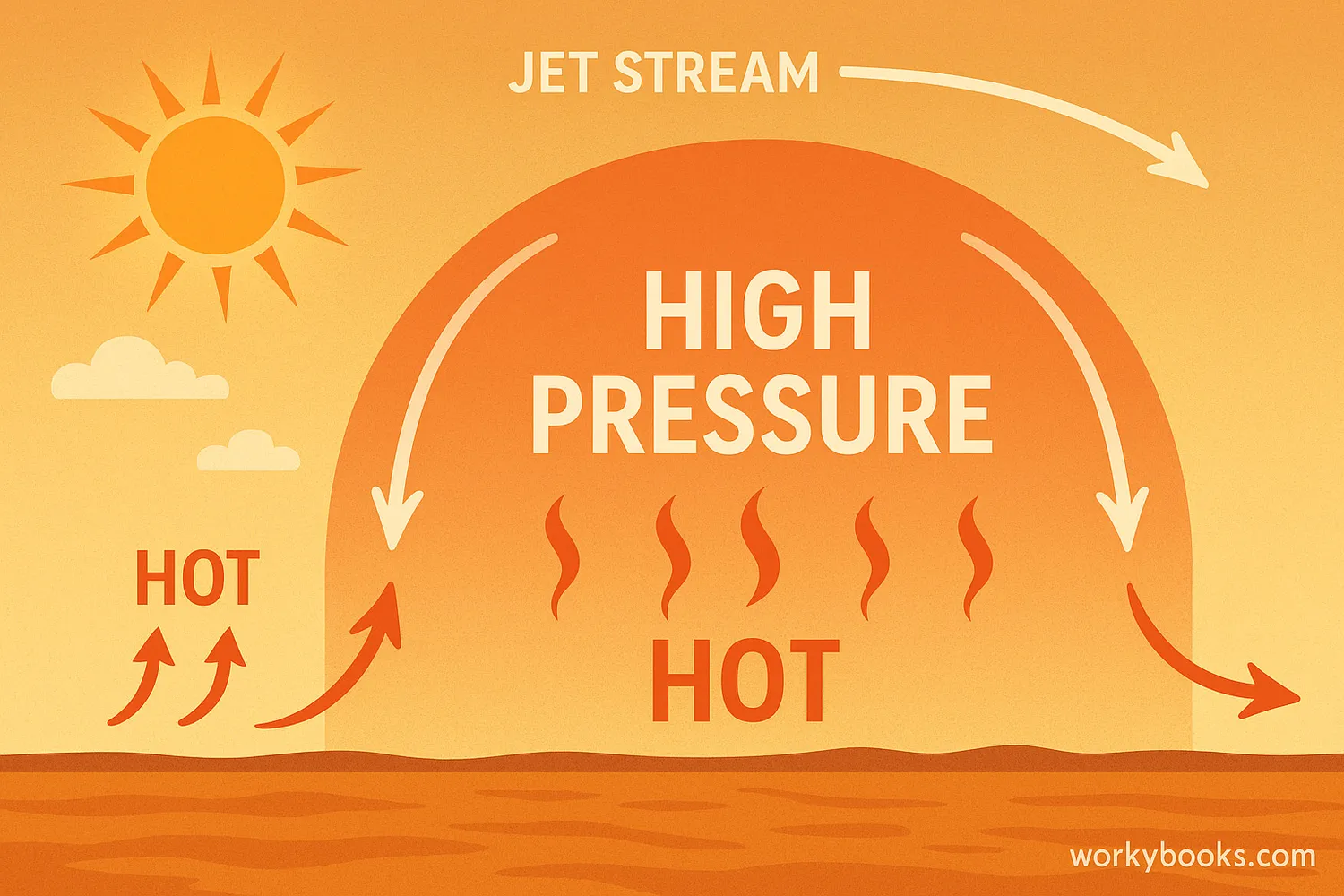
Students view how heatwaves form under a high-pressure dome trapping warm air.
Diagram of heatwave formation from high pressure and sinking warm air.

The air around us is always on the move, carrying different temperatures and moisture levels. Sometimes, this movement stops or slows down in just the right way to create extremely hot conditions. This is what we call a heatwave – a period of unusually hot weather that lasts for several days.

One of the main causes of a heatwave is a high-pressure system. Imagine a large dome of air pushing down on the Earth's surface. This dome prevents air from rising. When air sinks, it warms up. This warming effect, combined with clear skies that allow more sunlight to reach the ground, traps heat close to the surface. It's like putting a lid on a pot, keeping the heat inside.

Normally, weather systems move across the globe, bringing changes in temperature, wind, and precipitation. However, during a heatwave, these high-pressure systems can become 'stuck' or stagnant over a region. This means the hot air stays put, building up heat day after day. This is often linked to the behavior of the jet stream, a fast-moving current of air high in the atmosphere. The jet stream usually guides weather systems. If it takes a large loop or becomes weaker, it can allow high-pressure systems to linger.

Another factor is the type of air mass involved. An air mass is a large body of air that has similar temperature and humidity throughout. For a heatwave, we typically see a large, warm, and dry air mass move into a region. This air mass might originate from a desert area or simply heat up as it sits over land under the high-pressure dome.

The interaction of these factors – a strong, stagnant high-pressure system, a specific air mass, and the influence of the jet stream – creates the perfect recipe for a heatwave. Understanding these complex interactions helps meteorologists predict when and where a heatwave might occur, giving people time to prepare for the extreme summer heat and ensure public safety. These events are crucial for understanding global climate patterns and their effects on local weather conditions.

Interesting Fact: The deadliest heatwave in U.S. history occurred in 1980, causing an estimated 1,700 deaths across the central and eastern United States.

Comprehension quiz (10 questions)

1. What is a heatwave?

Period of hot weather
Heavy rainfall
Strong winds
Cold temperatures

2. What prevents air from rising during a heatwave?

Low-pressure system
High-pressure system
Strong winds
Jet stream

3. How does a high-pressure system warm the air?

It pulls air up
It adds moisture
It causes air to sink
It creates clouds

4. What happens if a high-pressure system becomes 'stuck'?

Causes cold weather
Prevents heat build-up
Hot air stays put
Increases rainfall

5. What is the jet stream's role in weather systems?

Makes air colder
Creates high pressure
Guides weather systems
Causes thunderstorms

6. What kind of air mass is typically involved in a heatwave?

Cold and wet
Warm and dry
Cool and moist
Fast-moving

7. Why are clear skies mentioned as a factor?

Allow more rain
Allow more sunlight
Block heat
Cool the air

8. Understanding heatwave causes helps predict them.

True
False

9. Which scenario would likely cause a heatwave?

Weak high pressure
Stagnant high pressure
Strong jet stream
Cold air mass

10. What does 'stagnant' mean in the passage?

Moving quickly
Not moving
Becoming colder
Losing pressure
Who it's for

Perfect for the way you teach

Teachers
  • Build comprehension skills
  • Auto-graded quiz
  • Differentiated reading
Parents
  • Read together at home
  • Improve fluency
  • Quiet reading time
Homeschoolers
  • Reading curriculum support
  • Independent practice
  • Track Lexile growth
Topics

Reviews & Ratings

No reviews yet. Be the first to share your experience!

More reading you might love

19 more
Passage
Extreme Weather and Climate Change  - reading educational content

Extreme Weather and Climate Change

Reading Passage

$1.50
Worksheet
Climate and weather activity - worksheet educational content

Climate and weather activity

Worksheet

$1.50
Worksheet
Climate and Weather — Distinguishing Characterstics - worksheet educational content

Climate and Weather — Distinguishing Characterstics

Worksheet

Free
Passage
How Climate Change Affects Weather - reading educational content

How Climate Change Affects Weather

Reading Passage · MS-ESS3-5

$1.50
Passage
Weather Safety and Preparedness - reading educational content

Weather Safety and Preparedness

Reading Passage · MS-ESS3-2

$1.50
Worksheet
Comparing Weather and Climate Texts - worksheet educational content

Comparing Weather and Climate Texts

Worksheet · RI.5.9

Free
Passage
What Are Weather Hazards - reading educational content

What Are Weather Hazards

Reading Passage · NGSS 4-ESS3-2

$1.50
Passage
How is Climate Different from Weather? - reading educational content

How is Climate Different from Weather?

Reading Passage · RI.3.1

Free
Worksheet
Drought - worksheet educational content

Drought

Worksheet · NGSS K-ESS3-2 AND CCSS.ELA-LITERACY.RI.2.1

$1.50
Passage
What Is The Difference Between Climate Model And Weather Model? - reading educational content

What Is The Difference Between Climate Model And Weather Model?

Reading Passage

$1.50
Worksheet
Weather and Clothing - worksheet educational content

Weather and Clothing

Worksheet · NGSS K-ESS2-1

$1.50
Worksheet
Weather Instruments - worksheet educational content

Weather Instruments

Worksheet · NGSS K-ESS2-1

$1.50
Worksheet
Weather-Watching - worksheet educational content

Weather-Watching

Worksheet · NGSS K-ESS2-1

$1.50
Worksheet
Observing Weather - worksheet educational content

Observing Weather

Worksheet · NGSS K-ESS2-1

Free
Passage
Weather Factors - reading educational content

Weather Factors

Reading Passage · MS-ESS2-5

$1.50
Passage
Weather Maps and Forecasting - reading educational content

Weather Maps and Forecasting

Reading Passage · MS-ESS2-5

$1.50
Worksheet
Weather Maps - worksheet educational content

Weather Maps

Worksheet · NGSS K-ESS2-1

$1.50
Worksheet
Meet the Weather Instruments - worksheet educational content

Meet the Weather Instruments

Worksheet · NGSS K-ESS2-1

$1.50
Worksheet
Reading Weather Data - worksheet educational content

Reading Weather Data

Worksheet · NGSS K-ESS2-1

$1.50
Copyright © 2026 Workybooks. Made with ♥ in California.