What Is The Difference Between Climate Model And Weather Model? — Reading Comprehension
Rate this
Premium Resource
Present
Present in classroom. No work saved
Assign
Classroom with student accounts, Track progress
Quick Play
No student accounts, assign with a link
Grades
3
4
5
6
PRINT+DIGITAL RESOURCE
This learning resource is available in interactive and printable formats. The interactive worksheet can be played online and assigned to students. The Printable PDF version can be downloaded and printed for completion by hand.
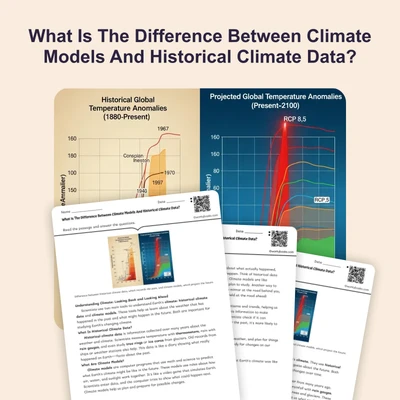
This reading passage delves into the fundamental differences between weather models and climate models, explaining their distinct purposes, scales, and applications. The text clarifies that while weather models focus on short-term, specific atmospheric predictions (like daily forecasts), climate models simulate long-term, global trends and patterns (over decades or centuries). It defines key terms and uses simple language to make the concepts accessible. The passage is audio-integrated and aligns with the NGSS disciplinary core idea for Earth's Systems, helping students understand how scientists use technology to study and predict changes in the Earth's atmosphere and climate.
Weather and climate are often confused, but they refer to different scales of time and a different set of atmospheric variables. Understanding their differences is essential to grasping how scientists predict future conditions on Earth.
A weather model is a system used by meteorologists to forecast short-term atmospheric conditions, such as temperature, precipitation, and wind, over a specific area. These models are highly detailed and rely on real-time data from satellites, weather balloons, and ground stations. They work by using complex equations to predict how the current state of the atmosphere will evolve over the next few hours to a couple of weeks. Their predictions are most accurate for the immediate future and decrease in reliability the further they look ahead.
In contrast, a climate model is designed to predict long-term changes and trends in Earth's climate system. These models are not concerned with forecasting whether it will rain next Tuesday in a specific city. Instead, they simulate how factors like greenhouse gas concentrations, volcanic eruptions, and solar radiation will affect global temperatures, sea levels, and atmospheric circulation over decades or centuries. Climate models, including the most advanced climate models used today, are less about predicting specific events and more about understanding the probabilities and patterns of future climate.
Both types of models use supercomputers to run their simulations, but they focus on different variables and timescales to provide us with valuable insights, whether it's planning your weekend or preparing for the future of our planet.
Fun Fact: The first weather forecasts were based on observations of cloud movements, wind direction, and air pressure, without any of the sophisticated computer models we use today.
What is the primary purpose of a weather model?
To predict daily weather over the next several monthsTo forecast long-term atmospheric changesTo forecast short-term weather conditionsTo simulate volcanic eruptions and solar radiation
What kind of data do weather models use to make predictions?
Information about volcanic eruptionsLong-term data from decades pastFuture greenhouse gas concentrationsReal-time data from satellites and ground stations
What is a key difference between weather models and climate models?
Weather models are less accurate than climate modelsWeather models predict specific events, while climate models predict long-term trendsWeather models rely on past data, while climate models use real-time dataWeather models require more powerful computers than climate models
If you wanted to know the average temperature in your city in 2050, what would be the best tool to use?
A real-time weather modelA climate modelA satellite imageAn antique weather balloon
How do climate models differ from weather models in their time scale?
Climate models predict a few hours ahead, while weather models predict years aheadClimate models look at the last week, while weather models look at the last centuryClimate models focus on decades, while weather models focus on daysClimate models look at the past, while weather models predict the future
If a scientist wants to determine how a change in ocean currents will affect rainfall patterns across an entire continent over the next 50 years, what tool would be most appropriate?
A supercomputer-driven weather modelA climate model focusing on global trendsA simple ground station measuring temperatureAn old-fashioned weather balloon
You are planning to build a house in an area known for severe storms. Which model's data would be more useful for understanding the long-term risk of such events in that location?
A local real-time weather modelA global climate modelA model that predicts specific stormsA model that forecasts short-term wind patterns
A scientist observes that a specific region has had an unusually high number of intense heat waves over the last decade. To investigate if this pattern will continue, the scientist should use which type of model?
A short-term weather forecasting modelA climate modelA simple model based on local observationsA model used for daily rainfall predictions
Perfect For:
👩🏫 Teachers
• Reading comprehension practice
• Auto-graded assessments
• Literacy skill development
👨👩👧👦 Parents
• Reading practice at home
• Comprehension improvement
• Educational reading time
🏠 Homeschoolers
• Reading curriculum support
• Independent reading practice
• Progress monitoring
Reading Features:
📖
Reading Passage
Engaging fiction or nonfiction text
❓
Comprehension Quiz
Auto-graded questions
📊
Instant Feedback
Immediate results and scoring
📄
Printable Version
Download for offline reading
🔊
Read Aloud
Voice-over with word highlighting
Reviews & Ratings
No reviews yet. Be the first to share your experience!
Related Content
Climate and weather activity
This worksheet is perfect for understanding the differences between climate and weather. Students will read the phrases ...
Climate and Weather — Distinguishing Characterstics
This worksheet highlights the differences between climate and weather. The chart format makes comparing and contrasting ...
Comparing Weather and Climate Texts
This reading comprehension worksheet has 5th graders read two informational texts about Weather and Climate. Students th...
RI.5.9
Tools and Technology in Earth Science
This middle school science reading passage explores the wide range of tools and technologies used in Earth science, from...
MS-ESS2-2MS-ESS3-2MS-ETS1-1MS-PS4-3
What Is Earth Science?
This engaging middle school science passage introduces students to the field of Earth science, aligning with NGSS standa...
MS-ESS1MS-ESS2MS-ESS3SEP
What Is Space Weather and How Does It Affect the Earth?
This NGSS-aligned science passage for middle school explains what space weather is and how it affects Earth. Students le...
MS-ESS2-2
Extreme Weather and Climate Change
This Grade 6-8 science passage, aligned to NGSS standards, explores the impact of climate change on extreme weather even...
Scientific Inquiry in Earth Science
This passage explores scientific inquiry in Earth science for grades 6-8, aligned with NGSS standards MS-ESS1-4, MS-ESS2...
MS-ESS1-4MS-ESS2-1MS-ESS3-5SEP
Earth's Major Climate Zones Explained
This engaging science passage for grades 6-8 explains Earth's major climate zones, including tropical, temperate, and po...
Climate Through Earth's History
This engaging passage for grades 6-8 explores how Earth's climate has naturally changed over millions of years, highligh...
MS-ESS1-4MS-ESS2-6
Earth: Our Home in Space
This engaging Grade 4-5 science passage, aligned to NGSS, introduces students to Earth's special place in the solar syst...
Weather vs. Climate
This comprehensive passage for grades 6-8 explores the difference between weather and climate, aligning with NGSS standa...
MS-ESS2-6
How is Climate Different from Weather?
This passage distinguishes climate from weather for young readers. It defines climate as the usual weather patterns over...
RI.3.1RI.4.14.ESS2.D
Air Masses and Weather
This audio-integrated passage, "Air Masses and Weather," is designed for 6th-grade students to understand how the moveme...
Antarctica Climate
This engaging science passage for grades 6-8 explores Antarctica, the coldest climate zone on Earth. Students will learn...
Climate Zones Word Sort
This word sort activity helps students understand different climate zones through real-world locations. Students classif...
How Climate Change Affects Weather
This middle school science passage explores how and why weather patterns are changing globally. Students will learn abou...
MS-ESS3-5
Polar Bears and Climate
This informational text on polar bears is a great way to practice reading comprehension. Students will read the passage ...
RI.4.1W.4.72-LS4-1RF.4.4
Escape Velocity and Space Travel
This middle school science passage introduces students to the concept of escape velocity—the minimum speed required to b...