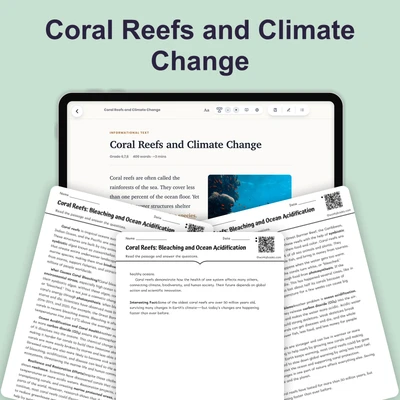
Heatwaves and Climate Change
Interactive passage with audio narration, comprehension questions, and printable PDF.
By completing this purchase you agree to our Terms of Use and Privacy Policy. Your subscription renews automatically until you cancel. You can cancel anytime from your account settings. All sales are final and non-refundable. Digital content is available for download in your account immediately upon purchase.
What's included
Heatwaves and Climate Change preview and details
About this printable Heatwaves and Climate Change science reading passage, NGSS-aligned (Grade 6)
Sample passage and quiz from Heatwaves and Climate Change
Reading passage and comprehension quiz preview
Heatwaves and Climate Change
A heatwave is a stretch of unusually hot weather that lasts for days or weeks. Scientists observe that heatwaves are becoming more frequent, more intense, and longer-lasting as Earth's climate warms. Evidence shows that global temperatures have risen over the past century due to human activities like burning fossil fuels. This warming creates conditions that make extreme heat events more common and more dangerous.
The connection between climate change and heatwaves involves an important concept called temperature range. Every location on Earth experiences a range of temperatures throughout the year, from cool to hot. When the whole temperature range shifts upward due to global warming, the extreme-hot end gets pushed to new records. Days that were once rare become more common. Scientists explain that this is similar to rolling dice that are weighted toward higher numbers. You can still roll low numbers, but high numbers appear more often.
Heatwaves pose serious dangers to people and communities. Extreme heat can overwhelm the human body's ability to cool itself, leading to heat-related illness or even death. Older adults and people with certain health conditions face the highest risks. During heatwaves, power grids can become strained as everyone runs air conditioning at once. Cities experience particularly intense heat because of the urban heat island effect, where pavement and buildings absorb and trap heat.
In July 2023, Phoenix, Arizona experienced 31 consecutive days with temperatures above 110°F, breaking previous records. This event demonstrates how climate change can push temperatures into dangerous territory for extended periods. Scientists recorded hundreds of heat-related deaths during this event, showing the deadly impact of extreme heat.
Understanding heatwaves matters because heat is often called the quiet, deadly side of climate change. Unlike hurricanes or floods, extreme heat does not create dramatic images, but it kills more people than most other weather disasters. Evidence shows that asking questions about the factors causing global temperature rise helps communities prepare for and respond to increasingly dangerous heatwaves. This knowledge connects to broader understanding of how climate change affects human health and why cities need special planning to protect residents during extreme heat events.
Interesting Fact: Scientists have found that some heatwaves would have been virtually impossible without human-caused climate change. Computer models show certain recent extreme heat events had less than a 1% chance of occurring in a world without global warming.
Comprehension quiz (10 questions)
1. What is a heatwave?
2. According to the passage, what has caused global temperatures to rise over the past century?
3. What does the term 'temperature range' mean in the context of this passage?
4. What is the urban heat island effect?
5. How does climate change make extreme heat events more common?
6. Which group faces the highest risk during heatwaves?
7. What real-world example does the passage provide to demonstrate extreme heat?
8. Why is heat called the 'quiet, deadly side of climate change'?
9. True or False: Heatwaves are becoming less frequent as the climate changes.
10. True or False: Computer models show that some recent extreme heat events would have been virtually impossible without human-caused climate change.
Perfect for the way you teach
- Build comprehension skills
- Auto-graded quiz
- Differentiated reading
- Read together at home
- Improve fluency
- Quiet reading time
- Reading curriculum support
- Independent practice
- Track Lexile growth