Why We Have Seasons
Interactive worksheet with auto-grading, instant feedback, and printable PDF.
By completing this purchase you agree to our Terms of Use and Privacy Policy. Your subscription renews automatically until you cancel. You can cancel anytime from your account settings. All sales are final and non-refundable. Digital content is available for download in your account immediately upon purchase.
What's included
Why We Have Seasons preview and details
About this worksheet
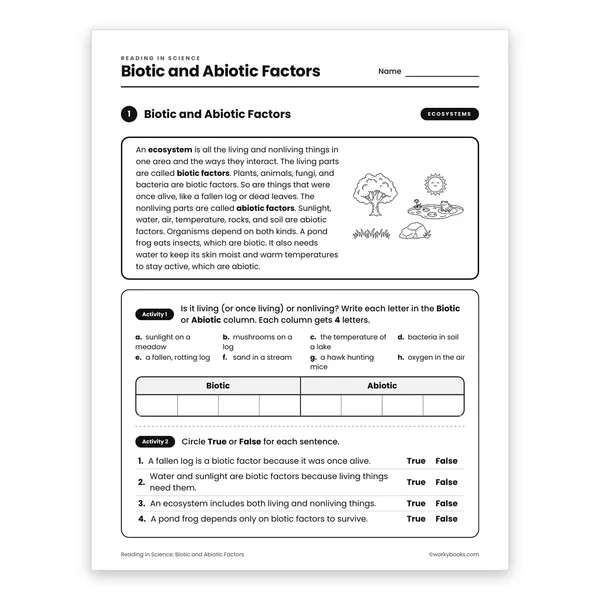
Clear up the most common seasons myth with this one-page reading worksheet! Students learn how Earth's tilted axis and its orbit around the Sun cause the seasons.
The passage explains that Earth travels around the Sun in an orbit, and that one full trip, or revolution, takes about 365 days. Earth also spins on an imaginary line called its axis, which is tilted about 23.5 degrees and always points the same way in space. In June, the Northern Hemisphere tilts toward the Sun, so sunlight hits it more directly and days are longer, which makes summer. In December, it tilts away from the Sun, sunlight is more spread out, and days are shorter, which makes winter. The passage also tackles the idea that summer happens because Earth is closer to the Sun, and explains why that is not true. A simple diagram shows Earth tilted the same way in June and December on opposite sides of its orbit. In the first activity, students complete four sentences with the words axis, revolution, tilted, and direct. In the second activity, students decide if three sentences are true or false, including the closer-to-the-Sun myth. The sheet is written to Texas TEKS 6.9A and also fits NGSS MS-ESS1-1.
What's inside:
- A short passage with an orbit and tilt diagram
- 4 fill in the blank sentences with a word bank
- 3 true or false sentences
- A visual answer key
How teachers use it:
- As an introduction to a unit on seasons
- For bell work, stations, or an exit ticket
- As homework or sub plans, with no prep needed
It takes about 10 minutes and prints clearly in black and white. This worksheet is part of our Reading in Science series on the Sun, Earth, and Moon.
Perfect for the way you teach
- Assign in one click
- Track progress per student
- Auto-graded results
- Practice at home
- Print or do on-screen
- Build skill mastery
- Standards-aligned
- Self-paced
- Ready-to-use today