
Gregor Mendel’s Discovery of Traits: A Guide for Grades 5–8
Have you ever wondered why you might have your mom’s eye color but your dad’s smile? The answer starts with a curious monk and a garden full of pea plants. More than 150 years ago, Gregor Mendel’s discovery of traits — and how they pass from parents to offspring — changed science forever, and he made it long before anyone knew what a gene was.
Who Was Gregor Mendel?
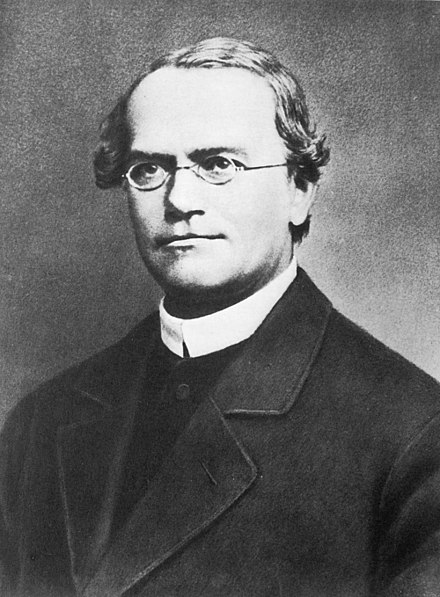
Gregor Mendel (1822–1884) was a monk, a teacher, and a scientist. He was born in 1822 in a village called Heinzendorf, in what was then the Austrian Empire — today that area is part of the Czech Republic. From a young age, Mendel loved learning about plants and nature.
As an adult, he became a monk and lived in a monastery, a quiet place where monks live, work, and study. The monastery had a garden, and that garden became Mendel’s laboratory. Working patiently over about eight years, he grew and studied around 28,000 pea plants — that’s a lot of peas!
Why Did Mendel Study Pea Plants?
Pea plants turned out to be perfect for studying heredity, and Mendel chose them for good reasons:
He could control how they were pollinated, deciding which plants would breed together.
They grow quickly, so he could study many generations in a few years.
They have easy-to-see traits, like flower color and seed shape.

What did Gregor Mendel discover?
Through his careful experiments, Mendel discovered three important principles that help explain how traits are inherited. These principles are still important today and form the foundation of genetics, the science of heredity.
Mendel’s experiments on pea plants
Mendel focused on seven traits, including these three:
| Trait | Options |
|---|---|
| Flower color | Purple or white |
| Seed shape | Round or wrinkled |
| Pod color | Green or yellow |
To run his experiments, he used two kinds of plants:
- Purebred plants always produce offspring with the same trait as the parent. A purebred purple-flower plant always makes purple flowers.
- Hybrid plants are the result of crossing two different purebred plants — for example, a purple-flower plant crossed with a white-flower plant.
By carefully crossing these plants and counting the results, Mendel made discoveries that changed science forever.
By crossing these plants and observing the results, Mendel made some amazing discoveries.
Words to Know (Genetics Vocabulary)
Before we look at what Mendel found, here are the key terms scientists use today:
Phenotype – the trait you can actually see (the visible flower color).
Gene – a set of instructions for a trait. Mendel called these “factors.”
Allele – a different version of a gene (for example, a purple allele or a white allele).
Dominant – a trait that shows up even when only one copy is present (purple flowers).
Recessive – a trait that is hidden when a dominant allele is present, and only shows when two copies are present (white flowers).
Genotype – the alleles an organism carries (its genetic “code”).
Gregor Mendel’s Discovery of Traits: Three Principles of Inheritance
1. The Principle of Dominance
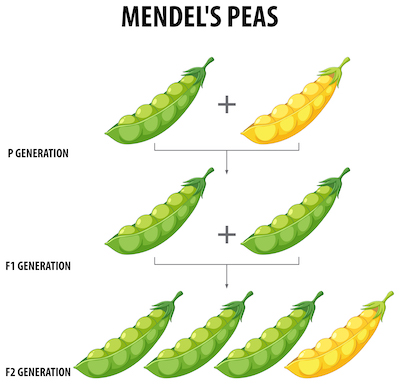
When Mendel crossed a purebred purple-flower plant with a purebred white-flower plant, all the offspring had purple flowers. The white color seemed to disappear. Mendel called purple the dominant trait because it covered up the white one. The hidden white trait is called recessive.
2. The Principle of Segregation
Here’s the surprising part. When Mendel let those purple hybrid plants pollinate themselves, the white flowers came backin the next generation — about 1 white flower for every 3 purple flowers, a pattern known as the 3:1 ratio.
Why? Because each plant carries two alleles for each trait, one from each parent. These alleles separate (segregate) when reproductive cells form, so each offspring randomly gets one allele from each parent. A recessive trait can hide for a generation and then reappear.
3. The Principle of Independent Assortment
Mendel also found that traits are inherited independently of one another. The allele a plant gets for flower color does not affect the allele it gets for seed shape. Each trait is passed down on its own.
Try It Yourself: A Simple Punnett Square
A Punnett square is a tool scientists use to predict offspring traits. Let’s cross two purple hybrid plants. We’ll use a capital P for the dominant purple allele and a lowercase p for the recessive white allele. Both parents are Pp.
| P | p | |
|---|---|---|
| P | PP | Pp |
| p | Pp | pp |
Read your results:
- PP, Pp, Pp → purple flowers (3 boxes)
- pp → white flowers (1 box)
That’s the 3:1 ratio Mendel discovered, right there in four boxes! Only the plant with two recessive alleles (pp) shows white flowers.
Want more practice? Try the Predicting Traits with Punnett Squares reading passage and quiz.
How Mendel Changed Science
Before Mendel, many people thought traits blended like mixing paint — a tall parent and a short parent would make a medium-height child, and the original traits would be lost forever. Mendel proved this wrong. Traits are passed down in predictable patterns, and hidden traits can reappear.
Thanks to Mendel, we now understand that:
- Traits follow predictable rules we can chart with a Punnett square.
- Alleles come in pairs, one from each parent, and can be dominant or recessive.
- Different traits are inherited independently.
These same patterns explain many human traits, and Gregor Mendel’s discovery of traits laid the groundwork for everything from medicine to agriculture.
Fun Facts About Gregor Mendel
- His work was ignored during his lifetime. Scientists didn’t rediscover it until around 1900 — about 16 years after he died — and only then realized how important it was.
- Mendel was also a teacher and a beekeeper, and he studied weather too.
- Although he worked with peas, his principles apply to all living things, including animals and humans.
Keep Learning with Workybooks
Ready to put Mendel’s ideas into practice? These NGSS-aligned passages and activities pick up right where this post leaves off:
- 🧬 Gregor Mendel: The Father of Genetics — free interactive reading passage with an auto-graded quiz (Grades 5–8, MS-LS3-2)
- 🌿 Inherited Traits and How They Are Passed On — dominant vs. recessive traits, explained (Grades 5–8)
- 🎯 Predicting Traits with Punnett Squares — apply the 3:1 ratio yourself (Grades 5–8)
- 🌱 Mendel’s Pea Plant Experiment — hands-on worksheet
- 🔬 Mendelian Inheritance Patterns — go deeper on inheritance patterns
- 📜 History of Genetics — from Mendel’s peas to the Human Genome Project (Grades 5–8)
Browse the full Workybooks science library →
Comprehension Questions
Think about it: Mendel’s work was ignored for over 30 years. Why do you think important discoveries are sometimes overlooked at first?
Where was Gregor Mendel born, and what country is that area part of today?
Why were pea plants a good choice for Mendel’s experiments? Give two reasons.
What is the difference between a dominant trait and a recessive trait?
In Mendel’s second generation, what ratio of purple to white flowers did he observe?
Related Posts

Prokaryotic vs. Eukaryotic Cells Reading Passages + Activities

Weather Quiz: Introduction to Heat Domes