History of Genetics
Interactive passage with audio narration, comprehension questions, and printable PDF.
By completing this purchase you agree to our Terms of Use and Privacy Policy. Your subscription renews automatically until you cancel. You can cancel anytime from your account settings. All sales are final and non-refundable. Digital content is available for download in your account immediately upon purchase.
What's included
History of Genetics preview and details
About this printable History of Genetics science reading passage, NGSS-aligned (Grades 5-8)
Sample passage and quiz from History of Genetics
Reading passage and comprehension quiz preview
History of Genetics
Genetics explains how traits are passed from one generation to the next in living things. The science of genetics helps us understand why children resemble their parents and why certain diseases run in families. For centuries, people noticed patterns of inheritance, but they did not know the underlying reasons. Today, our knowledge of genetics shapes medicine, agriculture, and technology.
The Birth of Genetics: Mendel’s Pea Plants
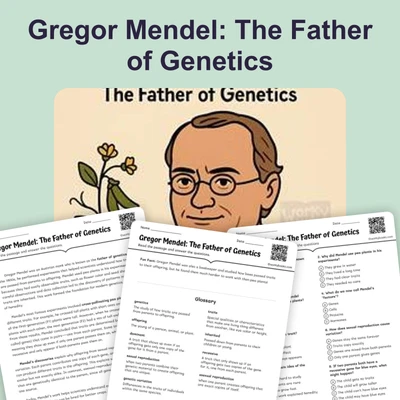
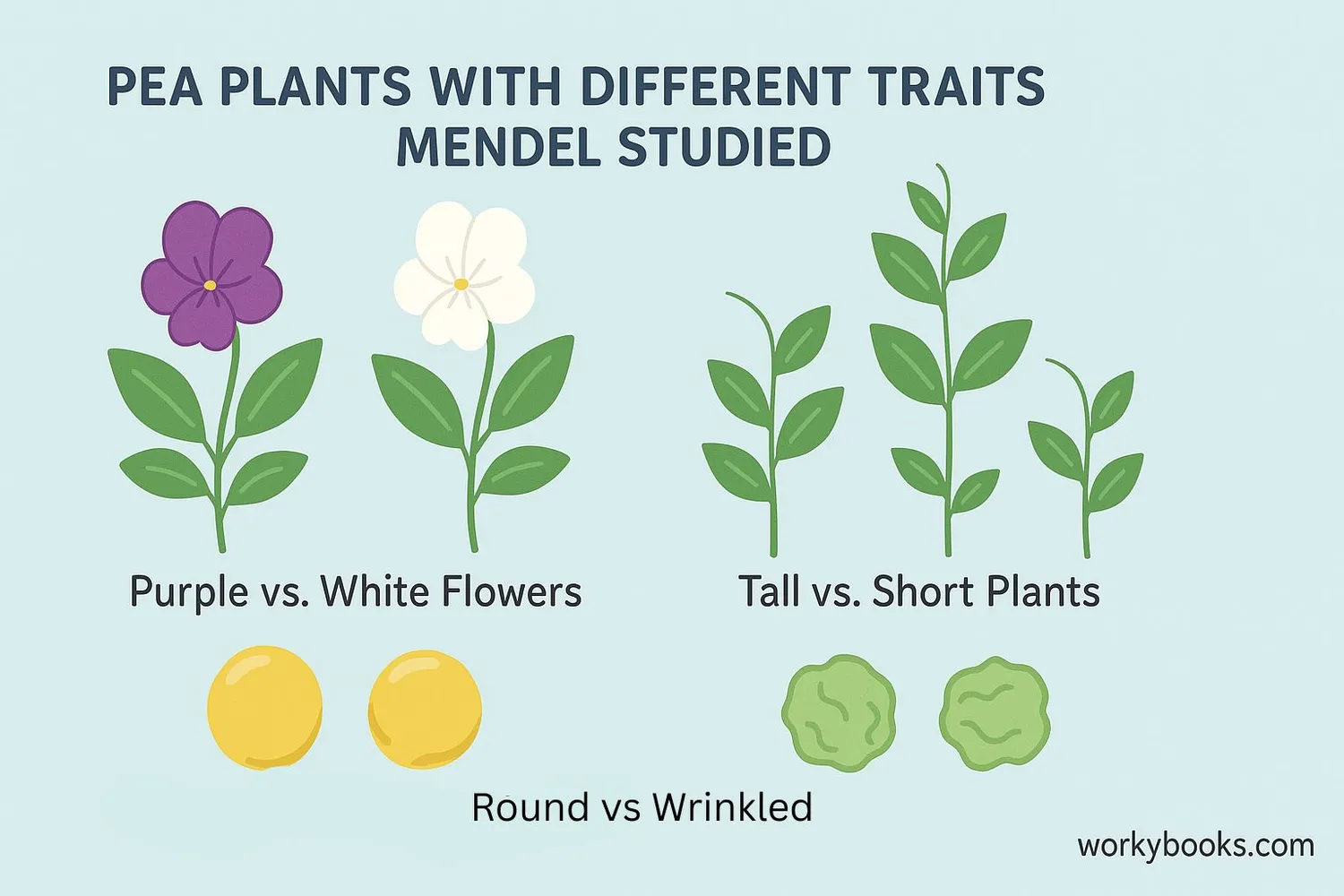
In the 1860s, Gregor Mendel, an Austrian monk, conducted careful experiments with pea plants. By tracking how traits like flower color and seed shape appeared in different generations, Mendel discovered patterns of inheritance. He noticed that traits were controlled by what he called “factors,” now known as genes. Mendel’s work showed that genes are inherited in predictable ways, following what are now called Mendel’s Laws of Inheritance. However, his findings were not widely recognized until 1900, when other scientists rediscovered his research and confirmed its accuracy with new data.
The Chromosome Theory and DNA Structure
In the early 1900s, scientists learned that genes are located on chromosomes inside the cell nucleus. This became known as the chromosome theory of inheritance. In 1953, James Watson, Francis Crick, Rosalind Franklin, and Maurice Wilkins uncovered the structure of DNA (deoxyribonucleic acid). They revealed that DNA is shaped like a double helix—a twisted ladder. DNA stores the instructions for building and operating all living things. The understanding of DNA’s structure explained how genetic information is copied and passed on. This led to advances in genetics, such as genetic engineering and DNA fingerprinting.
The Human Genome Project and Modern Genetics
In 2003, an international team completed the Human Genome Project, mapping all the genes in human DNA—over 20,000 in total. This massive achievement allows scientists to study how genes influence health, traits, and diseases. Modern genetics involves the study of mutations, genetic variation, and how genes interact with the environment. Discoveries in genetics have led to better medicines, improved crops, and new ways to diagnose and treat diseases. Scientists from around the world and many backgrounds have contributed to these breakthroughs, showing that scientific progress depends on diverse perspectives and collaboration.
Understanding the history of genetics shows how scientific knowledge grows as new evidence builds on earlier discoveries. From Mendel’s pea plants to decoding the human genome, each step reveals more about the complex system of heredity and life itself.
Interesting Fact: Only about 2% of your DNA actually codes for proteins—the rest has important roles scientists are still discovering!
Comprehension quiz (10 questions)
1. What did Gregor Mendel study to discover patterns of inheritance?
2. What is the main function of DNA in living things?
3. When was the Human Genome Project completed?
4. What does 'chromosome theory of inheritance' mean?
5. What are mutations?
6. What is the meaning of 'inheritance' as used in the passage?
7. What does 'genetic variation' refer to in the passage?
8. Why did it take so long for Mendel’s work to be recognized?
9. True or False: Only about 2% of your DNA codes for proteins.
10. True or False: The Human Genome Project mapped less than 500 genes in humans.
Perfect for the way you teach
- Build comprehension skills
- Auto-graded quiz
- Differentiated reading
- Read together at home
- Improve fluency
- Quiet reading time
- Reading curriculum support
- Independent practice
- Track Lexile growth