Predicting Traits with Punnett Squares
Interactive passage with audio narration, comprehension questions, and printable PDF.
By completing this purchase you agree to our Terms of Use and Privacy Policy. Your subscription renews automatically until you cancel. You can cancel anytime from your account settings. All sales are final and non-refundable. Digital content is available for download in your account immediately upon purchase.
What's included
Predicting Traits with Punnett Squares preview and details
About this printable Predicting Traits with Punnett Squares science reading passage, NGSS-aligned (Grades 5-8)
Sample passage and quiz from Predicting Traits with Punnett Squares
Reading passage and comprehension quiz preview
Predicting Traits with Punnett Squares

A Punnett square is a simple diagram used to predict how traits may be inherited through sexual reproduction. Named after British geneticist Reginald Punnett, this tool helps scientists and students understand the chances of an offspring inheriting specific traits from its parents. It models how genes are passed from parents to offspring and how dominant and recessive traits appear in future generations.
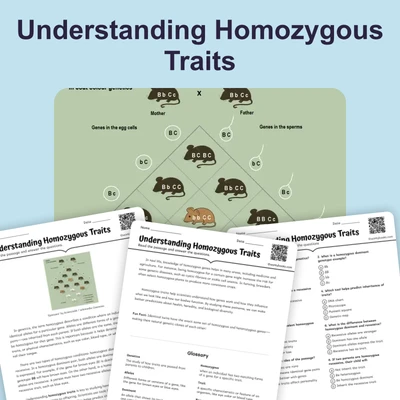
Each parent contributes one allele for every gene. An allele is a version of a gene. For example, a gene for flower color might have a purple allele (P) and a white allele (p). A capital letter is used for a dominant allele, and a lowercase letter is used for a recessive allele. A Punnett square shows all the possible combinations of alleles that the offspring could inherit. If both parents have one dominant and one recessive allele (Pp), the Punnett square will show a 75% chance of a purple flower and a 25% chance of a white one.
Punnett squares are especially helpful in predicting how traits will show up in future generations. They don’t guarantee the outcome for a single offspring, but they show the probabilities. For example, if two parents are both carriers of a recessive gene for a disease, a Punnett square can show that there’s a 25% chance their child will have the disease, a 50% chance they will be a carrier, and a 25% chance they will be unaffected.
Understanding Punnett squares helps students grasp how genetic variation happens and why not all siblings look the same. It also shows how traits can stay hidden for generations before appearing again.
Fun Fact: Reginald Punnett also helped create the first genetics textbook—and he used chickens to study inherited traits!
Comprehension quiz (8 questions)
1. What is a Punnett square used for?
2. Who created the Punnett square?
3. What does each parent pass to their offspring?
4. What does a lowercase letter represent in a Punnett square?
5. What is the chance of a white flower when two Pp plants are crossed?
6. How does a Punnett square help scientists?
7. What is the main idea of the passage?
8. If two carriers of a recessive disease gene have a child, what’s the chance the child will be a carrier?
Perfect for the way you teach
- Build comprehension skills
- Auto-graded quiz
- Differentiated reading
- Read together at home
- Improve fluency
- Quiet reading time
- Reading curriculum support
- Independent practice
- Track Lexile growth