Inherited Traits
Interactive passage with audio narration, comprehension questions, and printable PDF.
By completing this purchase you agree to our Terms of Use and Privacy Policy. Your subscription renews automatically until you cancel. You can cancel anytime from your account settings. All sales are final and non-refundable. Digital content is available for download in your account immediately upon purchase.
What's included
Inherited Traits preview and details
About this printable Inherited Traits science reading passage, NGSS-aligned (Grades 5-8)
Sample passage and quiz from Inherited Traits
Reading passage and comprehension quiz preview
Inherited Traits and How They Are Passed On

Inherited traits are physical or behavioral characteristics passed from parents to offspring through genes. Every living organism inherits traits from its biological parents, whether it’s the color of a cat’s fur, the shape of a plant’s leaves, or a person’s blood type. These traits are carried on structures called chromosomes, which are made of DNA. Each gene on a chromosome contains instructions for a specific trait.
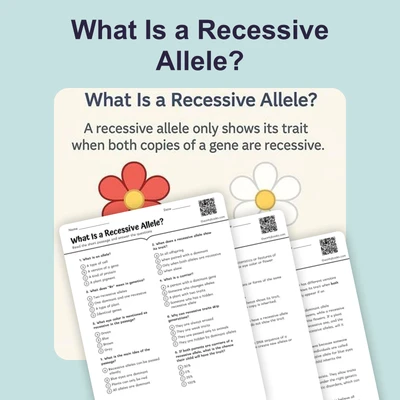
Traits come in two main forms: dominant and recessive. A dominant trait is one that will appear in the offspring even if only one parent passes it on. A recessive trait, on the other hand, only shows up if both parents pass on the same recessive gene. For example, having dimples is a dominant trait, while having no dimples is recessive. If a child gets a dominant gene from one parent and a recessive gene from the other, the dominant trait will be seen.
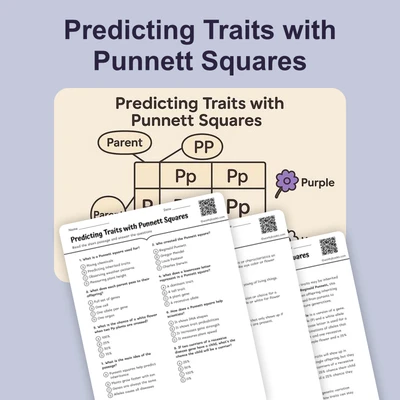
To predict how traits may appear in the next generation, scientists use tools like Punnett squares. These show the possible gene combinations from the parents. For instance, if both parents carry a recessive gene for blue eyes, there is a chance their child will inherit blue eyes—even if the parents have brown eyes.
Inherited traits also explain why family members sometimes look alike or share similar abilities. However, not all traits are inherited. Some traits, like language or table manners, are learned through experience, not passed down in DNA. Traits affected by both genes and the environment are called multifactorial traits. Height, for example, is influenced by both genetics and nutrition.
Studying inherited traits helps scientists understand heredity, predict genetic conditions, and even improve crops and livestock. It also helps us understand ourselves and how we are connected to our families.
Fun Fact: Humans have about 20,000 genes, and many of them influence multiple traits at once!
Comprehension quiz (8 questions)
1. What are inherited traits?
2. What are chromosomes made of?
3. What type of trait appears if only one parent passes it on?
4. Which tool helps predict trait inheritance?
5. Why can a child have blue eyes if both parents have brown eyes?
6. What is a multifactorial trait?
7. What is the main idea of the passage?
8. Which of the following is a learned trait?
Perfect for the way you teach
- Build comprehension skills
- Auto-graded quiz
- Differentiated reading
- Read together at home
- Improve fluency
- Quiet reading time
- Reading curriculum support
- Independent practice
- Track Lexile growth