
Severe Weather Worksheets for 2nd Grade
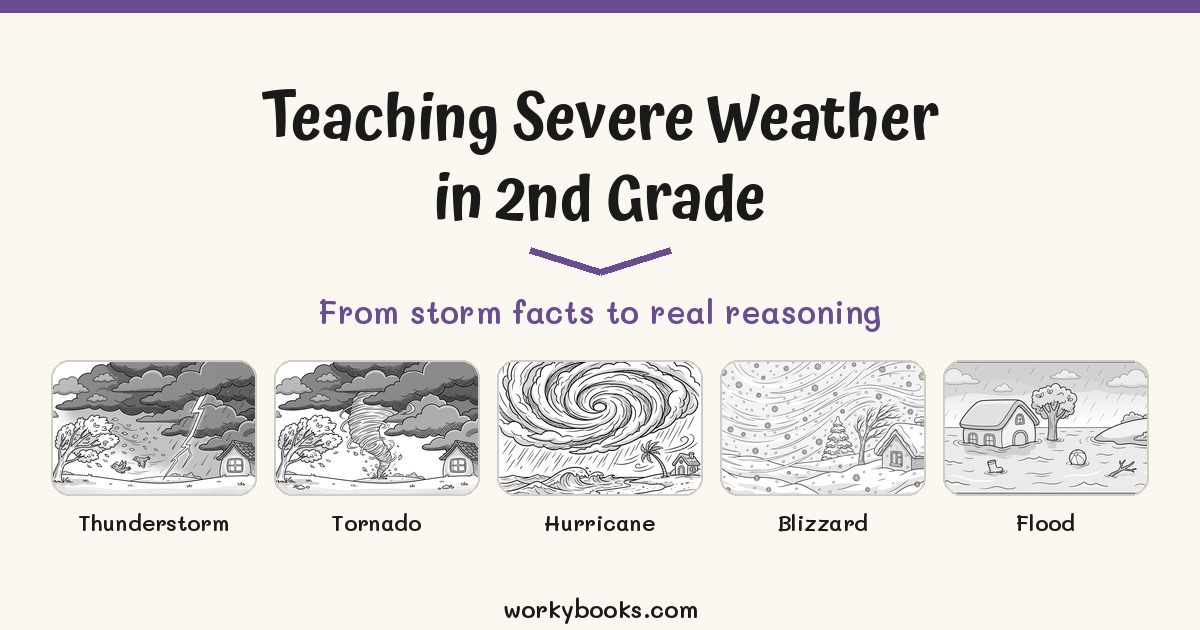
The best severe weather worksheets for 2nd grade do more than name the storm. Severe weather is, hands down, the most exciting weather topic you will teach all year. Kids lean in for lightning, funnel clouds, and walls of snow in a way they simply do not for “partly cloudy.” That built-in excitement is a gift — and it is usually spent on vocabulary and coloring pages, when it could be spent on something far more valuable: teaching children to read a storm, reason about what is coming, and know what to do to stay safe.
This post is the second in our series on building weather understanding from the ground up. The first post showed how everyday sky-watching in K–2 lays the foundation for science reasoning. This one picks up the thread for Grades 2–3, where students are ready for the big, dramatic weather — and ready to think like young scientists about it. Below you will find the teaching approach, a breakdown of what makes each storm different, and a ready-to-run 5-day lesson plan built around a set of printable, reasoning-first worksheets.
A quick word on framing. As a curriculum that takes climate literacy seriously, we believe the groundwork for understanding our changing world is laid early — not with frightening headlines, but with the durable skills of careful observation, evidence-based reasoning, and preparedness. At Grades 2–3, that means we keep the focus exactly where it belongs: what each kind of severe weather is, how to recognize it, and how to stay safe. Empowering, curiosity-driven, and never scary.
Why severe weather is the perfect topic for reasoning
Most extreme weather worksheets for 2nd grade stop at recall: match the word to the picture, fill in the blank, color the cloud. Children memorize that a tornado is a spinning wind and move on. They are not actually thinking — and within a week, the facts fade.
Severe weather is the ideal place to ask for more, because every storm leaves clues. Dark clouds, a bending tree, a funnel reaching down, a sky thick with snow — these are observable signals a child can read and reason from. That turns a worksheet from a memory quiz into a small act of science: I see this evidence, so I think this is coming, so here is what I should do.
That is the shift these resources are built around, and it is the same “analysis lane” that runs through our whole weather sequence: less naming, more reasoning.
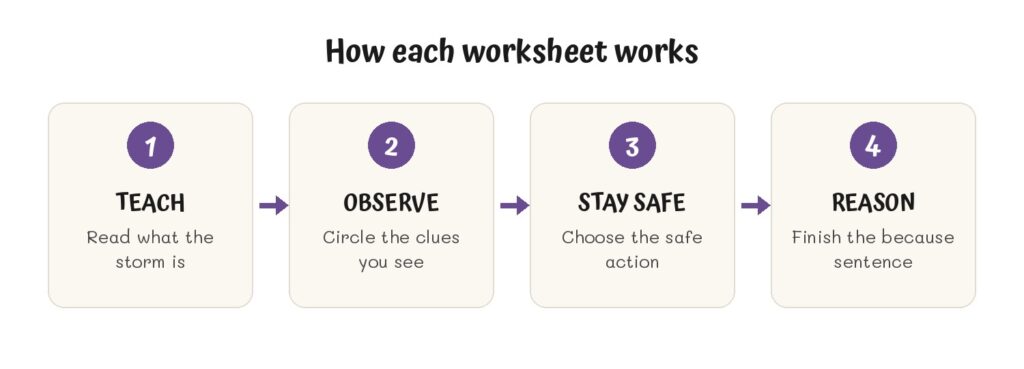
Each worksheet in this set follows the same four-step rhythm, which is what makes them work as a teaching tool rather than busywork:
- Teach — A few plain-language facts introduce the storm: what it is, where it comes from, what makes it special. (This is your informational-text moment.)
- Observe — Students circle the clues they would see or hear, with a few distractors mixed in so they have to think, not guess.
- Stay safe — Students choose the safe action in each pair. This is real, age-appropriate weather safety guidance, framed as a decision.
- Reason — Students finish a “because” sentence that ties evidence to conclusion, supported by a word bank.
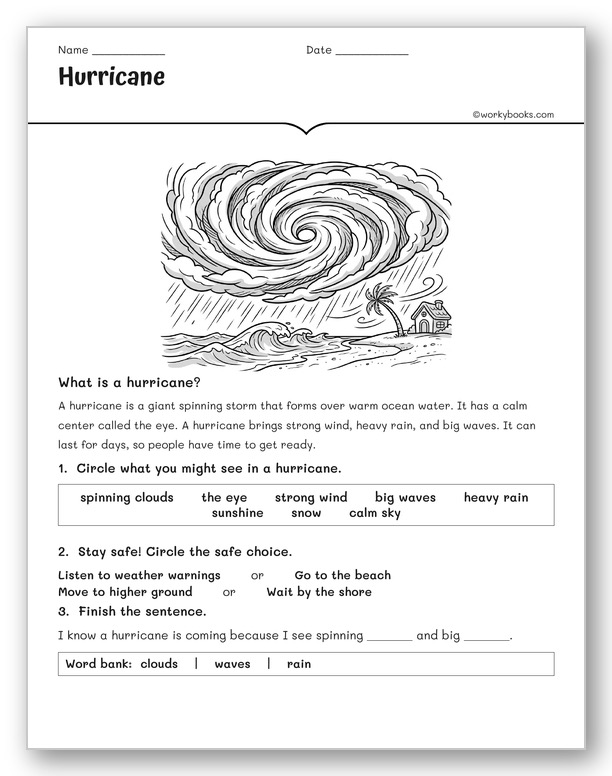
Because the routine is identical across all five storms, students learn it once and then deepen it five times. The cognitive load drops, and the thinking gets sharper with each sheet. Every sheet is one page with a clear illustration as the focus, plus an answer key — so it works as independent practice, a guided lesson, or a quick assessment.
What makes each storm different (the part kids remember)
Here is where these worksheets earn their place. Taught as a list, severe weather blurs together — “scary weather, stay inside.” Taught by identity, each storm becomes memorable, because each one has its own signature clue and its own safety rule. This is also the heart of a strong weather unit: comparing and contrasting, not just collecting. The detailed illustration on each sheet works as a simple, kid-friendly weather diagram — something students can point to, label, and read, rather than just a picture to color.
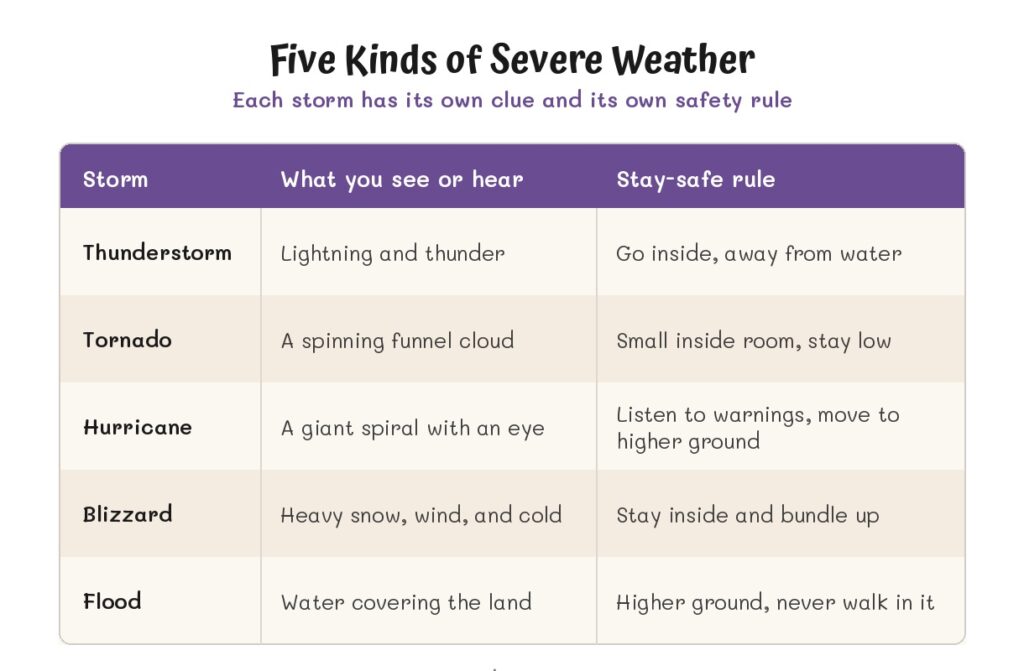
Thunderstorm — the lightning-and-thunder storm
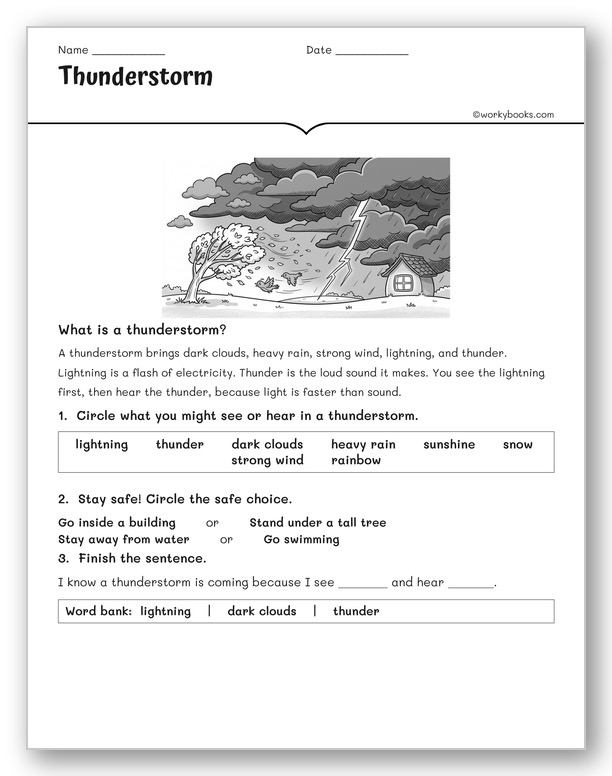
A thunderstorm is a single, local, short event: one tall storm cloud brings heavy rain, gusty wind, and its unmistakable signature — lightning and thunder. The memorable science hook for this age: you see the lightning first, then hear the thunder, because light travels faster than sound. Safety rule: go inside, and stay away from water. The sheet’s illustration doubles as a simple diagram of a thunderstorm for kids — dark clouds, slanting rain, and a bold lightning bolt they can point to and reason from. If you have searched for a clear thunderstorm diagram for kids, this is that, with a thinking task built around it.
Tornado — the spinning funnel
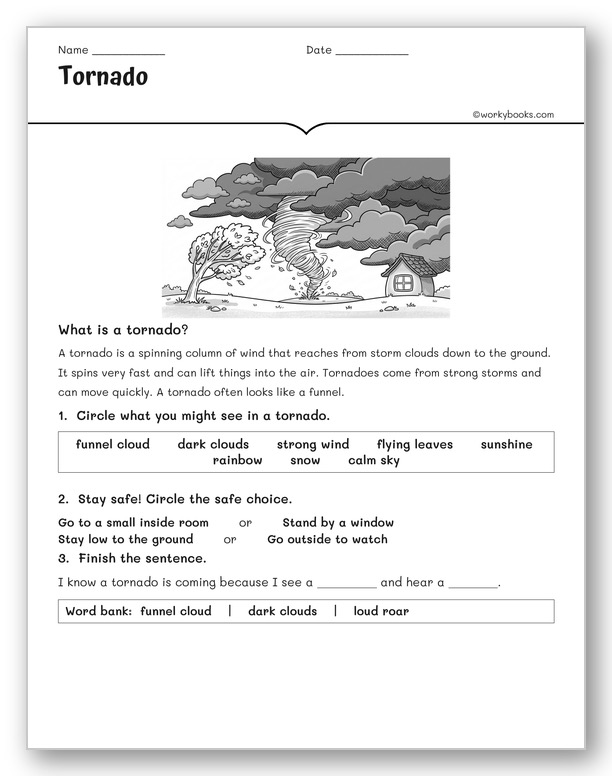
A tornado is a fast, spinning column of wind that reaches from storm clouds down to the ground. Its signature is the funnel shape and the debris whirling at its base. The funnel illustration reads as a simple tornado diagram for kids, so they can see the shape before they name it. Because tornadoes come fast and move quickly, tornado safety is about acting now: go to a small inside room on the lowest floor, away from windows, and stay low.
Hurricane — the giant ocean spiral
A hurricane is a different animal entirely: an enormous, slow, ocean-born storm — hundreds of miles wide — that spins around a calm center called the eye and lasts for days. A helpful idea for this age is that a hurricane is not a bigger thunderstorm; it is a giant spinning system with many storms inside it. Its illustration works as a simple hurricane diagram — the eye at the center and the spiral cloud bands wrapping around it — so students can see why it looks the way it does, not just memorize the word. Because it is tracked for days, hurricane safety is about preparation: listen to weather warnings and move to higher ground, away from the coast and its rising water.
Blizzard — snow plus wind plus cold
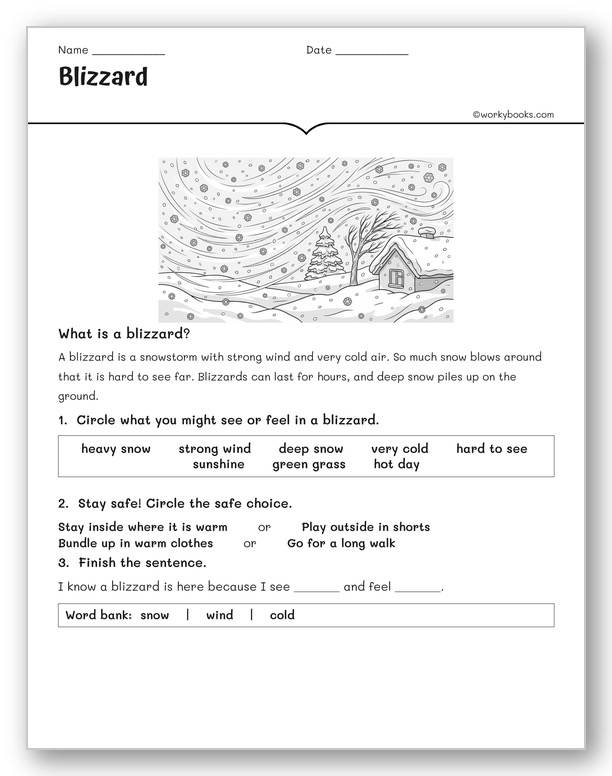
A blizzard is more than a snowstorm: it is heavy snow plus strong wind plus very cold air, with so much snow blowing that it is hard to see far. It is the defining winter weather hazard. Safety rule: stay inside where it is warm, and bundle up in warm clothes if you must go out.
Flood — when water covers the land
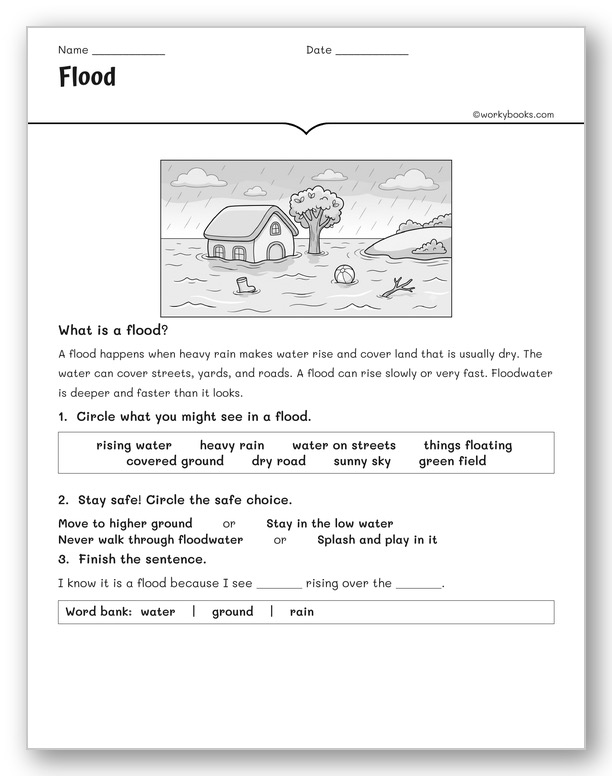
A flood is the one storm where the danger is the water itself, not the sky. Heavy rain makes water rise and cover land that is usually dry — streets, yards, roads. The crucial idea: floodwater is deeper and faster than it looks. Flood safety carries the single most important rule in the whole set: move to higher ground, and never walk, play, or drive through floodwater.
Notice the satisfying symmetry once you lay them side by side: a hot, electrical storm; a wind vortex; a tropical giant; a cold-and-snow event; and a too-much-water event. Five storms, five identities, five rules.
Teaching safety without the fear
Severe weather sits close to real fear for some children — a thunderstorm that woke them up, a flood on the news. The goal is to convert that worry into competence. A few principles that keep these lessons empowering:
- Lead with knowing, not warning. Understanding what a storm is shrinks it down to size. Mystery is what frightens; explanation calms.
- Make safety a decision, not a danger list. “Circle the safe choice” gives children agency. They are the ones who know what to do.
- Keep the images friendly. The illustrations show storms as dramatic but never destructive — no people in danger, no damage. (For your own classroom, these are the kind of clear, kid-friendly illustrations for severe weather worksheets that invite discussion rather than alarm.)
- Name the helpers. Weather scientists track these storms and send warnings; that is why we get ready. Severe weather is something people watch, predict, and prepare for — not something that simply happens to us. (Kid-friendly explainers from NOAA SciJinks and safety steps from Ready.gov Kids are great companions for older students.)
A 5-day lesson plan using these severe weather worksheets for 2nd grade
Here is a complete, ready-to-run unit built around these five 2nd grade severe weather worksheets — one storm per day. The daily routine is identical, so you teach the structure once and reinforce it all week.
Unit objective: Students will describe what each kind of severe weather is, identify the clues that signal it, choose appropriate safety actions, and explain their reasoning in writing, using evidence.
Standards: NGSS K-ESS3-2 (ask questions to obtain information about the purpose of weather forecasting to prepare for, and respond to, severe weather). ELA: RI.2.1 (ask and answer questions about informational text), W.2.1 (write opinions with reasons), SL.2.1 (participate in discussion).
Materials: The five printable worksheets (Thunderstorm, Tornado, Hurricane, Blizzard, Flood), each with answer key; chart paper for a class “Severe Weather” anchor chart; the five-storms comparison graphic (IMAGE 3) displayed.
The daily routine (about 25–30 minutes)
Run this same arc each day with that day’s storm:
- Hook (3 min). Show the worksheet illustration only. Ask: “What do you notice? What do you think this weather is?” Collect observations before naming it.
- Teach — I do (5 min). Read the “What is a ___?” facts aloud. Add the storm’s name, signature clue, and one safety rule to the class anchor chart.
- Observe — we do (6 min). Work the “circle the clues” task together the first day; release responsibility on later days. Discuss why the distractors (sunshine, snow on a hot day, calm sky) do not belong.
- Stay safe — we do (5 min). Read each safety pair. Have students thumbs-up the safe choice and explain why the other is unsafe before circling.
- Reason — you do (6 min). Students finish the “because” sentence independently, using the word bank. This is the written, assessable product.
- Share (3 min). Two or three students read their sentence. Add the storm’s row to the anchor chart.
Day-by-day sequence
- Day 1 — Thunderstorm. Best first because it is the most familiar. Anchor the lightning-before-thunder idea; practice the “go inside” rule.
- Day 2 — Tornado. Contrast with Day 1: a tornado is wind you can see (the funnel). Practice the “small inside room, stay low” drill physically.
- Day 3 — Hurricane. Introduce scale and time — huge, slow, days long, has an eye. Connect to the idea of warnings and getting ready.
- Day 4 — Blizzard. Shift to winter weather: snow plus wind plus cold. Contrast “stay warm” safety with the others.
- Day 5 — Flood. Close with the water storm and its non-negotiable rule. Use the finished anchor chart to compare all five.
Wrap-up and assessment
On Day 5, the completed anchor chart becomes a comparison tool: Which storms come fast? Which give us days of warning? Which one’s danger is on the ground, not in the sky? For assessment, the five “because” sentences are a simple evidence-based writing portfolio; the circle-the-clue tasks show whether students can separate signal from distractor. For an extension, ask students to sort the five storms by season, by speed, or by “where it forms” — pure reading and reasoning, no new content needed.
Differentiation
- Emerging readers: Read the facts aloud and let students answer orally before writing; the word banks make the sentence accessible.
- On-level: Students complete each sheet independently after the Day 1 model.
- Extension: Have students write a second “because” sentence using a different clue, or compare two storms in a sentence (“A hurricane lasts longer than a thunderstorm because…”).
The reasoning thread: from “because” to CER
The “because” sentence on each sheet is doing quiet, important work. “I know a thunderstorm is coming because I see lightning and hear thunder” is a claim joined to evidence — the seed of claim-evidence-reasoning (CER). Students who built that habit on calm-weather sheets in our earlier unit are now applying it to high-stakes, high-interest weather. From here, the natural next step is a full three-part CER organizer (Claim / Evidence / Reasoning), where students separate the moves and write a fuller explanation. The “because” sentence is the on-ramp; CER is the highway.
Standards alignment
These resources are built for grade 2 science and the surrounding band:
- NGSS K-ESS3-2 — the purpose of weather forecasting is to prepare for and respond to severe weather. Every sheet’s teach-and-safety arc is this standard in action.
- CCSS ELA RI.2.1, W.2.1, SL.2.1 — reading informational text and answering questions, writing opinions with reasons, and participating in discussion. The facts, the “because” sentence, and the share-out cover all three.
Because they pair science content with reading and writing, these double as a literacy block — useful when instructional minutes are tight.
Frequently asked questions
What is the best way to teach severe weather in 2nd grade? Move past naming and memorizing. The most effective approach teaches a few facts about each storm, then has students read the clues, choose safe actions, and explain their thinking in writing. A consistent teach → observe → safety → reason routine — the structure of these severe weather worksheets for 2nd grade — builds science reasoning and weather safety at the same time.
What severe weather should 2nd graders learn about? The five that cover the major categories: thunderstorm (electrical), tornado (wind), hurricane (tropical), blizzard (winter), and flood (water). Together they give students a complete, comparable picture of severe and extreme weather without overwhelming them.
Are these extreme weather worksheets aligned to standards? Yes. They align to NGSS K-ESS3-2 (forecasting to prepare for and respond to severe weather) and to grade-2 ELA standards for informational reading, opinion writing, and discussion (RI.2.1, W.2.1, SL.2.1).
Do these worksheets include weather diagrams for kids? Each sheet is built around a clear, labeled-style illustration that works as a simple weather diagram for kids — a diagram of a thunderstorm with clouds, rain, and lightning; a simple hurricane diagram showing the eye and spiral bands; a funnel tornado diagram; and snow and flood scenes. Students read the diagram for clues, then reason and write — so the visual does real teaching work, not just decoration.
How do you teach weather safety without scaring kids? Lead with understanding, frame safety as a decision the child gets to make, keep the illustrations friendly and free of danger, and emphasize that scientists watch and warn so we can prepare. Knowing what a storm is — and what to do — turns worry into confidence.
Get the severe weather worksheets
Each worksheet is a one-page, no-prep printable with an answer key, ready for your weather unit tomorrow. Teach them one storm at a time, or grab the whole set as a combined thunderstorms, tornadoes, and hurricanes worksheet pack (with blizzard and flood included):
- Thunderstorm — lightning, thunder, and the “go inside” rule
- Tornado — the funnel cloud and tornado safety
- Hurricane — the ocean spiral, the eye, and hurricane safety
- Blizzard — the snowstorm that brings wind and cold, and how to stay warm
- Flood — rising water and the most important rule of all, flood safety
Looking for the calmer foundation first? Start with our K–2 weather-reasoning routine in Post 1 of this series, then bring your students here when they are ready for the big weather.
All five teach-and-reason worksheets — Thunderstorm, Tornado, Hurricane, Blizzard, and Flood — each one page with an answer key. Standards-aligned to NGSS K-ESS3-2. Just print and go.
Get the 5-Sheet Bundle →About Workybooks. Workybooks creates standards-aligned, printable worksheets that push past recall toward real reasoning — claim-evidence-reasoning, sentence frames, and graphic organizers for K–8 science, math, and social studies. Our curriculum team includes former classroom teachers and instructional designers, and every resource is aligned to NGSS and Common Core and classroom-tested before it ships. Explore the full library at workybooks.com
Related Posts

Free Printable 5th Grade Science Worksheets and Activities
4th Grade Common Core Math Worksheets | Workybooks