Ancient Egypt Reading Passages: Bilingual Unit (CA HSS 6.2)
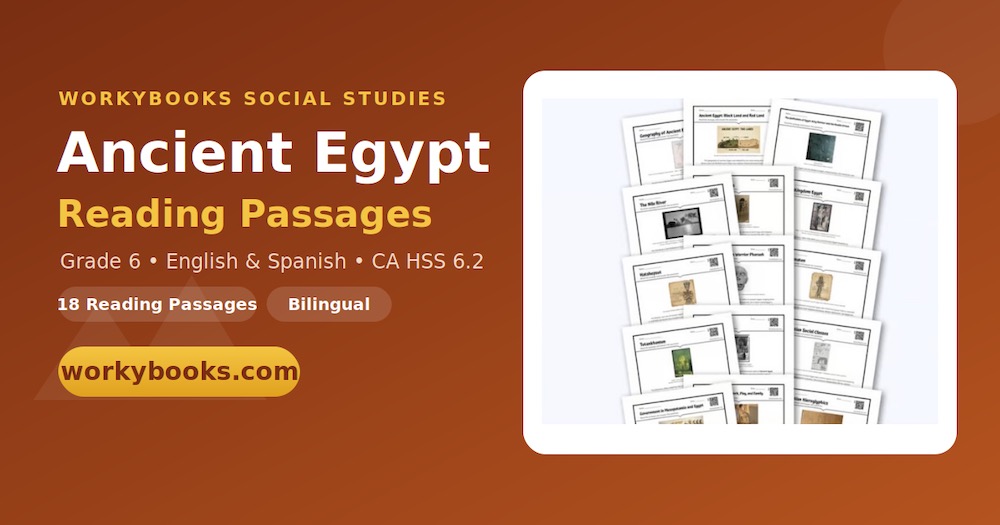
Few topics grab a sixth grader’s imagination like Ancient Egypt. Golden masks, towering pyramids, mysterious hieroglyphs, and boy kings buried with treasure. But behind the mummies and monuments is one of the richest case studies in how geography shapes a civilization. These Ancient Egypt reading passages turn standards-aligned learning for your Grade 6 classroom.
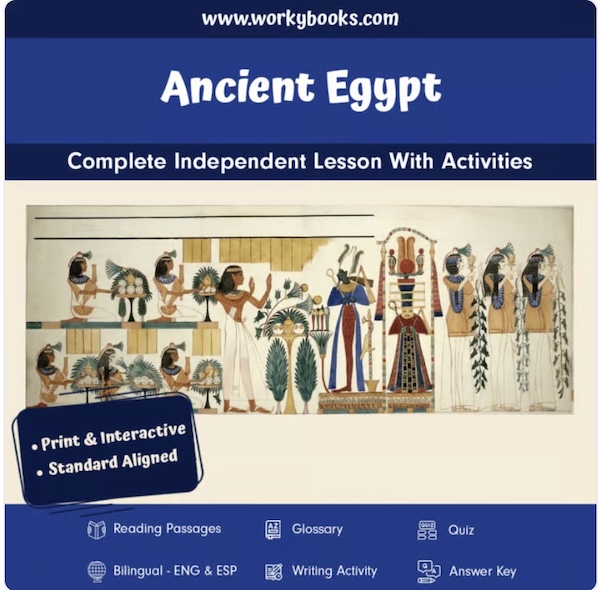
This unit is a complete, standards-aligned collection of differentiated reading passages — available in English and Spanish. The unit covering the history, geography, and daily life of Ancient Egypt, paired with a glossary, quizzes, writing activities, graphic organizers, and a full answer key.
Here’s a look at what the unit covers and how it supports every reader in your classroom. (Ready to grab it now? Get the full Ancient Egypt unit on TpT.)
The Gift of the Nile: Geography That Built a Civilization
Ancient Egypt begins with a single, life-giving fact of geography: the Nile River. Students explore how the Nile shaped Egypt.
They’ll learn the difference between Egypt’s Black Land and Red Land. Passages explain how the yearly flooding, or inundation, deposited nutrient-rich silt that fueled agriculture. Elaborates how Egyptians used irrigation for their fields. Students even discover how the flood cycle gave rise to the Egyptian calendar. By connecting rainfall, farming, and the rise of towns, learners see exactly why historians call Egypt “the gift of the Nile”.
One Crown, One Kingdom: King Narmer Unifies Egypt
Before Egypt was a single nation, it was two lands. This section tells the story of King Narmer, the ruler traditionally credited with joining Upper and Lower Egypt into one kingdom. Build a timeline of early Egyptian history, and begin exploring the social hierarchy that would define Egyptian life. All aligned to CA HSS 6.2.2 to CCSS RH.6-8.1.
God-Kings on the Throne: What Is a Pharaoh?
At the top of Egyptian society stood the pharaoh. Students learn what made pharaohs so powerful. They were considered god-kings, believed to be living links between the people and the gods. This passage explains their role in religion, government, from pyramids to temples.
The New Kingdom and Its Legendary Pharaohs
The New Kingdom was Egypt’s golden age of empire and imperial power — and it produced the most famous rulers in Egyptian history. This is often students’ favorite part of the unit, and it’s built around five unforgettable pharaohs:
- Hatshepsut, the Female Pharaoh — one of the few women to rule as pharaoh, remembered for a reign of trade, wealth, and monumental building.
- Thutmose III, the Warrior Pharaoh — a brilliant military leader whose conquests expanded Egypt to its greatest size.
- Akhenaten, the Heretic Pharaoh — the king who tried to replace Egypt’s many gods with worship of a single god, the Aten. He also moved his capital to Amarna.
- Tutankhamun, the Boy King — the young ruler whose nearly intact tomb, discovered by Howard Carter in the Valley of the Kings.
- Ramses the Great (Ramses II) — the long-reigning builder of colossal monuments, known for the Battle of Kadesh against the Hittites.
Each ruler comes with a self-contained reading passage, so you can teach them in sequence or spotlight just one.
Life Along the Nile: Society, Government, and Daily Life
Beyond the throne, this unit brings everyday Egypt to life. Students examine the social classes of Ancient Egypt — the pharaoh and royal family at the top, followed by nobles, priests, officials, scribes, and warriors. A comparison of government in Mesopotamia and Egypt helps students see how different early civilizations organized power.
Passages on daily life round out the picture: what families ate, how children were raised, the work people did. It’s the human side of history that helps abstract concepts stick.
Writing, Art, and the World Beyond
Ancient Egypt left behind an extraordinary cultural legacy. One of the passages explore it. Students investigate Egyptian hieroglyphs — the picture-based writing system recorded on papyrus by trained scribes. Later we know how the Rosetta Stone finally allowed modern scholars to read them.
From there, learners explore Egyptian art and architecture, the temples and tombs built to last for eternity, and the beliefs behind them. The unit closes with the Ancient Egyptian afterlife. The practice of mummification, and why Egyptians filled tombs with everything a soul might need for the journey ahead. Students can even follow the story to its end with a passage on the decline of Ancient Egypt.
What’s Inside the Ancient Egypt Reading Passages Unit
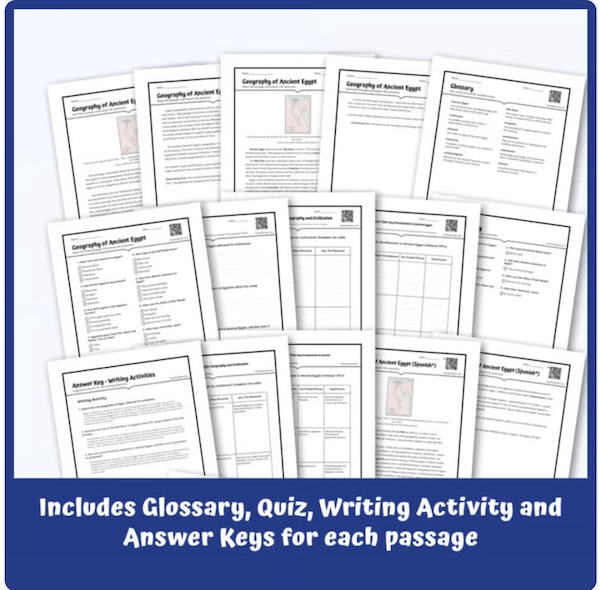
Every topic above comes with a complete teaching toolkit designed to save you prep time and reach every learner:
- Differentiated Reading Passages (English & Spanish): Detailed, illustrated passages at multiple reading levels, with Spanish translations for every topic to support bilingual and ESL learners.
- Glossary: Clear definitions of key vocabulary, including Pharaoh, Hieroglyphics, Inundation, Silt, and Dynasty.
- Quiz: Multiple-choice questions that assess comprehension of the passages and core historical facts.
- Writing Activity: Open-ended comprehension and analysis prompts that push students to synthesize information and explain historical relationships in their own words.
- Graphic Organizers: Cause-and-effect and chronological-development tables for each topic, so students can visualize timelines and trace the impact of geographic and political change.
- Answer Key: Complete and suggested answers for every quiz, writing activity, and graphic organizer — making grading quick and painless.
Standards-Aligned Ancient Egypt Reading Passages for Every Learner
The unit is aligned to California History–Social Science 6.2 and supports Common Core literacy standards RH.6-8.1, RH.6-8.2, and RI.6-8.1.
Just as importantly, the built-in Spanish translations and leveled passages help cover the same lesson. One resource reaches your on-level readers, your students who need more support, and your Spanish-speaking and ESL learners — all at once.
Bring Ancient Egypt to Life in Your Classroom
From the flooding of the Nile River to the tomb of the boy king, this unit gives your students a story worth remembering and the reading, writing, and thinking practice worth teaching. Everything is ready to print and go — no prep, no piecing resources together.
👉 Get the full Ancient Egypt unit here — every passage, quiz, writing activity, graphic organizer, and answer key in one download.
You can also explore all our Ancient Egypt reading passages on Workybooks and give every student in your classroom a front-row seat to one of history’s greatest civilizations.
Grade 6 World History | Ancient Civilizations | CA HSS 6.2 • CCSS RH.6-8 | English & Spanish
Related Posts
8 Collision Worksheets — Grade 4 NGSS 4-PS3-3 | Workybooks
What Animals Live in the Desert?