Reading PassagePremium

African Americans Fight for the Union

Interactive passage with audio narration, comprehension questions, and printable PDF.

No ratings yet
Grades 3–5ElaSocial-studiesHistoryEnglish · SpanishInteractive · Printable
Aligned toHSS 5.10.3RI.4.1
Just this resource
$1.50
One-time purchase
Best value
Unlock everything
$49.99$29.99/yr
40% off until Aug 1 — 10,000+ resources
Renews at $49.99/year.
Unlock above to use these actions

What's included

Reading passage
Audio narration
Comprehension quiz
Writing activity
Glossary & flashcards
Differentiated version
Spanish translation

Part of this bundle

African Americans Fight for the Union preview and details

About this printable African Americans Fight for the Union reading passage (Grades 3-5)

This U.S. history reading passage explores the vital role of African American soldiers in the Union Army during the Civil War. Nearly 200,000 Black soldiers, known as the United States Colored Troops (USCT), joined the fight for freedom after the Emancipation Proclamation. The passage highlights their bravery, the challenges they faced, and the impact they made on American history. Students will learn about key individuals, such as Frederick Douglass, and important events like the Battle of Fort Wagner. The reading is designed to align with HSS 5.10.3 and RI.4.1 standards. Included are a glossary, multiple-choice quiz, writing prompts, graphic organizers, and a timeline. This resource also features a Spanish translation and read aloud audio, providing accessible support for diverse learners. The passage emphasizes themes of courage, unity, and the lasting contributions of African Americans to the nation's history.
Written by Workybooks TeamPublished by Workybooks
Preview

Sample passage and quiz from African Americans Fight for the Union

Reading passage and comprehension quiz preview

African Americans Fight for the Union
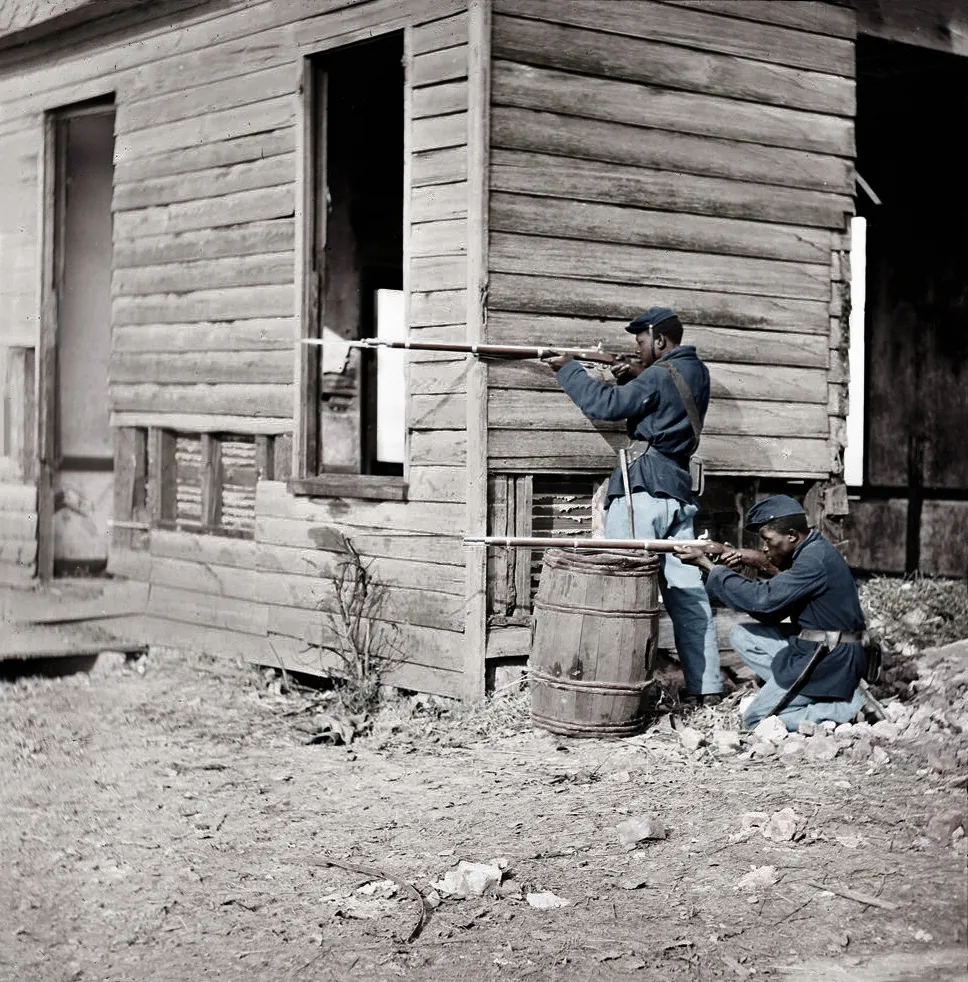
African-American Union Army infantrymen. Restored, retouched and colourised

African-American Union Army infantrymen. Restored and retouched / Wikimedia Commons

The Civil War was a fight between the North and the South from 1861 to 1865. During this war, nearly 200,000 African American men joined the Union Army to help end slavery. Most of them joined after President Abraham Lincoln signed the Emancipation Proclamation in 1863. This important order made it clear that enslaved people in the South were free if the Union won the war.

Before the Emancipation Proclamation, Black men were not allowed to join the army. Many wanted to fight for their own freedom and to show their courage. Leaders like Frederick Douglass encouraged them to join. He knew that Black soldiers could help win the war and prove that all people deserved equal rights.

After 1863, thousands of African Americans signed up. They formed special groups called the United States Colored Troops (USCT). These units had Black soldiers and white officers. The USCT fought in many important battles. One famous battle was at Fort Wagner in South Carolina. The 54th Massachusetts Regiment, made up of Black soldiers, showed great bravery. Even though many were hurt or killed, they never gave up. Their actions inspired others to join and fight for freedom.

African American soldiers faced many challenges. They often received less pay than white soldiers. They had to do hard work, like digging trenches or building roads. Sometimes they were treated unfairly or faced discrimination. But they kept fighting because they wanted to prove their worth and help end slavery.

By the end of the war, nearly 200,000 Black men had served in the Union Army and Navy. Their service helped the North win the Civil War. Their bravery and sacrifice showed that they deserved equal rights. After the war, their actions helped lead to new laws that gave more rights to African Americans.

Interesting Fact: The Medal of Honor, the highest award for bravery in battle, was given to 25 African American soldiers during the Civil War.

Comprehension quiz (8 questions)

1. When did the Civil War begin?

1861
1863
1865
1850

2. Who signed the Emancipation Proclamation?

Abraham Lincoln
Frederick Douglass
George Washington
Ulysses S. Grant

3. What was the USCT?

Special Black army units
A battle
A new law
A navy ship

4. Why did African American soldiers join the Union Army?

To fight for freedom
To become president
To move north
To avoid work

5. What was one challenge faced by Black soldiers?

Less pay
More holidays
Higher ranks
Easy battles

6. How did the 54th Massachusetts Regiment show courage?

They fought bravely at Fort Wagner
They signed a law
They built roads
They sailed ships

7. The Medal of Honor was given to 25 Black soldiers. True or False?

True
False

8. What does discrimination mean?

Unfair treatment
Being brave
Joining the army
Winning a battle
Curriculum

Common Core standards for African Americans Fight for the Union

RI.4.1

Refer to details and examples in a text when explaining what the text says explicitly and when drawing inferences from the text.

Who it's for

Perfect for the way you teach

Teachers
  • Build comprehension skills
  • Auto-graded quiz
  • Differentiated reading
Parents
  • Read together at home
  • Improve fluency
  • Quiet reading time
Homeschoolers
  • Reading curriculum support
  • Independent practice
  • Track Lexile growth
Topics

Reviews & Ratings

No reviews yet. Be the first to share your experience!

More reading you might love

19 more
Worksheet
Snorkeling & Scuba Diving - worksheet educational content
Grade 4

Snorkeling & Scuba Diving

reading informational text · RI.2.2

$1.50
Worksheet
Polar Bears and Climate - worksheet educational content
Grades 4–5

Polar Bears and Climate

reading informational text · RI.4.1

Free
Worksheet
Climate and Water Cycle - worksheet educational content
Grades 4–5

Climate and Water Cycle

writing · W.4.2.A

Free
Worksheet
Earthquakes and Infrastructure - worksheet educational content
Grades 4–5

Earthquakes and Infrastructure

reading informational text · W.4.7

$1.50
Worksheet
The Rubik's Cube - worksheet educational content
Grades 4–5

The Rubik's Cube

reading informational text · RI.2.2

Free
Worksheet
Understanding Climate Action Context Clues - worksheet educational content
Grades 4–5

Understanding Climate Action Context Clues

vocabulary development · L.4.4.A

$1.50
Worksheet
Earthquake and buildings - worksheet educational content
Grades 4–5

Earthquake and buildings

reading informational text · RI.4.1

$1.50
Passage
How Do Scientists Study Past Climates? - reading educational content
Grades 4–7

How Do Scientists Study Past Climates?

reading literature · RI.4.1

Free
Passage
Earth Day and Types of Pollution - reading educational content
Grades 4–5

Earth Day and Types of Pollution

science · RI.4.1

Free
Passage
Earth Day and Green Initiatives - reading educational content
Grades 4–5

Earth Day and Green Initiatives

science · RI.4.1

$1.50
Passage
Sunspots and Solar Flares - reading educational content
Grades 4–5

Sunspots and Solar Flares

earth and space science · RI.4.1

Free
Passage
How might climate change affect animals? - reading educational content
Grades 2–4

How might climate change affect animals?

weather and climate · RI.3.1

$1.50
Passage
What can happen to sea levels because of climate change? - reading educational content
Grades 2–4

What can happen to sea levels because of climate change?

weather and climate · RI.3.1

Free
Passage
Reduce Your Carbon Footprint: Simple Tips for Home - reading educational content
Grades 2–4

Reduce Your Carbon Footprint: Simple Tips for Home

weather and climate · RI.3.1

Free
Passage
How using less plastic helps the environment? - reading educational content
Grades 2–4

How using less plastic helps the environment?

weather and climate · RI.3.1

Free
Passage
How Kids Can Help Fight Climate Change? - reading educational content
Grades 2–4

How Kids Can Help Fight Climate Change?

weather and climate · RI.3.1

Free
Passage
How is Climate Different from Weather? - reading educational content
Grades 2–4

How is Climate Different from Weather?

weather and climate · RI.3.1

Free
Passage
Can you give an example of a renewable energy source? - reading educational content
Grades 2–4

Can you give an example of a renewable energy source?

weather and climate · RI.3.1

Free
Passage
What is recycling, and why is it important? - reading educational content
Grades 2–4

What is recycling, and why is it important?

science · RI.3.1

Free
Copyright © 2026 Workybooks. Made with ♥ in California.