Breadbasket Colonies
Interactive passage with audio narration, comprehension questions, and printable PDF.
By completing this purchase you agree to our Terms of Use and Privacy Policy. Your subscription renews automatically until you cancel. You can cancel anytime from your account settings. All sales are final and non-refundable. Digital content is available for download in your account immediately upon purchase.
What's included
Part of this bundle

Breadbasket Colonies preview and details
About this printable Breadbasket Colonies reading passage (Grades 3-5)
Sample passage and quiz from Breadbasket Colonies
Reading passage and comprehension quiz preview
Middle Colonies
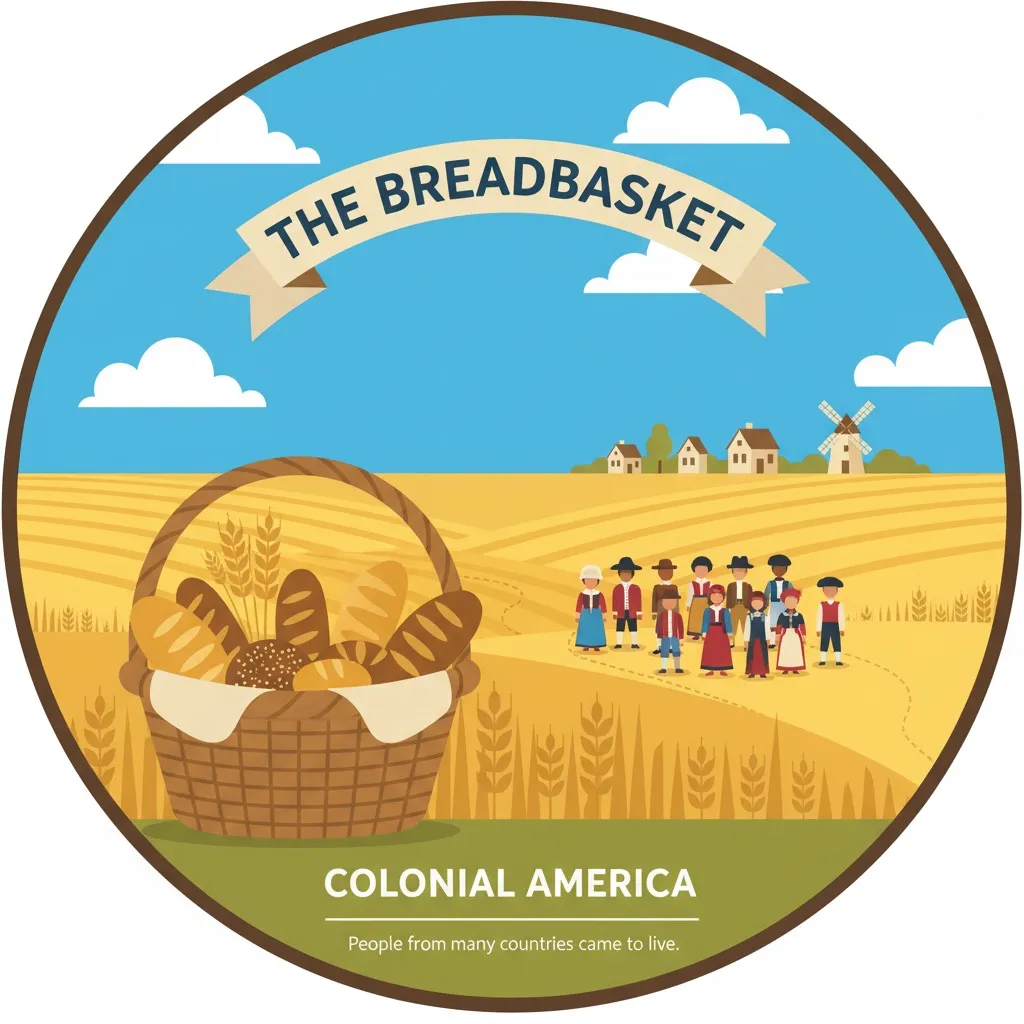
The Middle Colonies of Colonial America were known as the "Breadbasket Colonies." These colonies included New York, New Jersey, Pennsylvania, and Delaware. People called them the Breadbasket Colonies because they grew so much grain. Their fertile soil was perfect for farming. The weather was mild, with warm summers and enough rain. This helped crops like wheat, oats, and barley grow very well.
Many families in the Middle Colonies owned farms. The land was divided into medium-sized farms, not too big or too small. Colonists worked hard to plant and take care of their crops. They used simple tools, like wooden plows pulled by horses or oxen. In the early morning, everyone helped in the fields. Children, parents, and even grandparents worked together. The whole family helped with planting, weeding, and harvesting.
Wheat was the most important crop. Farmers grew so much wheat that they could sell it to other colonies. They also grew oats, barley, corn, and rye. These grains were used to make bread, porridge, and other foods. The grains were taken to local mills. At the mill, people ground the grain into flour. The flour was put into barrels and loaded onto wagons or ships. Merchants sold the flour to cities like Boston, Charleston, and even to England.
The Middle Colonies were special because of their diverse people. Many settlers came from different countries. There were English, Dutch, German, Swedish, and Irish families. They brought different ways of farming and new ideas. This diversity helped the colonies grow stronger. People learned from each other and shared new crops and farming methods.
Because the Middle Colonies could grow so much grain, other colonies depended on them for food. The grains from the Breadbasket Colonies helped feed many people. If there was a poor harvest in another colony, the Middle Colonies could send extra food. This made the colonies more united and helped them survive hard times.
Farming was not the only job, but it was the most important one. Some people worked as millers, bakers, or merchants. Towns grew near rivers where mills and markets could be built. Rivers made it easy to move goods to different places. This trade made the Middle Colonies rich and busy.
In conclusion, the Breadbasket Colonies were very important to Colonial America. Their fertile soil, mild weather, and hard-working people made them a center for grain and food. Their success in farming helped all the colonies and brought people together.
Interesting Fact: The city of Philadelphia in Pennsylvania became one of the largest cities in the colonies, thanks to the busy trade of wheat and flour from the Breadbasket Colonies!
Comprehension quiz (8 questions)
1. Which colonies were called Breadbasket Colonies?
2. What was the main crop grown?
3. Why did other colonies depend on the Middle Colonies?
4. How did rivers help the Middle Colonies?
5. How did diversity help the colonies?
6. What happened if a colony had a poor harvest?
7. The Middle Colonies were called the Breadbasket Colonies. (True or False)
8. What does 'fertile' mean?
Common Core standards for Breadbasket Colonies
Refer to details and examples in a text when explaining what the text says explicitly and when drawing inferences from the text.
Perfect for the way you teach
- Build comprehension skills
- Auto-graded quiz
- Differentiated reading
- Read together at home
- Improve fluency
- Quiet reading time
- Reading curriculum support
- Independent practice
- Track Lexile growth