California Statehood 1850
Interactive passage with audio narration, comprehension questions, and printable PDF.
By completing this purchase you agree to our Terms of Use and Privacy Policy. Your subscription renews automatically until you cancel. You can cancel anytime from your account settings. All sales are final and non-refundable. Digital content is available for download in your account immediately upon purchase.
What's included
Part of this bundle

California Statehood 1850 preview and details
About this printable California Statehood 1850 reading passage (Grades 3-5)
Sample passage and quiz from California Statehood 1850
Reading passage and comprehension quiz preview
California Statehood 1850
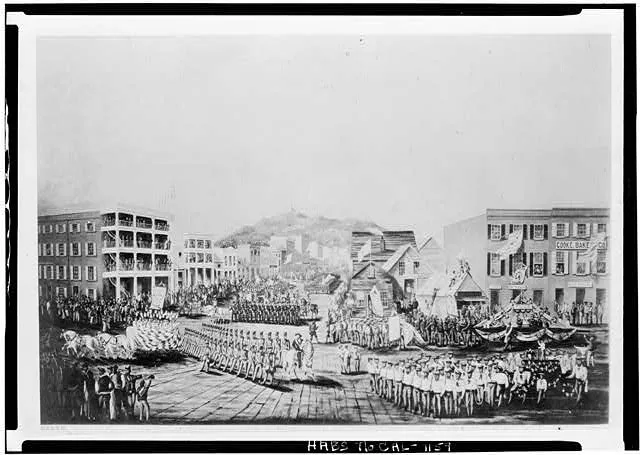
"Admission Day Celebration, Historic View, 1850, Montgomery & California Streets, San Francisco, San Francisco County, CA" by Historic American Buildings Survey / Library of Congress.
In 1850, California became the 31st state in the United States. California joined the Union quickly and did not become a territory first. Many important events led to this fast change.
In 1848, gold was discovered at Sutter’s Mill in California. News of gold spread quickly across the country. Soon, thousands of people traveled west. This was called the California Gold Rush. People came from all over the United States and even other countries. They wanted to find gold and become rich. Towns grew quickly. The population of California grew from about 15,000 to over 100,000 in just a few years.
With so many people moving in, California needed laws and a government. The people held a meeting called a convention. They decided to write a constitution. They also voted that California should not allow slavery. Many people in the United States were arguing about slavery at this time.
The government in Washington, D.C. was having a hard time. Some states in the South wanted slavery to be allowed everywhere. States in the North did not want slavery to spread. This argument was called the slavery debate. California’s choice to be a free state caused more debate.
In 1850, Congress passed a set of laws called the Compromise of 1850. This compromise made it possible for California to become a state. The compromise let California join as a free state. At the same time, the government created new rules to keep peace between the North and South.
California skipped being a territory because it had so many people and needed a government fast. Most other states became territories first, then waited to become states. But California’s population and gold made it urgent to join the Union quickly.
California’s statehood was important to the United States. It showed how fast the country was growing. It also showed how people could solve big problems by working together.
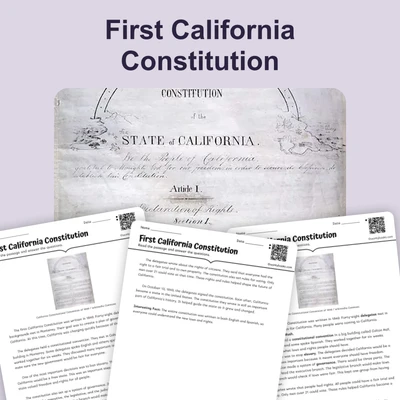
Interesting Fact: California’s first constitution was written in both English and Spanish, because so many people spoke Spanish at that time.
Comprehension quiz (8 questions)
1. When did California become a state?
2. What was found at Sutter’s Mill?
3. How did California's population change?
4. Why did California skip being a territory?
5. What is a free state?
6. What was the Compromise of 1850?
7. California joined the Union in 1850. True or false?
8. What does 'constitution' mean in the passage?
Perfect for the way you teach
- Build comprehension skills
- Auto-graded quiz
- Differentiated reading
- Read together at home
- Improve fluency
- Quiet reading time
- Reading curriculum support
- Independent practice
- Track Lexile growth