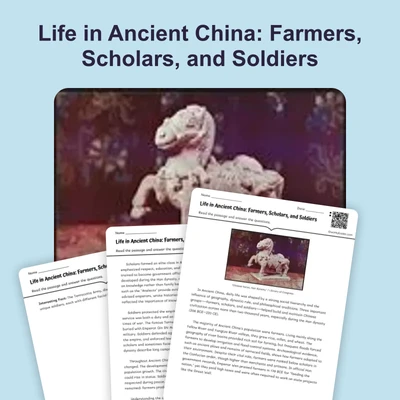
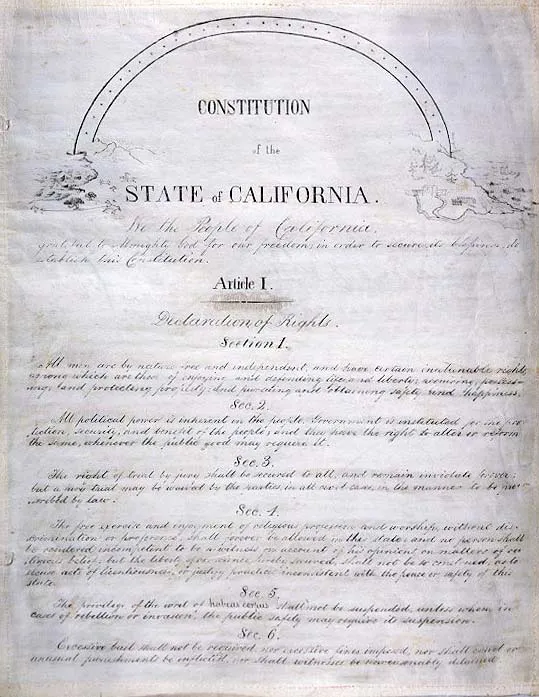
First California Constitution
Interactive passage with audio narration, comprehension questions, and printable PDF.
By completing this purchase you agree to our Terms of Use and Privacy Policy. Your subscription renews automatically until you cancel. You can cancel anytime from your account settings. All sales are final and non-refundable. Digital content is available for download in your account immediately upon purchase.
What's included
Part of this bundle

First California Constitution preview and details
About this printable First California Constitution reading passage (Grades 3-5)
Sample passage and quiz from First California Constitution
Reading passage and comprehension quiz preview
First California Constitution
California Constitutional Convention of 1849 / Wikimedia Commons
The first California Constitution was written in 1849. Forty-eight delegates from many backgrounds met in Monterey. Their goal was to create a plan of government for California. At this time, California was changing quickly because of the Gold Rush.
The delegates held a constitutional convention. They met in Colton Hall, a large building in Monterey. Some delegates spoke English and others spoke Spanish. They worked together for six weeks. They discussed many important issues. They wanted to make sure the new government would be fair for everyone.
One of the most important decisions was to ban slavery. The delegates agreed that California would be a free state. This was an important step. It showed that the new state valued freedom and rights for all people.
The constitution also set up a system of governance. It created three branches of government: the executive, the legislative, and the judicial. The executive branch would be led by a governor. The legislative branch would make laws. The judicial branch would decide if laws were fair. This system helped prevent any one group from having too much power.
The delegates wrote about the rights of citizens. They said that everyone had the right to a fair trial and to own property. The constitution also set rules for voting. Only men over 21 could vote at that time. These rights and rules helped shape the future of California.
On October 13, 1849, the delegates signed the constitution. Soon after, California became a state in the United States. The constitution they wrote is still an important part of California's history. It helped guide the state as it grew and changed.
Interesting Fact: The entire constitution was written in both English and Spanish, so everyone could understand the new laws and rights.
Comprehension quiz (8 questions)
1. When was California's first constitution written?
2. Where did the delegates meet?
3. How many delegates wrote the constitution?
4. Why did the delegates ban slavery?
5. What did the constitution set up?
6. Why was the constitution written in two languages?
7. The delegates worked together for six weeks. True or false?
8. What is a 'delegate'?
Perfect for the way you teach
- Build comprehension skills
- Auto-graded quiz
- Differentiated reading
- Read together at home
- Improve fluency
- Quiet reading time
- Reading curriculum support
- Independent practice
- Track Lexile growth