California Water Resources — Reading Comprehension
Rate this
Premium Resource
Present
Present in classroom. No work saved
Assign
Classroom with student accounts, Track progress
Quick Play
No student accounts, assign with a link
Grades
3
4
5
Standards
D2.HIS.2.3-5
D2.HIS.3.3-5
D2.GEO.1.3-5
RI.4.3
RI.4.4
W.4.2
PRINT+DIGITAL RESOURCE
This learning resource is available in interactive and printable formats. The interactive worksheet can be played online and assigned to students. The Printable PDF version can be downloaded and printed for completion by hand.
This engaging history passage explores the crucial role of water in shaping California during the Progressive Era, focusing on the late 1800s and early 1900s. Students will discover how water supported California’s rapid growth in farmland and cities, made possible by new inventions and hard work. The passage highlights key events such as the construction of aqueducts and irrigation systems, and explains how these changes helped turn California into one of America's leading farming states. Young readers will meet important historical figures, learn about problem-solving during tough times, and see the impact of water on industry and agriculture. The reading includes a glossary, timeline, comprehension quiz, writing activities, and graphic organizers, all aligned to C3 and Common Core standards. Read aloud audio and Spanish translation are included to support all learners. This resource is perfect for building historical understanding and literacy skills while exploring the themes of innovation, teamwork, and perseverance.
CONTENT PREVIEW
Expand content preview
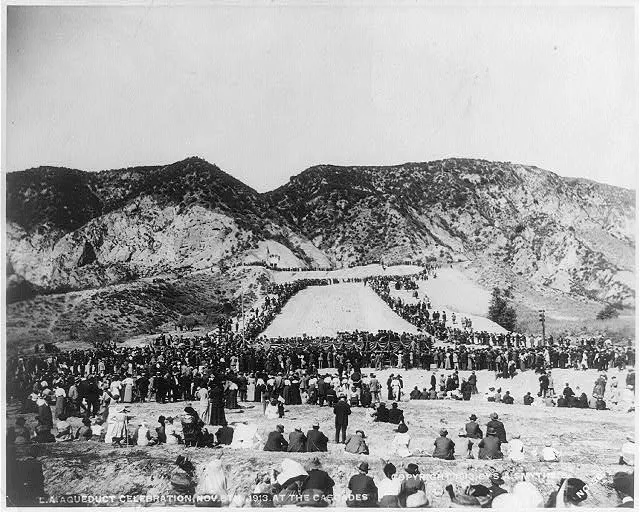
L. A. Aqueduct celebration, Nov. 5th, 1913. at the Cascades. Source: Library of Congress - Smythe, S. A.
California is a state where water is not always easy to find. Much of California is dry, with deserts and valleys that do not get much rain. But the state is also famous for its rich farmland and large cities. To grow crops and support millions of people, California needed a way to move water from where it was plentiful to where it was needed most.
In the early 1900s, leaders and engineers began building huge projects to bring water to dry areas. These projects included long aqueducts—large pipes or channels that carry water over great distances. The Los Angeles Aqueduct was finished in 1913 and carried water from the distant Sierra Nevada Mountains to the city of Los Angeles. This helped the city grow quickly and become one of the largest in the country.
Water was also needed for farming. California’s Central Valley became one of the most important farming areas in the world. To support all the crops, farmers used irrigation—the process of bringing water to fields. Ditches, canals, and pumps delivered water to places where it did not naturally flow. This allowed farmers to grow fruits, vegetables, and nuts even in dry seasons.
But moving water across California was not easy. It required careful planning and teamwork. Many people had to agree on how water should be shared between cities, farms, and nature. Leaders set up water management programs to keep track of how much water was used and to make sure everyone had enough. Sometimes, there were arguments and controversies about who should get the water first.
These huge projects changed California. Cities grew, farms thrived, and the state became a leader in agriculture. But there were also challenges. Moving so much water changed rivers and lakes, and sometimes harmed wildlife. People learned that water is one of the most important and debated resources in the state.
California’s story shows how people can solve big problems by working together, using new ideas, and respecting the land. The struggle to control water made California stronger and taught important lessons about sharing and caring for natural resources.
Interesting Fact: The Los Angeles Aqueduct is over 200 miles long—about the distance from Los Angeles to San Diego!
When was the Los Angeles Aqueduct finished?
1913190019201950
Why did California need aqueducts?
To bring water to dry placesTo build new roadsTo grow tall treesFor gold mining
Where did the aqueduct bring water from?
The Sierra Nevada MountainsThe Pacific OceanSan Francisco BayCentral Valley
What is irrigation used for?
Bringing water to cropsBuilding housesMaking roadsFeeding animals
How did moving water help California?
Cities and farms could growRivers dried upIt stopped rainPeople left the state
What was one challenge of water projects?
Deciding who got waterFinding goldGrowing forestsBuilding schools
Water is a debated resource in California. True or false?
TrueFalse
What does 'controversies' mean?
Arguments or disagreementsFun celebrationsRainy daysNew crops
Perfect For:
👩🏫 Teachers
• Reading comprehension practice
• Auto-graded assessments
• Literacy skill development
👨👩👧👦 Parents
• Reading practice at home
• Comprehension improvement
• Educational reading time
🏠 Homeschoolers
• Reading curriculum support
• Independent reading practice
• Progress monitoring
Reading Features:
📖
Reading Passage
Engaging fiction or nonfiction text
❓
Comprehension Quiz
Auto-graded questions
📊
Instant Feedback
Immediate results and scoring
📄
Printable Version
Download for offline reading
🔊
Read Aloud
Voice-over with word highlighting
Reviews & Ratings
No reviews yet. Be the first to share your experience!
Related Content
Informational Text —Healthy Teeth and Gums
RI.4.10RI.4.3RF.4.4RF.4.4.A
Informational Text —Migratory Birds
Engage young minds with this worksheet that delves into the wonders of migratory birds. Learn about their extraordinary ...
RI.4.10RI.4.3RF.4.4RF.4.4.A
Natural Disasters and Urban flooding
This reading comprehension worksheet focuses on the topic of natural disasters, specifically urban flooding. Following t...
RI.4.44-ESS3ESS3.B4-ESS3-1
The Formation of Fossils
L.4.2.DL.4.6RI.4.4
Climate and Water Cycle
W.4.2.ARI.4.4RI.4.1
Ocean Acidification
Download this reading comprehension worksheet about ocean acidification. The worksheet includes an informational text ab...
RI.4.4
Understanding Climate Action Context Clues
Understanding Climate Action" worksheet, aligned with CCS L.4.4.A and NGSS. This resource introduces key concepts such a...
L.4.4.ARI.4.1RI.4.4
Informational Text —The History of Toothpaste
RI.4.4RI.4.4
Informational Text —All About Dentists
Students read an informational text explaining what dentists do and how they are trained. Aligned to RI.4.3-2
RI.4.10RI.4.3RF.4.4RF.4.4.A
The Role of Pollinators in Nature
Learn about the fascinating world of pollinators and discover their crucial role in the reproductive process of flowerin...
RI.4.2RI.4.3RI.4.4RI.5.1
Pollination: A Crucial Ecosystem Service
Explore the vital role of pollination beyond plant reproduction, as it sustains ecosystems by ensuring food security, pr...
RI.4.2RI.4.3RI.4.4RI.5.1
Seed Dispersal: How Plants Travel
Plants may seem stationary, but their seeds have amazing ways to travel! Explore the fascinating world of seed dispersal...
RI.4.2RI.4.3RI.4.4RI.5.1
The States of Matter: Solid
Discover the differences between solids, liquids and gases by exploring how their particles are arranged and move. This ...
RI.4.2RI.4.3RI.4.4RI.5.1
What is a Simple Machine
Discover the power of simple machines! This informational text explores how basic tools like levers, pulleys and incline...
RI.4.2RI.4.3RI.4.4RI.5.1
The Life Cycle of a Salmon
Salmon have a remarkable life cycle that takes them from rivers to the ocean and back again. They hatch as alevin, grow ...
RI.3.1RI.4.4RI.4.2
Journey of a Sea Turtle
Sea turtles lay their eggs on beaches, and their hatchlings begin a dangerous journey to the ocean. After growing in the...
RI.3.1RI.4.4RI.4.2
Heroes for Freedom: Harriet Tubman
Harriet Tubman, born into slavery, became a hero who risked her life to lead others to freedom through the Underground R...
RI.3.1RI.4.4RI.4.2RI.5.2
Heroes for Freedom: Fannie Lou Hamer
Fannie Lou Hamer overcame racial segregation and poverty to become a powerful voice for civil rights. Her fight for voti...
RI.3.1RI.4.4RI.4.2RI.5.2
Sports: Lionel Messi
Lionel Messi, known for his unparalleled dribbling and passing, has broken records, won multiple FIFA Ballon d'Or awards...
RI.3.1RI.4.4RI.4.2RI.5.2
Natural Disaster: Droughts
Droughts are long periods with insufficient water, leading to crop failures and water shortages. Conserving water and pl...