This learning resource is available in interactive and printable formats. The interactive worksheet can be played online and assigned to students. The Printable PDF version can be downloaded and printed for completion by hand.
This engaging history reading passage covers the Bear Flag Revolt, a pivotal moment during Westward Expansion when American settlers in California declared independence from Mexico in 1846. Aligned with standards HSS 4.3.5 and RH.6-8.1, the passage details the events, key figures, and outcomes of the rebellion in Sonoma. Students will explore the causes and effects of the revolt and learn how it contributed to California becoming an American state. The resource includes a glossary, timeline, multiple-choice quiz, writing prompts, graphic organizers, and accessible Spanish translation. A read aloud audio option supports diverse learners. This comprehensive package helps students build historical understanding and literacy skills while meeting history and literacy standards.
CONTENT PREVIEW
Expand content preview
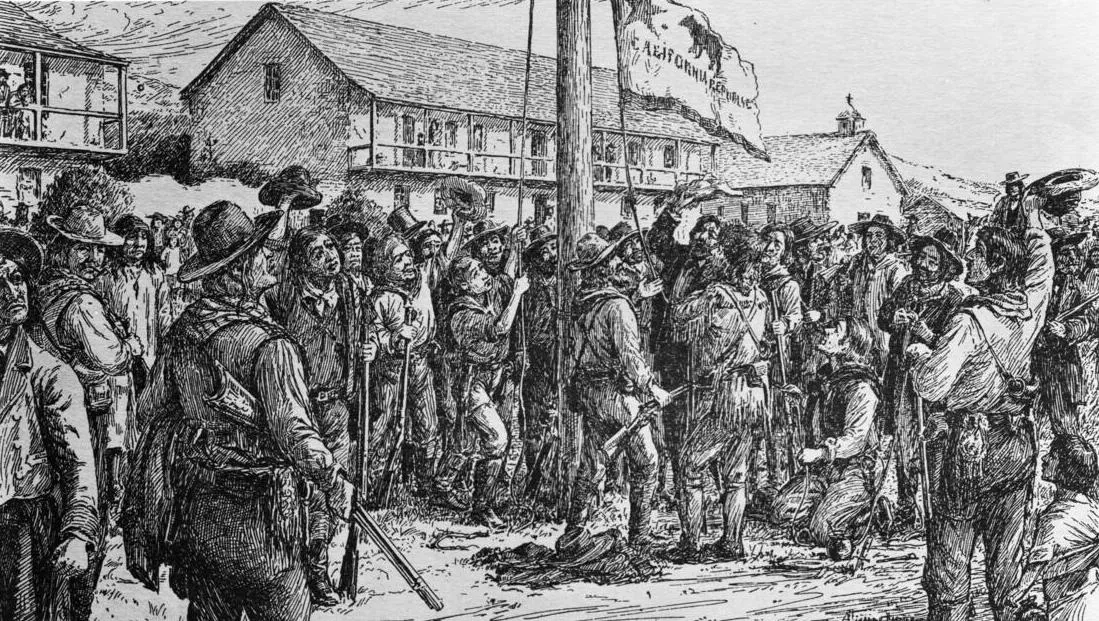
"Raising of the Bear Flag over Sonoma, June 14, 1846" by Charlies Pierce / Wikimedia Commons
The Bear Flag Revolt took place in June 1846 in the town of Sonoma, California. At that time, California was controlled by Mexico. Many American settlers had moved into California, hoping for new land and a better life. Tensions grew between the settlers and the Mexican government.
Some settlers felt that the Mexican leaders did not treat them fairly. They were worried that they might lose their land. In response, a small group of American settlers decided to take action. On June 14, 1846, about 30 settlers gathered in Sonoma. They captured the Mexican commander, General Mariano Vallejo, without a fight. The settlers then raised a homemade flag with a star and a grizzly bear on it. This became known as the Bear Flag.
The rebellion did not last long. The settlers declared California to be an independent republic. They chose William B. Ide as their leader. For a few weeks, the Bear Flag flew over Sonoma. People in other parts of California heard about the revolt. Some joined the cause, and others watched to see what would happen next.
Soon after, news arrived that the United States and Mexico had gone to war. U.S. Navy forces landed in California. The American flag replaced the Bear Flag in Sonoma. The Bear Flag Revolt had helped show that many settlers wanted California to be part of the United States.
After the revolt, California became a U.S. territory. Just a few years later, in 1850, California became the 31st state. The Bear Flag became a symbol of California’s history and is still seen on the state flag today.
The Bear Flag Revolt is remembered for the courage and determination shown by a small group of settlers. Their actions helped change the future of California.
Interesting Fact: The original Bear Flag was destroyed in the 1906 San Francisco earthquake and fire.
When did the Bear Flag Revolt happen?
June 1846July 1776May 1848April 1850
Where did the revolt start?
SonomaLos AngelesSan FranciscoSacramento
Who was captured by the settlers?
General VallejoWilliam B. IdeJames MarshallJohn Sutter
Why did settlers start the revolt?
Unfair treatmentGold discoveryNew railroadDrought
What flag did the settlers raise?
Bear FlagAmerican FlagMexican FlagBritish Flag
What happened after the U.S. Navy arrived?
American flag replaced Bear FlagSettlers left SonomaGold was foundNew country formed
California is still part of Mexico. True or false?
FalseTrue
What does 'rebellion' mean?
Fight against leadersA type of animalA new stateA law
Perfect For:
👩🏫 Teachers
• Reading comprehension practice
• Auto-graded assessments
• Literacy skill development
👨👩👧👦 Parents
• Reading practice at home
• Comprehension improvement
• Educational reading time
🏠 Homeschoolers
• Reading curriculum support
• Independent reading practice
• Progress monitoring
Reading Features:
📖
Reading Passage
Engaging fiction or nonfiction text
❓
Comprehension Quiz
Auto-graded questions
📊
Instant Feedback
Immediate results and scoring
📄
Printable Version
Download for offline reading
🔊
Read Aloud
Voice-over with word highlighting
Reviews & Ratings
No reviews yet. Be the first to share your experience!
Related Content
California Statehood 1850
This engaging U.S. history passage explores the rapid path to statehood for California in 1850. Students will learn how ...
HSS 4.3.5RH.6-8.4
First California Constitution
This engaging history reading passage explores the creation of the First California Constitution in 1849, a pivotal even...
HSS 4.3.5RH.6-8.1
Africans and Filipinos in Early California
This history reading passage explores the important role of Africans and Filipinos in early California. Long before the ...
HSS 4.2.1RH.6-8.1
California Forty-Niners
This history reading passage explores the story of the California Forty-Niners, who rushed to California in 1849 in sear...
HSS 4.4.2RH.6-8.1
California Chinese Miners
This engaging history reading passage explores the experiences of Chinese miners during the California Gold Rush and Wes...
HSS 4.4.3RH.6-8.1
Effects of the Gold Rush
This engaging U.S. History reading passage explores the effects of the Gold Rush on California and the United States. Al...
HSS 4.4.4RH.6-8.1
Golden Spike 1869
This history reading passage explores the 1869 Golden Spike event that marked the completion of America's Transcontinent...
HSS 4.4.1RH.6-8.1
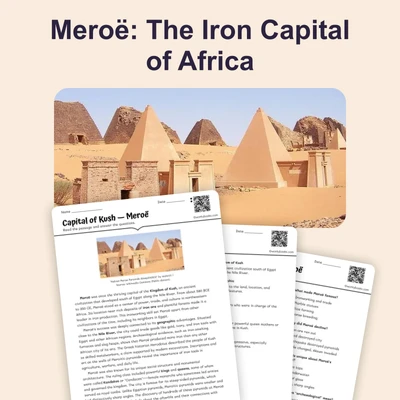
Meroë: Capital of Kush
This passage explores the rise and significance of Meroë, once the capital of the Kingdom of Kush in ancient Africa. Loc...
CA HSS 6.2.6RH.6-8.1RH.6-8.2WHST.6-8.2
Egypt Kush Trade
This engaging history reading passage explores the complex trade networks that connected Ancient Egypt, Kush, and region...
6.2.3RH.6-8.1RH.6-8.4RH.6-8.7
First Humans
This engaging history reading passage explores the evolution of early humans, tracing the journey from the earliest homi...
CA HSS 6.1RH.6-8.1RH.6-8.2W.6.2
Ancient Egyptian Afterlife
This engaging history reading passage explores ancient Egyptian beliefs about the afterlife and the construction of the ...
CA HSS 6.2RH.6-8.1RH.6-8.4
Han Dynasty: Seismograph
Discover the groundbreaking invention of the seismograph during the Han dynasty in ancient China in this engaging histor...
HSS 6.6.7RH.6-8.1RH.6-8.2WHST.6-8.2
Paleolithic Migration by Land and Sea
This passage explores the migration of Paleolithic humans from Africa to the rest of the world, focusing on the routes t...
6.1RH.6-8.1RH.6-8.2RH.6-8.4
Origins of Social Classes
This engaging history reading passage explores how the rise of farming and the spread of pastoral nomads across the Eura...