This learning resource is available in interactive and printable formats. The interactive worksheet can be played online and assigned to students. The Printable PDF version can be downloaded and printed for completion by hand.
This reading passage on Chemical Bonds provides middle school students with a clear explanation of how and why atoms connect to form molecules and compounds. Aligned with NGSS standard MS-PS1-1 (Develop models to describe atomic composition of simple molecules) and PS1.A (Structure and Properties of Matter), the content uses a structured approach with informative headings to organize key concepts. The passage first introduces chemical bonds as forces holding atoms together, then explores three main bond types: ionic bonds (complete electron transfer between unlike atoms), covalent bonds (electron sharing between similar atoms), and hydrogen bonds (weaker connections involving hydrogen). Real-world examples like table salt and water make abstract concepts concrete. This resource falls within Science→Physical Science→Chemical Reactions and uses straightforward language to help students understand how different bonding patterns determine the physical and chemical properties of substances they encounter daily.
CONTENT PREVIEW
Expand content preview
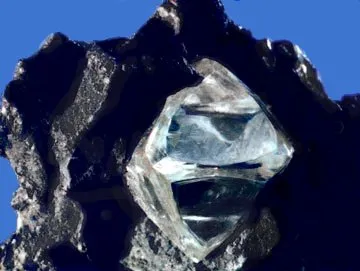
"Rough diamond" / U.S. Geological Survey / Wikimedia Commons.
What is a Chemical Bond?
A chemical bond is the force that holds atoms together in molecules and compounds. Think of it as the "glue" that connects atoms to each other. When atoms join together through chemical bonds, they create more stable arrangements than they would have on their own.
Types of Chemical Bonds
Ionic Bonds
Ionic bonds form when one atom completely transfers electrons to another atom. This happens between atoms that have very different properties - usually a metal and a non-metal. When an atom loses electrons, it becomes a positively charged ion. When an atom gains electrons, it becomes a negatively charged ion. These opposite charges attract each other strongly, creating an ionic bond. Table salt (sodium chloride) is a classic example, where sodium atoms donate electrons to chlorine atoms.
Covalent Bonds
Covalent bonds form when atoms share electrons rather than transferring them. This typically happens between non-metal atoms. By sharing electrons, both atoms can fill their outer electron shells and become more stable. Water (H₂O) is a perfect example, where oxygen shares electrons with two hydrogen atoms.
Hydrogen Bonds
Hydrogen bonds are weaker connections that form when a hydrogen atom bonded to a highly electronegative atom (like oxygen or nitrogen) is attracted to another electronegative atom. Though individually weak, many hydrogen bonds together can be quite strong. These bonds give water its unique properties and help shape proteins and DNA.
Why Chemical Bonds are Important
Chemical bonds determine the properties of substances - whether something is a gas, liquid, or solid; whether it conducts electricity; how it reacts with other substances; and even its color and odor. Everything from the air we breathe to the materials in our homes exists because of these different types of atomic connections.
Fun fact: The reason diamonds are so hard while graphite (pencil lead. is so soft comes down to chemical bonds. Both are made entirely of carbon atoms, but in diamonds, each atom forms strong bonds in a rigid 3D structure, while in graphite, the atoms form strong bonds in flat sheets with weak connections between layers, allowing them to slide apart easily when you write!
What is a chemical bond?
A type of moleculeThe force that holds atoms togetherA charged particleThe center of an atom
Which type of bond involves the complete transfer of electrons?
Covalent bondHydrogen bondIonic bondMetallic bond
In a covalent bond, atoms:
Transfer electronsShare electronsRepel each otherChange into different elements
Which substance is an example of ionic bonding?
Water (H₂O)Table salt (NaCl)Carbon dioxideDNA
Hydrogen bonds are typically:
The strongest type of chemical bondOnly found in waterWeaker than ionic and covalent bondsFound only between metals
Chemical bonds determine all of the following EXCEPT:
Whether a substance is solid, liquid, or gasThe number of protons in an atomHow a substance reacts with other substancesWhether a substance conducts electricity
The word "electronegative" in the passage most likely refers to:
Atoms that easily lose electronsAtoms that strongly attract electronsAtoms with no electrical chargeElectrons with negative charges
According to the passage, why do atoms form chemical bonds?
To become more stableTo create new elementsTo increase their atomic numberTo release energy
Perfect For:
👩🏫 Teachers
• Reading comprehension practice
• Auto-graded assessments
• Literacy skill development
👨👩👧👦 Parents
• Reading practice at home
• Comprehension improvement
• Educational reading time
🏠 Homeschoolers
• Reading curriculum support
• Independent reading practice
• Progress monitoring
Reading Features:
📖
Reading Passage
Engaging fiction or nonfiction text
❓
Comprehension Quiz
Auto-graded questions
📊
Instant Feedback
Immediate results and scoring
📄
Printable Version
Download for offline reading
🔊
Read Aloud
Voice-over with word highlighting
Reviews & Ratings
No reviews yet. Be the first to share your experience!
Related Content
Atomic Structure
This reading passage on Atomic Structure provides middle school students with an accessible explanation of the fundament...
MS-PS1-1RI.6.3RI.7.1
Parts of an Atom
This reading passage on Parts of an Atom provides middle school students with a structured and accessible explanation of...
MS-PS1-1RI.6.3RI.7.1
The Freezing Point of Water
This science reading passage, titled 'The Freezing Point of Water', introduces students to a key physical science concep...
MS-PS1-1RI.6.3RI.7.1
Physical Properties of Matter
This comprehensive reading passage introduces grades 6-8 students to the concept of physical properties of matter, perfe...
MS-PS1-1
Mixtures and Pure Substances
This middle school science passage provides an in-depth exploration of mixtures and pure substances, directly aligned to...
MS-PS1-1
Types of Mixtures
This comprehensive science passage for grades 6-8 introduces students to the concept of mixtures, focusing on distinguis...
MS-PS1-1
Solutions, Suspensions, and Colloids
This comprehensive science passage explores the differences between solutions, suspensions, and colloids, focusing on ho...
MS-PS1-1
The Nature of Science
This passage explores the nature of science for middle school students, aligning with NGSS standards MS-ETS1-4, MS-PS1-1...
MS-ETS1-4MS-PS1-1MS-LS1-1
Scientific Theories
This reading passage for grades 6-8 introduces students to the concept of scientific theories, emphasizing that these ar...
MS-PS1-1MS-PS1-4MS-PS3-4SCIENCE AND ENGINEERING PRACTICES
Particle Model of Matter
This comprehensive science reading passage for grades 6-8 explores the particle model of matter, aligning with NGSS stan...
MS-PS1-1MS-PS1-4
Valence Electrons
This middle school science passage introduces students to the concept of valence electrons, the outermost electrons that...
MS-PS1-1
The Idea of the Atom
This informational science passage introduces middle school students (grades 6-8) to the concept that all matter is made...
MS-PS1-1
Protons, Neutrons, and Electrons
This comprehensive middle school science passage explores the roles of protons, neutrons, and electrons, the three main ...
MS-PS1-1
What are Ions
This passage introduces middle school students to the concept of ions, explaining the processes by which atoms gain or l...
MS-PS1-1
Nucleus of the Atom
This comprehensive passage for grades 6-8 introduces students to the nucleus of the atom, the dense center that contains...
MS-PS1-1
How Atoms Differ
This middle school science reading passage, aligned with NGSS standard MS-PS1-1, explores the fundamental differences am...
MS-PS1-1
Isotopes
This middle school science passage explores the concept of isotopes, which are atoms of the same element with different ...
MS-PS1-1
Compounds vs. Mixtures
This educational passage for grades 6-8 explores the fundamental differences between compounds and mixtures, aligning wi...
MS-PS1-1
Organizing the Elements
This passage for middle school science explores how scientists organized the elements as more were discovered, leading t...