This learning resource is available in interactive and printable formats. The interactive worksheet can be played online and assigned to students. The Printable PDF version can be downloaded and printed for completion by hand.
This U.S. History passage explores the 1955 murder of Emmett Till and how it became a catalyst for the Civil Rights Movement. Students will learn about the causes, events, multiple perspectives, and consequences of this pivotal moment, analyzing historical evidence and a primary source quote. The passage is designed to help students develop historical reasoning, comprehension, and vocabulary skills while meeting C3 Framework and Common Core standards (D2.His.2.3-5, D2.His.3.3-5, RI.4.3, RI.4.4, W.4.2). Activities include a multiple-choice quiz, explanatory writing prompts, a T-Chart graphic organizer, and a timeline. The resource includes read aloud audio and a full Spanish translation, making it accessible for diverse learners and supporting language development alongside history content.
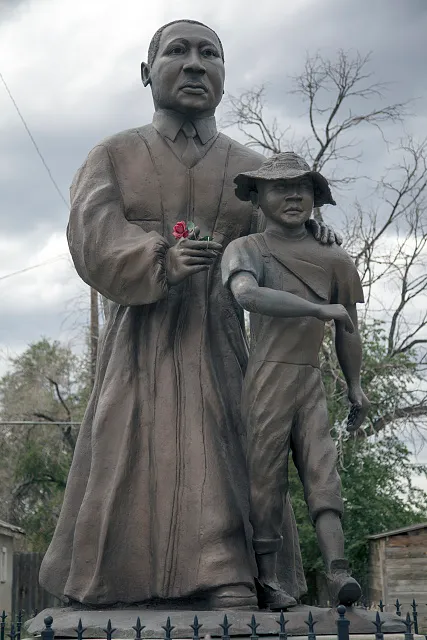
Statue of civil-rights pioneer Martin Luther King Jr. and civil-rights martyr Emmett Till at the Dr. Martin Luther King Jr. Cultural Center and Museum in Pueblo, Colorado. The museum was closed and its artifacts placed in storage one year after this photo was taken. Source: Library of Congress - Highsmith, Carol M., 1946-
In August 1955, the brutal murder of Emmett Till, a 14-year-old African American boy from Chicago, shocked the nation and became a turning point in American history. Emmett was visiting relatives in Money, Mississippi, when he was accused of whistling at a white woman in a grocery store. This accusation led to his kidnapping and murder by two white men, Roy Bryant and J.W. Milam. The case drew national attention because of the extreme violence and the public trial that followed.
The causes of Emmett Till's murder were rooted in the deep racism and segregation of the American South. During the 1950s, Jim Crow laws enforced the separation of Black and white people in public places, schools, and communities. Many white people in the South believed in white supremacy and resisted any challenge to their social order. Emmett's actions, seen as a violation of these strict racial norms, provoked a violent response. His mother, Mamie Till-Mobley, insisted on an open-casket funeral so the world could see her son's injuries. She said, "Let the world see what I’ve seen." This decision was a powerful form of protest, exposing the cruelty of racial violence.
The trial of Bryant and Milam highlighted the injustices of the legal system in Mississippi. Despite overwhelming evidence, including testimony from witnesses who saw Emmett taken from his uncle’s home, the all-white, all-male jury acquitted both men after just over an hour of deliberation. This outcome demonstrated how the justice system protected white defendants and dismissed Black victims. The verdict outraged many Americans and exposed the contradictions between American ideals of justice and the reality of racial inequality.
Reactions to Emmett Till’s murder varied across the country. African American communities, especially in the North, were horrified and deeply angered. Many white Southerners, on the other hand, defended the men or denied the severity of their actions. Some Southern newspapers even claimed that the story was exaggerated. However, the widespread publication of photographs of Emmett’s body and his mother’s courageous stand made it impossible to ignore the reality of racial violence. These images motivated many people to demand change.
The murder of Emmett Till became a catalyst for the Civil Rights Movement. Activists such as Rosa Parks and Dr. Martin Luther King, Jr. drew inspiration from the case. Rosa Parks later said that thinking about Emmett Till gave her the strength to refuse giving up her seat on a Montgomery bus. The event helped unite people across racial lines to fight for justice and equal rights. It also encouraged more Americans to question the legitimacy of segregation and discriminatory laws.
In examining the Emmett Till case, historians consider both the causes and the consequences. The murder was not an isolated act but part of a larger pattern of violence against African Americans in the South. However, the public outrage, fueled by media coverage and courageous individuals like Mamie Till-Mobley, helped transform a local tragedy into a national movement for civil rights. The case demonstrates the importance of evidence and the impact of ordinary people standing up for what is right, even when faced with great risk.
Interesting Fact: The Emmett Till murder trial was one of the first major criminal cases in U.S. history where the Black press and national media worked together to cover racial injustice in the South.