First Battle of Bull Run 1861 — Reading Comprehension
Premium Resource
Grades
6
7
8
Standards
D2.HIS.2.3-5
D2.HIS.3.3-5
RI.4.3
RI.4.4
W.4.2
PRINT+DIGITAL RESOURCE
This learning resource is available in interactive and printable formats. The interactive worksheet can be played online and assigned to students. The Printable PDF version can be downloaded and printed for completion by hand.
This passage explores the First Battle of Bull Run (1861), the first major land battle of the American Civil War. Students will analyze the causes, motivations, and consequences of this historic event while considering multiple perspectives, including Union and Confederate soldiers, commanders, and civilians. The passage uses a compare/contrast structure and integrates a primary source quote to help students develop historical reasoning and evidence-based analysis. Academic vocabulary is highlighted, and students can deepen their understanding through a glossary, timeline, multiple-choice quiz, writing activities, and a graphic organizer. This resource aligns with D2.His.2.3-5, D2.His.3.3-5, RI.4.3, RI.4.4, and W.4.2, and includes a Spanish translation and read aloud audio. Perfect for developing critical thinking and literacy skills in U.S. history classrooms.
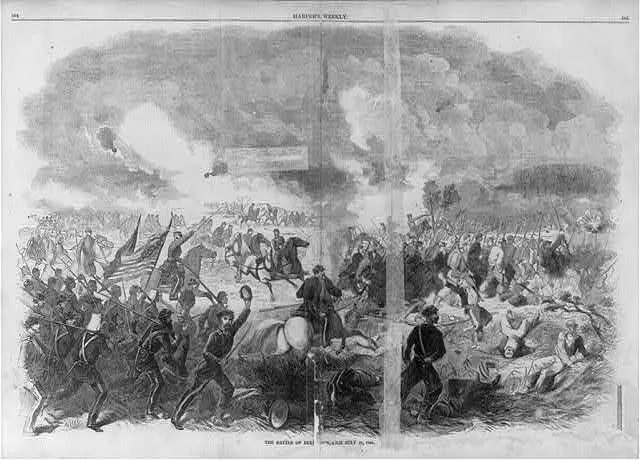
The battle of Bull Run, 2 P.M., July 21, 1861. Source: Library of Congress
The First Battle of Bull Run, fought on July 21, 1861, marked the first major land confrontation of the American Civil War. This battle, also called the First Battle of Manassas by the Confederacy, took place near Manassas, Virginia. The conflict revealed both the tensions and expectations held by the Union and Confederate sides. Both believed the war would be short and decisive, but the outcome of this battle proved otherwise.
The background of the battle involves deep division over issues such as slavery and states' rights. The Union, representing the northern states, aimed to preserve the United States as a single nation and later to end slavery. The Confederacy, made up of southern states, sought independence and the protection of their social and economic systems. In the months leading up to Bull Run, both sides rapidly assembled armies, but most soldiers were inexperienced and unprepared for large-scale warfare.
Union General Irvin McDowell was under political pressure to strike quickly and capture the Confederate capital of Richmond, Virginia. Many northern politicians believed that a quick victory would end the rebellion. Meanwhile, Confederate Generals P.G.T. Beauregard and Joseph E. Johnston sought to defend their territory and prove the South's determination. Civilians, including members of Congress, even traveled from Washington, D.C., to watch the battle, expecting an easy Union win.
The battle began with Union forces attacking Confederate positions along Bull Run Creek. At first, the Union troops pushed the Confederates back. However, the tide of battle shifted dramatically when Confederate reinforcements arrived by train—a first in military history. Confederate General Thomas J. Jackson earned the nickname "Stonewall" when his troops stood firm under fire, inspiring others. According to a soldier's letter, "There stands Jackson like a stone wall. Rally behind the Virginians!" This remark captured the turning point, as Southern forces regrouped and launched a strong counterattack.
As the Union soldiers retreated, confusion and panic spread. The disorganized withdrawal turned into a chaotic flight back toward Washington, D.C. Many soldiers and civilians realized that the war would not be quick or easy. The aftermath of the battle led both sides to reconsider their military strategies and prepare for a longer, more grueling conflict. The term "Stonewall" Jackson became a symbol of Southern resistance, while the Union recognized the need for better-trained armies.
Different perspectives on the battle highlight its complexity. Union leaders saw the defeat as a harsh lesson and a call for change in leadership and training. Confederate supporters celebrated a morale-boosting victory, but some worried about the high number of casualties and the reality of war. Civilians from both regions experienced shock and fear about the future. The battle exposed the contradiction between hopes for a short conflict and the reality of a divided nation. Historians argue that Bull Run set the stage for four years of intense struggle, shaping the course of American history.
The First Battle of Bull Run showed the importance of preparation, leadership, and public perception. The battle's consequences included increased enlistment, new military leaders, and greater awareness of the war's stakes. Ultimately, this early clash forced Americans on both sides to confront the true costs of civil war and the need for a long-term commitment to their causes.
Interesting Fact: Some of the spectators at Bull Run brought picnic baskets, not realizing how dangerous and deadly the battle would become.
When was the First Battle of Bull Run?
July 21, 1861April 12, 1861August 30, 1862May 10, 1863