From Horses to Trains
Interactive passage with audio narration, comprehension questions, and printable PDF.
By completing this purchase you agree to our Terms of Use and Privacy Policy. Your subscription renews automatically until you cancel. You can cancel anytime from your account settings. All sales are final and non-refundable. Digital content is available for download in your account immediately upon purchase.
What's included
Part of this bundle

From Horses to Trains preview and details
About this printable From Horses to Trains reading passage (Grades 3-5)
Sample passage and quiz from From Horses to Trains
Reading passage and comprehension quiz preview
From Horses to Trains
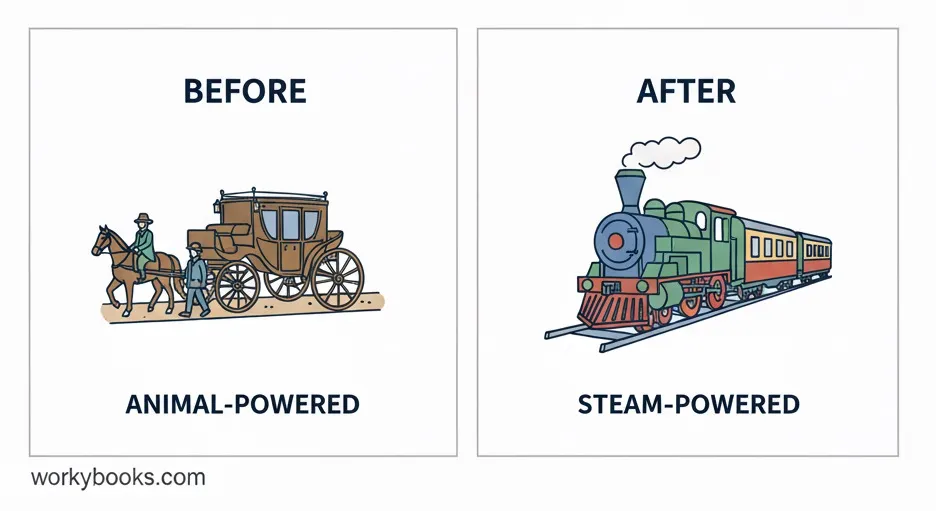
In the 1800s, travel in the United States was slow and difficult. Most people used horses or wagons to get from one place to another. Journeys could take days or even weeks. Roads were often muddy and rough. This made it hard for people and goods to move quickly across the country.
Things began to change with the transportation revolution. In the early 1800s, people wanted faster and easier ways to travel. Inventors and engineers worked on new ideas. The most important invention was the steam-powered locomotive. A locomotive is a special engine that pulls train cars on metal tracks. The first successful steam train in the United States ran in 1830. Soon, railroads began to spread across the land.
Trains were much faster than horses. A trip that once took weeks could now be finished in just a few days. For example, a journey from New York to Chicago by horse could take three weeks. By train, the same trip took less than two days. This big change in speed made it easier for people to visit family, move to new places, or get goods from far away.
The building of railroads was a huge job. Workers had to lay thousands of miles of track. They built bridges and tunnels to cross rivers and mountains. Many cities grew quickly near the railroads. Farmers could send their crops to markets far away. Factories could get raw materials faster and ship finished goods all over the country.
The transcontinental railroad was one of the biggest projects. It connected the east and west coasts of the United States. When it was finished in 1869, people could travel from coast to coast in less than a week. Before trains, this journey could take months by wagon or horseback.
The transportation revolution changed daily life. It helped people share ideas and news. It made the country feel smaller and more connected. The speed and power of trains inspired people and made them believe that anything was possible.
Interesting Fact: The first steam trains scared some people because they were loud and fast, but soon almost everyone wanted to ride them!
Comprehension quiz (8 questions)
1. What did people use before trains?
2. When did the first US steam train run?
3. What did workers build for trains?
4. Why were trains better than horses?
5. What did the transcontinental railroad connect?
6. How did trains change daily life?
7. Trains could cross the country in a week. True or false?
8. What is a locomotive?
Common Core standards for From Horses to Trains
Explain events, procedures, ideas, or concepts in a historical, scientific, or technical text, including what happened and why, based on specific information in the text.
Determine the meaning of general academic and domain-specific words or phrases in a text relevant to a grade 4 topic or subject area.
Describe the overall structure (e.g., chronology, comparison, cause/effect, problem/solution) of events, ideas, concepts, or information in a text or part of a text.
Write informative/explanatory texts to examine a topic and convey ideas and information clearly.
Perfect for the way you teach
- Build comprehension skills
- Auto-graded quiz
- Differentiated reading
- Read together at home
- Improve fluency
- Quiet reading time
- Reading curriculum support
- Independent practice
- Track Lexile growth