Navajo Code Talkers
Interactive passage with audio narration, comprehension questions, and printable PDF.
What's included
Navajo Code Talkers preview and details
About this printable Navajo Code Talkers reading passage (Grades 6-8)
Sample passage and quiz from Navajo Code Talkers
Reading passage and comprehension quiz preview
Navajo Code Talkers
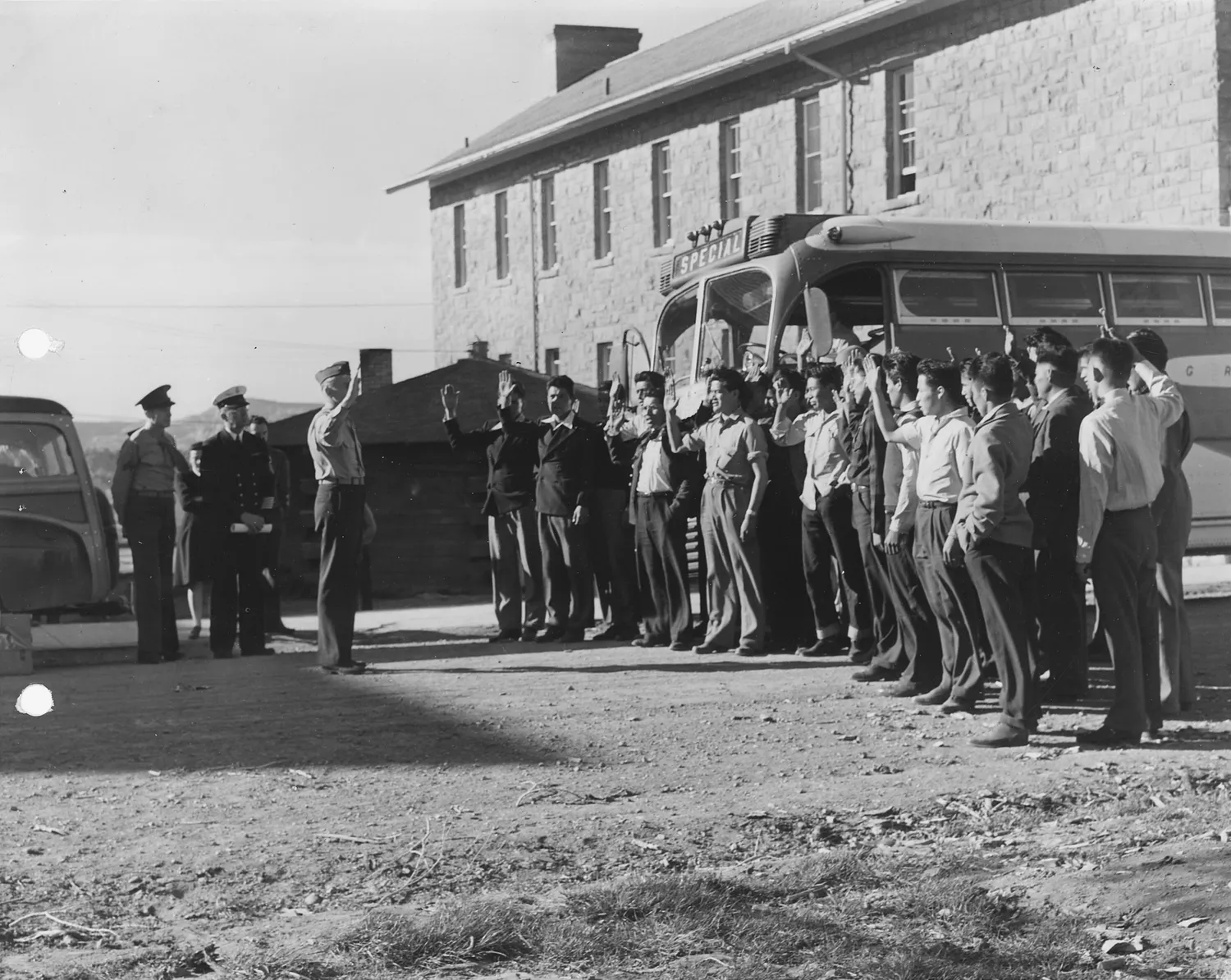
"First 29 Navajo U.S. Marine Corps code-talker recruits being sworn in at Fort Wingate" / Wikimedia Commons (Public domain).
During World War II, the United States military faced a serious problem. Enemy forces were intercepting and decoding military messages, putting American troops in danger. To solve this challenge, the U.S. Marine Corps recruited Navajo men to serve as code talkers. These men used the Navajo language, which was unfamiliar to most people outside their community, to create a new, secret way of communication on the battlefield.
The Navajo Code Talkers developed an entirely new cipher based on their language. Each word, letter, and concept was given a unique Navajo term or phrase. For example, the word 'turtle' might represent a tank, while 'chicken hawk' could mean a dive bomber. This system was extremely effective because the Navajo language was complex, unwritten, and had no direct translation in Japanese or German. As a result, the code was virtually impossible to break, even for the best enemy intelligence experts.
The Code Talkers’ contribution proved vital in major Pacific battles such as Iwo Jima and Okinawa. They sent and received thousands of messages about troop movements, supplies, and attack plans. Often, a single mistake or delay in transmission could cost lives or change the outcome of a battle. Despite this pressure, the Code Talkers worked quickly and with remarkable accuracy.
However, the use of Native American languages in the military was not without controversy. For decades, Native Americans had faced discrimination and efforts to erase their languages and cultures. Many young Navajo men had been punished in school for speaking their own language. Now, during wartime, the same language was suddenly valued for national security. This contrast highlights the complex relationship between the U.S. government and Native American communities.
The legacy of the Navajo Code Talkers is one of both pride and reflection. Their work was kept secret for many years, and most Americans did not learn about their achievements until decades after the war. In 2001, the Code Talkers finally received national recognition for their bravery and skill. Today, their story reminds us of the importance of diversity and the unexpected ways in which different cultures can shape history.
Interesting Fact: The Navajo Code was never broken during World War II, making it one of the only unbreakable codes in modern military history.
Comprehension quiz (8 questions)
1. Who were the Navajo Code Talkers?
2. What did the code use?
3. Where did Code Talkers serve?
4. Why was the code so effective?
5. How did the Code Talkers help the military?
6. Why was using the Navajo language complicated?
7. The Navajo Code was never broken.
8. What does 'legacy' mean?
Common Core standards for Navajo Code Talkers
Explain events, procedures, ideas, or concepts in a historical, scientific, or technical text, including what happened and why, based on specific information in the text.
Determine the meaning of general academic and domain-specific words or phrases in a text relevant to a grade 4 topic or subject area.
Write informative/explanatory texts to examine a topic and convey ideas and information clearly.
Perfect for the way you teach
- Build comprehension skills
- Auto-graded quiz
- Differentiated reading
- Read together at home
- Improve fluency
- Quiet reading time
- Reading curriculum support
- Independent practice
- Track Lexile growth