Neutrality Acts 1930s: Avoiding European War — Reading Comprehension
Grades
6
7
8
Standards
D2.HIS.2.3-5
D2.HIS.3.3-5
RI.4.3
RI.4.4
W.4.2
PRINT+DIGITAL RESOURCE
This learning resource is available in interactive and printable formats. The interactive worksheet can be played online and assigned to students. The Printable PDF version can be downloaded and printed for completion by hand.
This comprehensive history reading passage explores the Neutrality Acts of the 1930s and how the United States tried to avoid involvement in growing European conflicts. Students will examine the causes and motivations behind these laws, the debate between isolationism and intervention, and the consequences for U.S. foreign policy. With an analytical, compare/contrast structure, the passage integrates a real primary source excerpt and models historical reasoning, argument, and vocabulary. Aligned to C3 Framework (D2.His.2.3-5) and Common Core (RI.4.3, W.4.2), this resource includes a glossary, timeline, reading comprehension quiz, writing activities, graphic organizer, and a Spanish translation. Read aloud audio supports diverse learners. Perfect for classrooms exploring U.S. responses to European crises before World War II.
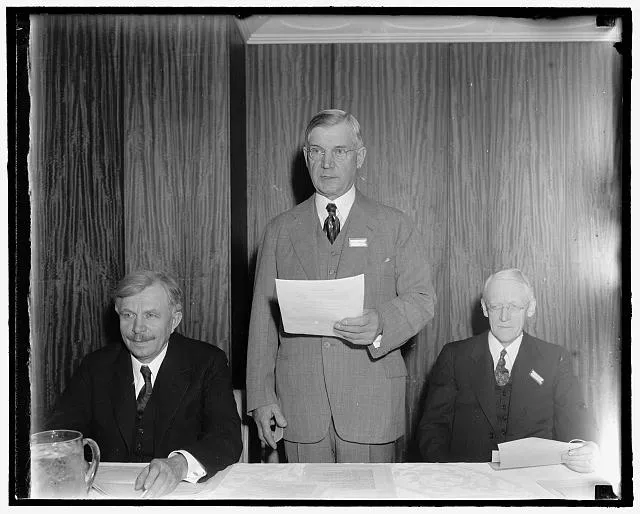
"Discuss America's foreign policy. Washington, D.C., April 15. In an effort to give impetus to the movement for revision of the Neutrality Act, an emergency conference of one hundred today assembled in Washington for a two-day discussion of American Foreign Policy. The meeting is being held under the auspices of the American Union for Concerted Pace Efforts. In the picture, left to right. James T. Shotwell, President, League of Nations Association - Rev. Roy M. Houghton, Congregational Church of New Haven, Conn., and Ernest Wilkins, President of Oberlin College, 4-15-39" by Harris & Ewing / Library of Congress.
The Neutrality Acts were a series of laws passed by the United States Congress in the 1930s to prevent the nation from being drawn into another European war. After the devastation of World War I, many Americans believed that the country should avoid foreign entanglements and focus on domestic problems like the Great Depression. This desire for isolationism became a powerful force in politics, shaping America's foreign policy during a time of growing threats in Europe and Asia.
At the heart of the Neutrality Acts was a problem: how could the United States stay out of wars that did not directly threaten its own security, while still upholding international responsibilities? Lawmakers debated whether the U.S. should take a moral stand against aggressive nations like Nazi Germany and Fascist Italy, or whether the risks of involvement were simply too great. Many people remembered how economic ties and alliances had drawn the U.S. into World War I. To address this, Congress passed the first Neutrality Act in 1935, which made it illegal to sell arms or provide loans to countries at war. This law aimed to keep America neutral even if other nations pressured it to help.
President Franklin D. Roosevelt, however, saw dangers in taking a strict neutral stance. He worried that the laws might actually help aggressors by limiting support to their victims. In a 1937 speech, Roosevelt warned, "When an epidemic of physical disease starts to spread, the community approves and joins in a quarantine of the patients to protect the health of the community against the spread of the disease." By comparing aggressive nations to a disease, Roosevelt argued that sometimes collective action was necessary to stop the spread of war. His point of view clashed with those in Congress who feared any step toward involvement.
Supporters of the Neutrality Acts believed these laws would protect American soldiers and resources. They argued that the U.S. had been tricked into World War I by business interests and propaganda. Critics, however, pointed out that neutrality could have unintended consequences. For example, when Italy invaded Ethiopia in 1935, the law prevented the U.S. from helping the victim, but did not stop oil shipments that fueled the Italian military. This contradiction showed how neutrality could sometimes favor the aggressor rather than the victim.
As the 1930s progressed, conflicts in Europe and Asia grew worse. Germany invaded neighboring countries, and Japan attacked China. The U.S. government revised the Neutrality Acts several times, allowing certain sales of weapons to nations fighting aggression, but only if they paid cash and transported the goods themselves. This "cash-and-carry" policy was a compromise between complete isolation and open support. It also revealed the tension between America's desire to remain uninvolved and its growing recognition that world events could not be ignored forever.
By 1939, with World War II underway, the limits of the Neutrality Acts became clear. The U.S. began to shift its policies, preparing to help its allies while still avoiding direct combat. The Neutrality Acts ultimately reflected the complex debate over America's role in the world: should it act only in self-interest, or should it defend international peace and justice?
Interesting Fact: President Roosevelt sometimes found creative ways to work around the Neutrality Acts, such as sending old military supplies to allies or using "lend-lease" agreements in 1941 to help Britain without declaring war.
What year was the first Neutrality Act passed?
1935194119291918
Which country invaded Ethiopia in 1935?
ItalyGermanyFranceJapan
Who was U.S. President during the Neutrality Acts?
Franklin D. RooseveltHarry TrumanWoodrow WilsonHerbert Hoover
Why did Congress pass the Neutrality Acts?
To avoid foreign warsTo support alliesTo expand U.S. territoryTo increase trade
What was the 'cash-and-carry' policy?
Sell arms if paid cashSend free weaponsNo contact with EuropeStop all exports
What did critics say about neutrality?
It could help aggressorsIt always stops warIt makes U.S. richerIt increases alliances
The U.S. never changed its Neutrality Acts. True or false?
TrueFalse
What does 'isolationism' mean?
Avoiding involvement abroadMaking new friendsStarting warsTrading with everyone
Perfect For:
👩🏫 Teachers
• Reading comprehension practice
• Auto-graded assessments
• Literacy skill development
👨👩👧👦 Parents
• Reading practice at home
• Comprehension improvement
• Educational reading time
🏠 Homeschoolers
• Reading curriculum support
• Independent reading practice
• Progress monitoring
Reading Features:
📖
Reading Passage
Engaging fiction or nonfiction text
❓
Comprehension Quiz
Auto-graded questions
📊
Instant Feedback
Immediate results and scoring
📄
Printable Version
Download for offline reading
🔊
Read Aloud
Voice-over with word highlighting
Related Content
Informational Text —Healthy Teeth and Gums
RI.4.10RI.4.3RF.4.4RF.4.4.A
Natural Disasters and Urban flooding
This reading comprehension worksheet focuses on the topic of natural disasters, specifically urban flooding. Following t...
RI.4.44-ESS3ESS3.B4-ESS3-1
The Formation of Fossils
L.4.2.DL.4.6RI.4.4
Climate and Water Cycle
W.4.2.ARI.4.4RI.4.1
Ocean Acidification
Download this reading comprehension worksheet about ocean acidification. The worksheet includes an informational text ab...
RI.4.4
Informational Text —The History of Toothpaste
RI.4.4RI.4.4
Informational Text —Migratory Birds
Engage young minds with this worksheet that delves into the wonders of migratory birds. Learn about their extraordinary ...
RI.4.10RI.4.3RF.4.4RF.4.4.A
Informational Text —All About Dentists
Students read an informational text explaining what dentists do and how they are trained. Aligned to RI.4.3-2
RI.4.10RI.4.3RF.4.4RF.4.4.A
Understanding Climate Action Context Clues
Understanding Climate Action" worksheet, aligned with CCS L.4.4.A and NGSS. This resource introduces key concepts such a...
L.4.4.ARI.4.1RI.4.4
Pollination: A Crucial Ecosystem Service
Explore the vital role of pollination beyond plant reproduction, as it sustains ecosystems by ensuring food security, pr...
RI.4.2RI.4.3RI.4.4RI.5.1
The States of Matter: Solid
Discover the differences between solids, liquids and gases by exploring how their particles are arranged and move. This ...
RI.4.2RI.4.3RI.4.4RI.5.1
What is a Simple Machine
Discover the power of simple machines! This informational text explores how basic tools like levers, pulleys and incline...
RI.4.2RI.4.3RI.4.4RI.5.1
The Role of Pollinators in Nature
Learn about the fascinating world of pollinators and discover their crucial role in the reproductive process of flowerin...
RI.4.2RI.4.3RI.4.4RI.5.1
Seed Dispersal: How Plants Travel
Plants may seem stationary, but their seeds have amazing ways to travel! Explore the fascinating world of seed dispersal...
RI.4.2RI.4.3RI.4.4RI.5.1
Sunspots and Solar Flares
This quiz is designed to test your understanding of the fascinating phenomena of sunspots and solar flares, as described...
RI.4.1RI.4.4RI.5.1ESS1.A
Learn about the Inner Planets
The inner planets of our solar system—Mercury, Venus, Earth, and Mars—are fascinating worlds made of rock and metal. Clo...
RI.4.4RI.4.2
The Sun: Our Nearest Star
The Sun is the heart of our solar system and the closest star to Earth. Composed of hot plasma, the Sun generates energy...
RI.4.4RI.4.2
Exploring Space: Rockets and Spacecraft
Space exploration has been one of humanity's greatest achievements, made possible by rockets and spacecraft. Rockets act...
RI.4.4RI.4.2
Understanding the Inner Planets
The inner planets of the solar system—Mercury, Venus, Earth, and Mars—are known for their solid, rocky surfaces. Mercury...
RI.4.4RI.4.2
The Sun: Our Special Star
The Sun is the closest star to Earth and the center of our solar system.