Thomas Jefferson and Slavery: Revolutionary Contradiction — Reading Comprehension
Premium Resource
Grades
6
7
8
Standards
D2.HIS.2.3-5
D2.HIS.3.3-5
RI.4.3
RI.4.4
W.4.2
PRINT+DIGITAL RESOURCE
This learning resource is available in interactive and printable formats. The interactive worksheet can be played online and assigned to students. The Printable PDF version can be downloaded and printed for completion by hand.
This passage examines the complex and contradictory relationship between Thomas Jefferson, a key author of the Declaration of Independence, and the institution of slavery in the United States. Students will analyze Jefferson's revolutionary ideals and his personal actions, using historical reasoning and evidence to uncover multiple perspectives on this period. The passage addresses causes, motivations, and consequences, and weaves in a primary source quote to model evidence-based analysis. Activities include a reading comprehension quiz, writing prompts, a graphic organizer, and a timeline of key events. A glossary is provided for academic vocabulary, and the passage is available in Spanish translation. This resource aligns with D2.His.2.3-5, D2.His.3.3-5, RI.4.3, RI.4.4, W.4.2, supporting both history and ELA standards. Read aloud audio is also available, making it accessible for diverse learners.
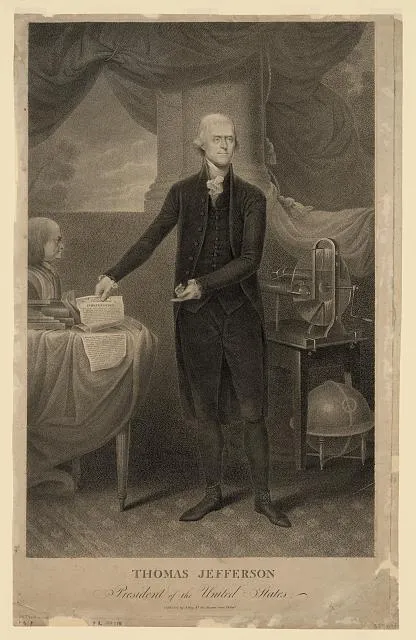
Thomas Jefferson, President of the United States. Source: Library of Congress - Tiebout, Cornelius, 1777-1832
Thomas Jefferson, the third President of the United States and author of the Declaration of Independence, played a vital role in shaping the new nation. However, Jefferson’s personal life and beliefs about slavery reveal a powerful contradiction at the heart of the American Revolution. While Jefferson wrote that “all men are created equal,” he himself owned hundreds of enslaved people throughout his life. This contrast between his words and actions sparked debate during his lifetime and continues to challenge historians today.
Jefferson was born in Virginia in 1743, into a wealthy family that depended on enslaved labor. Slavery was a central part of Virginia’s economy and society. As a young man, Jefferson inherited around 175 enslaved people from his father and later acquired even more. The plantation system, which relied on people forced to work without pay or freedom, provided Jefferson and other landowners with great prosperity. Yet, Jefferson also became a leader in the movement for independence from Britain. In 1776, he wrote the Declaration of Independence, stating that everyone had the right to “life, liberty, and the pursuit of happiness.”
This language inspired many, including those who were enslaved. Some enslaved people believed that the principles Jefferson described could apply to them, too. At the same time, slaveholders like Jefferson argued that American liberty did not require the end of slavery. Jefferson wrote in an 1820 letter, “We have the wolf by the ear, and we can neither hold him, nor safely let him go.” This quote shows Jefferson’s own discomfort with slavery, but also his fear that ending it might bring chaos. He believed that suddenly freeing enslaved people could cause violence or disrupt society.
There were people in Jefferson’s time who strongly opposed slavery and spoke out against it. Abolitionists, both Black and white, saw slavery as a violation of basic human rights. Some enslaved people risked their lives to escape or rebel. Meanwhile, other Americans, especially in the South, defended slavery as necessary for their way of life. Jefferson tried to take some small steps against slavery. For example, he included a section in the original draft of the Declaration of Independence criticizing the slave trade, but it was removed by other delegates. Later, as President, he signed a law banning the importation of enslaved people from Africa in 1807, but he did not end slavery itself.
Jefferson’s contradictory position is important to analyze for several reasons. First, it highlights the limits of the American Revolution’s promise of equality. The new nation did not grant rights to everyone. Second, it demonstrates how economic interests and social customs can shape—even override—political ideals. Third, Jefferson’s views on slavery influenced future debates, including the Civil War and the long struggle for civil rights. Historians continue to debate whether Jefferson truly wanted slavery to end or simply hoped to avoid conflict. The evidence shows that, despite his words, Jefferson kept over 600 people in bondage during his lifetime and only freed a few, most of whom were related to him.
In conclusion, Thomas Jefferson’s life and legacy show the deep contradictions in America’s founding era. His revolutionary ideals about freedom and equality inspired the world, but his actions as a slaveholder reveal the unfinished struggle for justice in the United States. Studying these complexities helps us understand both the progress and the failures of American history.
Interesting Fact: Jefferson’s home, Monticello, was built and run by enslaved people. Today, Monticello is a museum that tells the stories of both Jefferson and those he enslaved.
Who wrote the Declaration of Independence?
Thomas JeffersonGeorge WashingtonBenjamin FranklinJohn Adams
When did Jefferson sign the law banning slave imports?
1807177618201743
Where was Jefferson born?
VirginiaNew YorkMassachusettsGeorgia
Why did Jefferson fear ending slavery suddenly?
He feared chaos and violenceHe wanted more prosperityHe disliked independenceHe opposed abolitionists
What did abolitionists believe about slavery?
It violated human rightsIt was necessary for the economyIt should spreadIt was part of prosperity
What did Jefferson’s quote about the wolf show?
His discomfort and fearHis support for rebellionHis happinessHis love of equality
Jefferson freed all his enslaved people. True or false?
FalseTrue
What is a contradiction?
Words and actions do not matchA kind of lawA plantation systemA way of life
Perfect For:
👩🏫 Teachers
• Reading comprehension practice
• Auto-graded assessments
• Literacy skill development
👨👩👧👦 Parents
• Reading practice at home
• Comprehension improvement
• Educational reading time
🏠 Homeschoolers
• Reading curriculum support
• Independent reading practice
• Progress monitoring
Reading Features:
📖
Reading Passage
Engaging fiction or nonfiction text
❓
Comprehension Quiz
Auto-graded questions
📊
Instant Feedback
Immediate results and scoring
📄
Printable Version
Download for offline reading
🔊
Read Aloud
Voice-over with word highlighting
Related Content
Informational Text —Healthy Teeth and Gums
RI.4.10RI.4.3RF.4.4RF.4.4.A
Natural Disasters and Urban flooding
This reading comprehension worksheet focuses on the topic of natural disasters, specifically urban flooding. Following t...
RI.4.44-ESS3ESS3.B4-ESS3-1
The Formation of Fossils
L.4.2.DL.4.6RI.4.4
Climate and Water Cycle
W.4.2.ARI.4.4RI.4.1
Ocean Acidification
Download this reading comprehension worksheet about ocean acidification. The worksheet includes an informational text ab...
RI.4.4
Informational Text —The History of Toothpaste
RI.4.4RI.4.4
Informational Text —Migratory Birds
Engage young minds with this worksheet that delves into the wonders of migratory birds. Learn about their extraordinary ...
RI.4.10RI.4.3RF.4.4RF.4.4.A
Informational Text —All About Dentists
Students read an informational text explaining what dentists do and how they are trained. Aligned to RI.4.3-2
RI.4.10RI.4.3RF.4.4RF.4.4.A
Understanding Climate Action Context Clues
Understanding Climate Action" worksheet, aligned with CCS L.4.4.A and NGSS. This resource introduces key concepts such a...
L.4.4.ARI.4.1RI.4.4
Pollination: A Crucial Ecosystem Service
Explore the vital role of pollination beyond plant reproduction, as it sustains ecosystems by ensuring food security, pr...
RI.4.2RI.4.3RI.4.4RI.5.1
The States of Matter: Solid
Discover the differences between solids, liquids and gases by exploring how their particles are arranged and move. This ...
RI.4.2RI.4.3RI.4.4RI.5.1
What is a Simple Machine
Discover the power of simple machines! This informational text explores how basic tools like levers, pulleys and incline...
RI.4.2RI.4.3RI.4.4RI.5.1
The Role of Pollinators in Nature
Learn about the fascinating world of pollinators and discover their crucial role in the reproductive process of flowerin...
RI.4.2RI.4.3RI.4.4RI.5.1
Seed Dispersal: How Plants Travel
Plants may seem stationary, but their seeds have amazing ways to travel! Explore the fascinating world of seed dispersal...
RI.4.2RI.4.3RI.4.4RI.5.1
Sunspots and Solar Flares
This quiz is designed to test your understanding of the fascinating phenomena of sunspots and solar flares, as described...
RI.4.1RI.4.4RI.5.1ESS1.A
Learn about the Inner Planets
The inner planets of our solar system—Mercury, Venus, Earth, and Mars—are fascinating worlds made of rock and metal. Clo...
RI.4.4RI.4.2
The Sun: Our Nearest Star
The Sun is the heart of our solar system and the closest star to Earth. Composed of hot plasma, the Sun generates energy...
RI.4.4RI.4.2
Exploring Space: Rockets and Spacecraft
Space exploration has been one of humanity's greatest achievements, made possible by rockets and spacecraft. Rockets act...
RI.4.4RI.4.2
Understanding the Inner Planets
The inner planets of the solar system—Mercury, Venus, Earth, and Mars—are known for their solid, rocky surfaces. Mercury...
RI.4.4RI.4.2
The Sun: Our Special Star
The Sun is the closest star to Earth and the center of our solar system.