Topography of the Ocean Floor — Reading Comprehension
Rate this
Present
Present in classroom. No work saved
Assign
Classroom with student accounts, Track progress
Quick Play
No student accounts, assign with a link
Grades
5
6
7
8
Standards
RI.5.3
PRINT+DIGITAL RESOURCE
This learning resource is available in interactive and printable formats. The interactive worksheet can be played online and assigned to students. The Printable PDF version can be downloaded and printed for completion by hand.
This science passage with questions and answers on the ocean floor features diverse landscapes like continental shelves, abyssal plains, and mid-ocean ridges. These formations influence marine ecosystems, ocean currents, and natural resource exploration.
CONTENT PREVIEW
Expand content preview
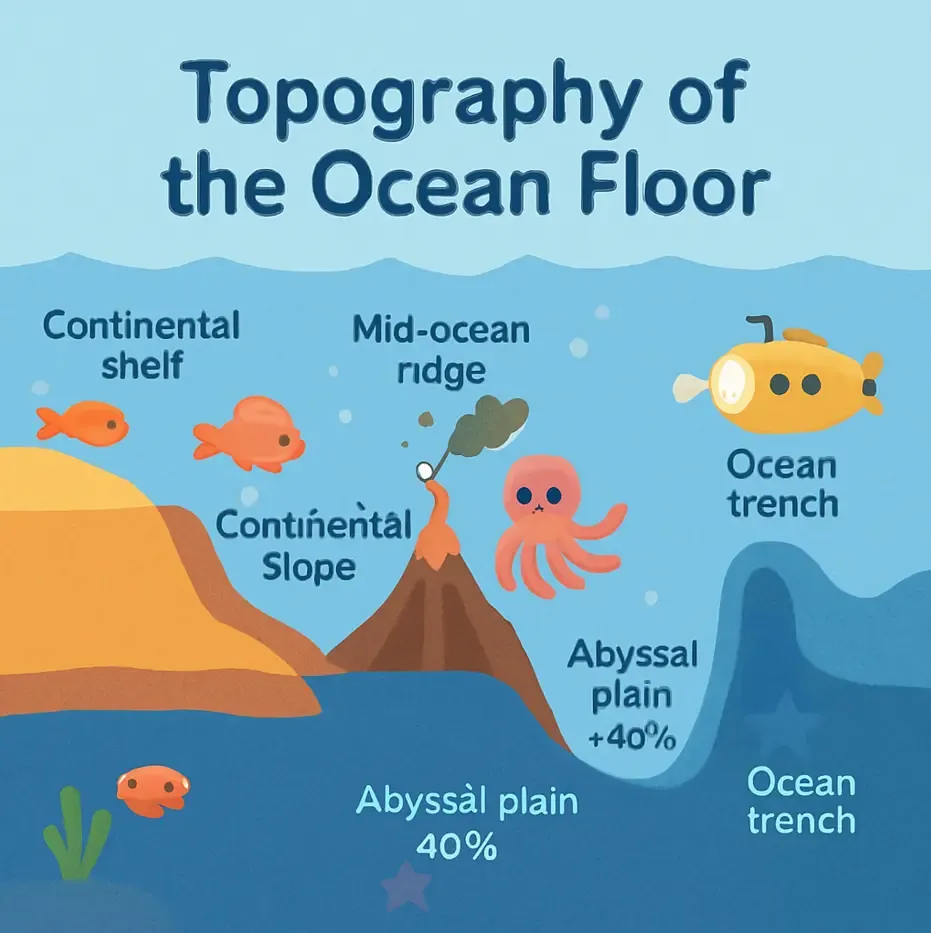
The ocean floor is a vast and varied landscape, with features as dramatic as those found on land. It is divided into several distinct regions, each with unique characteristics.
The continental shelf is the shallowest part of the ocean floor, extending from the shoreline to a depth of about 200 meters (650 feet). It is rich in marine life and resources like oil and natural gas. Beyond the shelf lies the continental slope, a steep drop-off that leads to the abyssal plain, the flat, deep ocean floor that covers about 40% of the Earth’s surface.
The ocean floor also features towering mid-ocean ridges, underwater mountain ranges formed by tectonic plate movement. These ridges are sites of volcanic activity and are home to unique ecosystems, such as hydrothermal vents. In contrast, ocean trenches are the deepest parts of the ocean, with the Mariana Trench reaching depths of over 11,000 meters (36,000 feet).
Other notable features include seamounts (underwater mountains) and guyots (flat-topped seamounts). These formations provide habitats for marine life and influence ocean currents.
Scientists use tools like sonar and submersibles to map the ocean floor. Understanding its topography is crucial for studying marine ecosystems, predicting tsunamis, and exploring natural resources.
Fun fact: The ocean floor is home to the longest mountain range on Earth—the Mid-Atlantic Ridge, which stretches over 16,000 kilometers (10,000 miles)!
Flat, deep regions of the oceanUnderwater mountainsShallow parts of the oceanDeep ocean trenches
What tool do scientists use to map the ocean floor?
TelescopesSonarThermometersBarometers
What is the fun fact mentioned in the passage?
The ocean floor has no mountainsThe Mid-Atlantic Ridge is the longest mountain range on EarthThe Mariana Trench is the shallowest part of the oceanSeamounts are found only on land
Why is understanding ocean topography important?
To study marine ecosystems and predict tsunamisTo measure air pressureTo study outer spaceTo predict earthquakes
Perfect For:
👩🏫 Teachers
• Reading comprehension practice
• Auto-graded assessments
• Literacy skill development
👨👩👧👦 Parents
• Reading practice at home
• Comprehension improvement
• Educational reading time
🏠 Homeschoolers
• Reading curriculum support
• Independent reading practice
• Progress monitoring
Reading Features:
📖
Reading Passage
Engaging fiction or nonfiction text
❓
Comprehension Quiz
Auto-graded questions
📊
Instant Feedback
Immediate results and scoring
📄
Printable Version
Download for offline reading
🔊
Read Aloud
Voice-over with word highlighting
Reviews & Ratings
No reviews yet. Be the first to share your experience!
Related Content
The Life and Legacy of Mahatma Gandhi
RF.5.4.ARF.5.4.BW.5.2L.5.6
Mesopotamia—Informatonal Text
This informational text on Mesopotamia is a great way to practice reading comprehension. Students will read the text the...
RI.5.3RI.5.10
Pollination: A Crucial Ecosystem Service
Explore the vital role of pollination beyond plant reproduction, as it sustains ecosystems by ensuring food security, pr...
RI.4.2RI.4.3RI.4.4RI.5.1
The States of Matter: Solid
Discover the differences between solids, liquids and gases by exploring how their particles are arranged and move. This ...
RI.4.2RI.4.3RI.4.4RI.5.1
What is a Simple Machine
Discover the power of simple machines! This informational text explores how basic tools like levers, pulleys and incline...
RI.4.2RI.4.3RI.4.4RI.5.1
The Role of Pollinators in Nature
Learn about the fascinating world of pollinators and discover their crucial role in the reproductive process of flowerin...
RI.4.2RI.4.3RI.4.4RI.5.1
Seed Dispersal: How Plants Travel
Plants may seem stationary, but their seeds have amazing ways to travel! Explore the fascinating world of seed dispersal...
RI.4.2RI.4.3RI.4.4RI.5.1
Cyclones and Anticyclones: A Comparison
Cyclones are low-pressure systems that bring stormy weather, while anticyclones are high-pressure systems that bring cle...
7.RI.7.1RI.5.3RI.5.5RI.6.9
Cold Fronts and Warm Fronts: A Comparison
Cold fronts bring thunderstorms and cooler temperatures, while warm fronts bring light rain and warmer temperatures. Bot...
7.RI.7.3RI.5.3RI.5.5RI.6.9
Latitude: A Key Factor Affecting Climate
Latitude determines a region’s climate by affecting sunlight and temperature. Tropical regions near the equator are warm...
RI.5.3
Elevation: A Key Factor Affecting Climate
Elevation influences climate by causing temperatures to drop as altitude increases. High-elevation areas receive more so...
RI.5.3
Vegetation: A Key Factor Affecting Climate
Vegetation influences climate by cooling temperatures, increasing humidity, and supporting rainfall. Forests also preven...
RI.5.3
Composition of the Ocean
The ocean is made up of water, dissolved salts, gases, and organic matter. Its composition varies with depth and influen...
RI.5.3
Circulation in the Ocean
Ocean circulation involves the movement of seawater driven by wind, temperature, and salinity. It includes surface curre...
RI.5.3
Surface Ocean Currents
Surface ocean currents are driven by wind and influenced by Earth’s rotation. They transport warm and cold water, regula...
RI.5.3
The Great Pacific Garbage Patch
The Great Pacific Garbage Patch is a massive collection of plastic waste in the North Pacific Ocean. It harms marine lif...
RI.5.3RI.6.3RI.7.3
Surface Water Runoff
Surface water runoff replenishes rivers and lakes but can cause flooding and pollution. Solutions like rain gardens and ...
RI.5.3RI.6.3RI.7.3
Freshwater and Its Sources
Freshwater is a limited resource, with most stored in glaciers and aquifers. Rivers, lakes, and groundwater are key sour...
RI.5.3RI.6.3RI.7.3
Runoff from Precipitation
Runoff from precipitation replenishes rivers and lakes but can cause flooding and pollution. Solutions like rain gardens...