This learning resource is available in interactive and printable formats. The interactive worksheet can be played online and assigned to students. The Printable PDF version can be downloaded and printed for completion by hand.
This NGSS-aligned reading passage for middle school students explores the fascinating topic of black holes. The text defines what a black hole is, focusing on the concept of immense gravity and the event horizon. It details the formation of stellar black holes from the death of massive stars and contrasts this with the fate of smaller stars. The passage also explains how scientists detect these invisible objects by observing their effects on surrounding matter, such as the formation of an accretion disk. The content is designed to be informative and engaging, providing a solid foundation for understanding this complex astronomical phenomenon. It includes key vocabulary and a relatable fun fact to reinforce learning.
CONTENT PREVIEW
Expand content preview
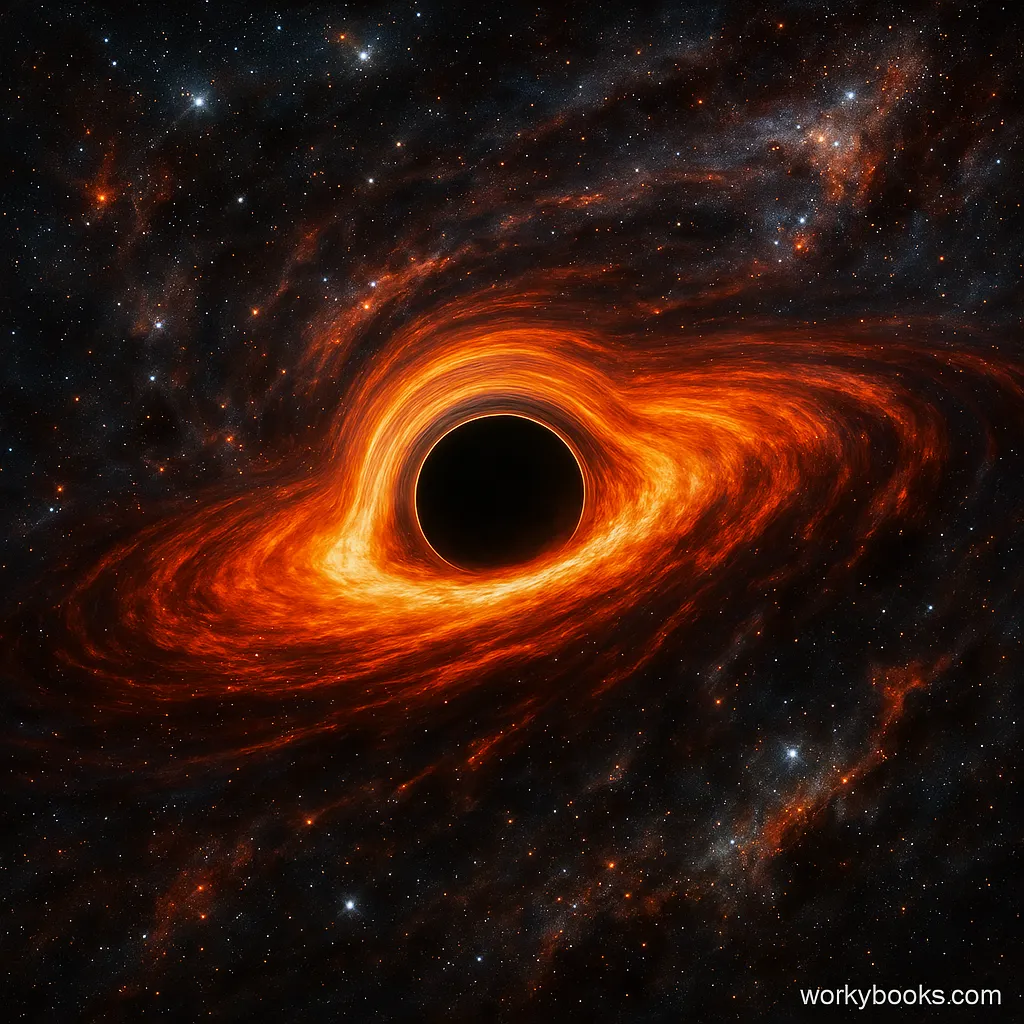
A supermassive black hole with its glowing accretion disk at the center of a galaxy.
A black hole is one of the most fascinating and mysterious objects in the universe. It is not an empty space but rather a region of spacetime where gravity is so incredibly strong that nothing, not even light, can escape. This extreme gravity is the result of a massive amount of matter being packed into an unbelievably small area. To visualize this, imagine squeezing a star that is several times more massive than our sun into a sphere the size of a single city. This immense concentration of mass creates a gravitational pull from which there is no return, defining the black hole's boundary as the event horizon.
Most black holes form from the death of massive stars. Stars are essentially gigantic nuclear furnaces, constantly generating energy through nuclear fusion. This outward pressure from fusion balances the inward pull of gravity. However, when a massive star exhausts its fuel, the fusion stops, and gravity wins. The star's core collapses in on itself, crushing all of its matter into a point of infinite density called a singularity. If the collapsing star is large enough, this collapse will create a black hole. Smaller stars, like our sun, do not have enough mass to become black holes; they will instead become white dwarfs.
Because black holes do not emit or reflect light, they are invisible. However, scientists can detect them by observing their effects on nearby objects. For example, a black hole's powerful gravity can pull in gas and dust from surrounding space, forming a glowing, swirling disk called an accretion disk. This disk heats up to millions of degrees as the particles rub against each other, emitting powerful X-rays that can be detected by special telescopes. By studying the motion of stars and other matter orbiting a black hole, astronomers can determine its mass and location.
Fun Fact: If a black hole with the same mass as the Sun were to take the Sun's place in our solar system, Earth would not be sucked in. Instead, we would continue to orbit it just as we orbit the Sun now, but in complete darkness.
What is the defining characteristic of a black hole?
It is a region of empty space.It is a star that has run out of fuel.Its gravity is so strong that nothing can escape.It is a type of nebula.
What is the name of the boundary around a black hole from which nothing can return?
Accretion diskSingularityEvent horizonGravitational field
A black hole is formed from the collapse of which type of celestial object?
A small planetA massive starA white dwarfA neutron star
What is the "singularity" of a black hole?
The glowing disk of gas.A point of infinite density.The outer boundary.The point where light escapes.
How do scientists primarily detect black holes?
By seeing them directly with a telescope.By the bright light they emit.By their effect on nearby matter.By their reflective surface.
Why doesn't a star like our Sun become a black hole?
It is not hot enough.It is not big enough.It doesn't have enough gravity.It has too much fusion.
What is the main idea of the provided passage?
Black holes are dangerous vacuums that suck up everything.Black holes are regions of space with powerful gravity, formed from collapsed stars.All stars will eventually turn into black holes.The event horizon is the most important part of a black hole.
If a black hole and a star of equal mass were both at the same distance from a planet, what would be the main difference in the planet's experience?
The planet would be pulled in by the black hole.The star would have a stronger gravitational pull.The planet would be pulled by the same gravitational force in both cases.The black hole would reflect light, while the star would not.
Perfect For:
👩🏫 Teachers
• Reading comprehension practice
• Auto-graded assessments
• Literacy skill development
👨👩👧👦 Parents
• Reading practice at home
• Comprehension improvement
• Educational reading time
🏠 Homeschoolers
• Reading curriculum support
• Independent reading practice
• Progress monitoring
Reading Features:
📖
Reading Passage
Engaging fiction or nonfiction text
❓
Comprehension Quiz
Auto-graded questions
📊
Instant Feedback
Immediate results and scoring
📄
Printable Version
Download for offline reading
🔊
Read Aloud
Voice-over with word highlighting
Reviews & Ratings
No reviews yet. Be the first to share your experience!
Related Content
Earth: Our Home in Space
This engaging Grade 4-5 science passage, aligned to NGSS, introduces students to Earth's special place in the solar syst...
Tools and Technology in Earth Science
This middle school science reading passage explores the wide range of tools and technologies used in Earth science, from...
MS-ESS2-2MS-ESS3-2MS-ETS1-1MS-PS4-3
What Is Space Weather and How Does It Affect the Earth?
This NGSS-aligned science passage for middle school explains what space weather is and how it affects Earth. Students le...
MS-ESS2-2
Space Stations
This informational science reading passage for grades 6-8 explores the complex systems and technology behind space stati...
MS-ESS1-3MS-ETS1-1
Escape Velocity and Space Travel
This middle school science passage introduces students to the concept of escape velocity—the minimum speed required to b...
MS-ESS1-2MS-PS2-4
Exploring Space: Rockets and Spacecraft
Space exploration has been one of humanity's greatest achievements, made possible by rockets and spacecraft. Rockets act...
RI.4.4RI.4.2
The Space Garden
This innovative passage combines plant science with space exploration, aligning with NGSS standards for life sciences an...
RL.3.1RL.2.1RL.4.9
International Space Station
Discover the wonders of the International Space Station with this informative coloring page showcasing the orbiting outpost where astronauts live and work in space. As children color the complex modul...
What Is Earth Science?
This engaging middle school science passage introduces students to the field of Earth science, aligning with NGSS standa...
MS-ESS1MS-ESS2MS-ESS3SEP
The Space Needle
Students read a passage about the history and features of Seattle's Space Needle, then answer comprehension questions to...
RI.4.2
Scientific Inquiry in Earth Science
This passage explores scientific inquiry in Earth science for grades 6-8, aligned with NGSS standards MS-ESS1-4, MS-ESS2...
MS-ESS1-4MS-ESS2-1MS-ESS3-5SEP
I Spy Outer Space
To reinforce their numeracy skills, the worksheet provides dedicated spaces where children can write the corresponding n...
K.CC.4K.CC.5K.CC.6
Measuring Distances in Space
This middle school science passage explores how astronomers measure the vast distances in space, aligning with NGSS stan...
MS-ESS1-3
The Space Food Lab
This engaging passage explores the fascinating world of space food technology, aligning with NGSS standards for engineer...
RL.3.1RL.2.1RL.4.7
The Space Telescope
This fascinating passage explores space telescope technology, aligning with NGSS standards for earth and space sciences....
RL.3.1RL.2.1RL.4.6
Meteorite Impacts on Earth
This engaging science reading passage for Grades 4-5 explores meteorite impacts on Earth, aligning with NGSS standards. ...
Earth's Spheres
This middle school science passage introduces students to Earth's four major spheres: the geosphere, hydrosphere, atmosp...
MS-ESS2-4MS-ESS2-6
Separating Words With Spaces
This worksheet will help your students to remember to add spaces between words. Students will read the sentences-- some ...
RF.K.1.CRF.K.1
Why Is The Mars Helicopter So Important For Future Space Exploration?
This engaging passage explores the groundbreaking role of the Ingenuity Mars Helicopter in future space exploration. Stu...
Space Needle
This Space Needle coloring page offers a fun way for kids to explore one of America's most unique architectural landmarks. The illustration features Seattle's iconic Space Needle with its distinctive...