What Is a Hydroelectric Power Plant? — Reading Comprehension
Rate this
Premium Resource
Present
Present in classroom. No work saved
Assign
Classroom with student accounts, Track progress
Quick Play
No student accounts, assign with a link
Grades
3
4
5
6
7
8
PRINT+DIGITAL RESOURCE
This learning resource is available in interactive and printable formats. The interactive worksheet can be played online and assigned to students. The Printable PDF version can be downloaded and printed for completion by hand.
This middle school science passage explains how hydroelectric power plants generate electricity using the energy of moving water. The passage describes key components such as dams, reservoirs, turbines, and generators, and explains how they work together to produce clean and renewable electricity. Students learn about the advantages of hydroelectric power—like low pollution and steady energy—and challenges such as habitat disruption. Aligned with NGSS standard MS-ESS3-1, the passage builds science comprehension and vocabulary while connecting physical science to environmental awareness and real-world applications.
CONTENT PREVIEW
Expand content preview
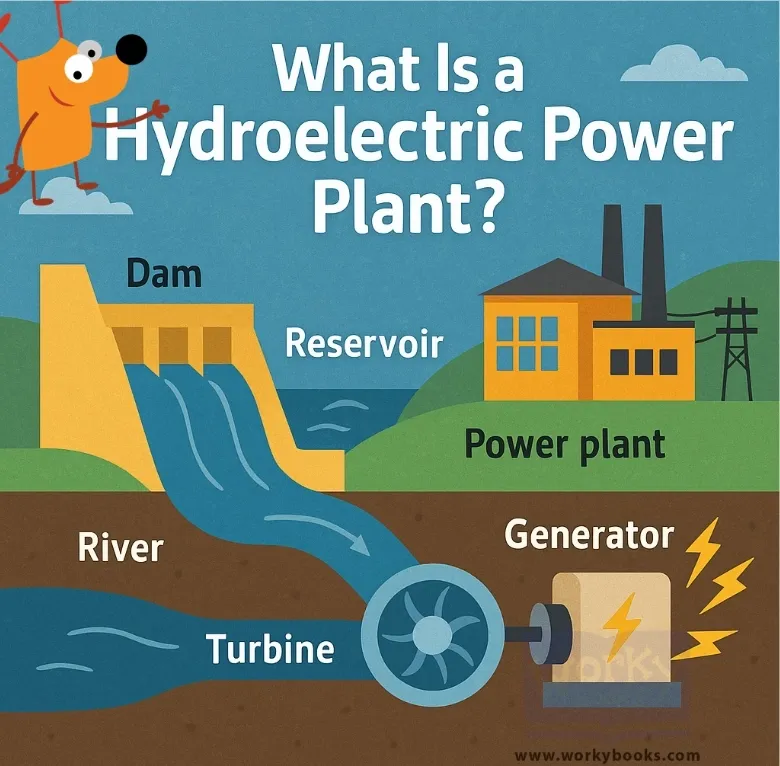
A hydroelectric power plant is a place where electricity is made using moving water. This type of power plant turns the energy from flowing or falling water into electrical energy. It is a clean and
source because it uses water from nature, which is always being replaced by rain and rivers.
The process begins with a dam built across a river. The dam blocks the flow of water and creates a reservoir, which is like a large lake. When the power plant needs to make electricity, water is released from the reservoir. The water flows through pipes inside the dam and spins a machine called a turbine.
The turbine is connected to a generator. When the turbine spins, it turns the generator, which makes electricity. This electricity travels through power lines to homes, schools, and businesses.
Hydroelectric power plants are used around the world. They are especially useful in places with large rivers or lots of rainfall. One of the biggest hydroelectric power plants is the Three Gorges Dam in China. In the United States, the Hoover Dam is a well-known example.
Hydroelectric power has many advantages. It does not create air pollution, and it produces a steady supply of energy. However, building dams can also cause problems. They can change the natural flow of rivers, affect fish habitats, and flood nearby land.
Even with these challenges, hydroelectric power plants are an important way to make electricity without using fossil fuels. They show how we can use natural forces like water to meet our energy needs and protect the planet.
Fun Fact: The energy from just one large hydroelectric power plant can power over a million homes!
What does a hydroelectric power plant use to make electricity?
WindSunlightMoving waterNatural gas
What holds back river water to create a reservoir?
TurbineGeneratorDamPipe
What does the turbine do in a hydroelectric power plant?
Stores energySpins from flowing waterCleans the riverStops pollution
What machine produces electricity in a hydroelectric plant?
MotorGeneratorFanFilter
What is one benefit of hydroelectric power?
It causes air pollutionIt runs on oilIt uses renewable waterIt works only at night
What is one problem caused by dams?
They make rivers cleanerThey stop electricityThey can harm fish habitatsThey make more rainfall
What is the main idea of the passage?
Water is dangerous to useHydroelectric plants are a clean way to make electricityRivers should not be dammedFossil fuels are always needed
If a town is near a strong river, what could it build to make clean energy?
A coal factoryA hydroelectric power plantA windmill farmA gas station
Perfect For:
👩🏫 Teachers
• Reading comprehension practice
• Auto-graded assessments
• Literacy skill development
👨👩👧👦 Parents
• Reading practice at home
• Comprehension improvement
• Educational reading time
🏠 Homeschoolers
• Reading curriculum support
• Independent reading practice
• Progress monitoring
Reading Features:
📖
Reading Passage
Engaging fiction or nonfiction text
❓
Comprehension Quiz
Auto-graded questions
📊
Instant Feedback
Immediate results and scoring
📄
Printable Version
Download for offline reading
🔊
Read Aloud
Voice-over with word highlighting
Reviews & Ratings
No reviews yet. Be the first to share your experience!
Related Content
Tools and Technology in Earth Science
This middle school science reading passage explores the wide range of tools and technologies used in Earth science, from...
MS-ESS2-2MS-ESS3-2MS-ETS1-1MS-PS4-3
What Is Earth Science?
This engaging middle school science passage introduces students to the field of Earth science, aligning with NGSS standa...
MS-ESS1MS-ESS2MS-ESS3SEP
Interpreting visual information on Layers of the Earth
This informational text on the layers of the earth is a great way to practice using images during reading. Students will...
RI.1.7RI.10RF.1.4.ARF.1.4
What Is Space Weather and How Does It Affect the Earth?
This NGSS-aligned science passage for middle school explains what space weather is and how it affects Earth. Students le...
MS-ESS2-2
What Do Humans Need? Informational text
This worksheet contains an informational text on what humans need to survive. Following the passage is a short comprehen...
RL.3.1
Scientific Inquiry in Earth Science
This passage explores scientific inquiry in Earth science for grades 6-8, aligned with NGSS standards MS-ESS1-4, MS-ESS2...
MS-ESS1-4MS-ESS2-1MS-ESS3-5SEP
What's The Main Idea?
These short science texts are a great way to practice main idea. Students will read the paragraphs and then choose the m...
RI.2.6
Reading for Main Details—Birds
This informational text on birds is a great way to practice main idea. Students will read the passage, then give the mai...
RI.2.6RI.2.8
Koi Fish—What’s the Main Idea?
This informational text on koi fish is a great introduction to teaching main idea. Students will be asked, in multiple c...
RI.3.2RF.3.4RI.3.1
Spider—Main Idea
This informational text on spiders is a great introduction to teaching main idea. Students will be asked, in multiple ch...
RI.3.2RF.3.4RI.3.1RI.2.6
Reading for Main Details—Beavers Teeth
This informational text on beavers is a great way to practice main idea. Students will read the passage, then give the m...
RI.2.6RI.2.10
Reading for Main Details—Veternarians
Practie summarizing paragraphs with this fun informational text on veternarians! Students will give the main idea of eac...
RI.2.2RI.2.10
Main Idea and Supporting Details in Informational Text
RI.3.1RI.3.2RI.3.8
Earth: Our Home in Space
This engaging Grade 4-5 science passage, aligned to NGSS, introduces students to Earth's special place in the solar syst...
The Diameter of Earth
This science reading passage explains the diameter of Earth, describing it as about 12,742 kilometers or 7,918 miles acr...
5-PS2-1
Main Idea and Details Graphic Organizer
This graphic organizer on main idea includes space to write the main idea and three supporting details.
RI.1.2RI.2.2RI.3.2RI.4.2
Bats and Butterflies—Informational Text
This informational text on bats and butterflies is a great way to practice spotting similarities between texts. Students...
RI.K.3
Main Idea and Suporting Details Graphic Organizer
This graphic organizer on main idea includes space to write the main idea and three supporting details.
RI.1.2RI.2.2RI.3.2RI.4.2
My Planet Earth
In this passage, students explore Earth as their home planet. They learn that Earth is made of land, water, and air, and...
FL.SS.2.G.1.1SS.2.G.1.3
Penguins— Main Purpose
This informational text on penguins with comprehension questions is a great way to practice reading fluency and main ide...