what is a Polar Covalent Bond — Reading Comprehension
Rate this
Premium Resource
Present
Present in classroom. No work saved
Assign
Classroom with student accounts, Track progress
Quick Play
No student accounts, assign with a link
Grades
3
4
5
6
7
8
PRINT+DIGITAL RESOURCE
This learning resource is available in interactive and printable formats. The interactive worksheet can be played online and assigned to students. The Printable PDF version can be downloaded and printed for completion by hand.
"This middle school science passage, aligned with NGSS standards, explores the concept of polar covalent bonds. It explains how these bonds form due to the unequal sharing of electrons between atoms with different electronegativity. The passage uses the example of water (H2O) to illustrate how this unequal sharing creates a dipole, with one end of the molecule having a partial positive charge and the other a partial negative charge. Students will learn the significance of electronegativity in determining bond polarity and understand the real-world implications of these bonds, such as water’s unique properties. The text is designed for self-study and includes a clear, factual tone to aid comprehension of fundamental chemistry principles."
CONTENT PREVIEW
Expand content preview
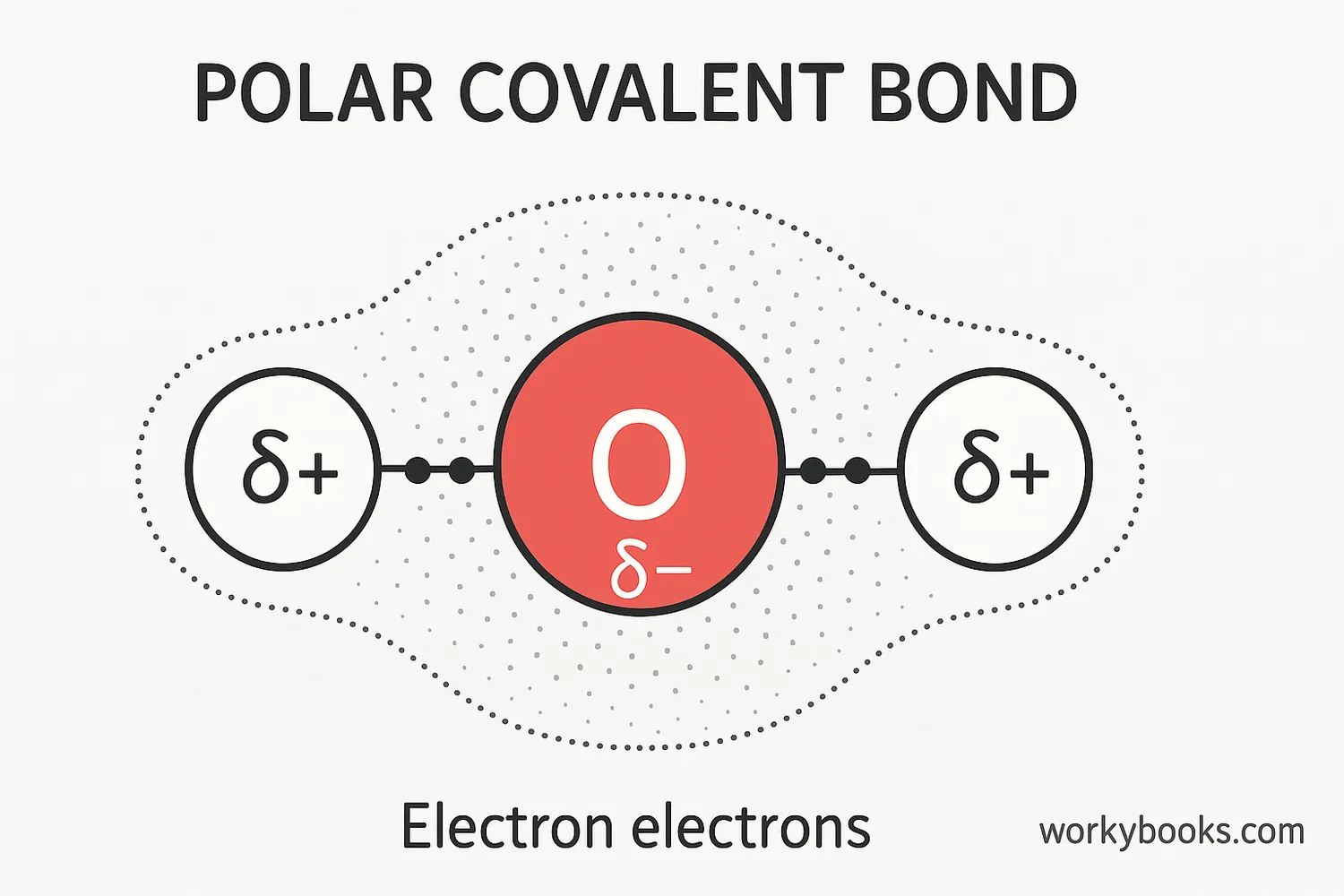
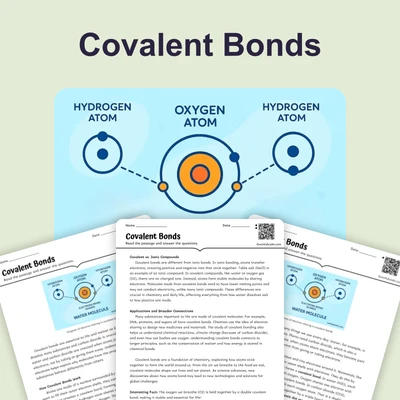
The polar covalent bonds in a water molecule, where electrons are pulled closer to the more electronegative oxygen atom, creating partial charges.
Chemical bonds are the forces that hold atoms together to form molecules. A covalent bond is a fundamental type of chemical bond where atoms share pairs of electrons. However, this sharing is not always equal. A polar covalent bond occurs when the shared electrons are pulled closer to one atom than the other, leading to an uneven distribution of charge. This happens because some atoms have a stronger attraction for electrons, a property known as electronegativity.
In a polar covalent bond, the atom with higher electronegativity will pull the shared electrons closer to itself. This gives that atom a slight negative charge, represented by the Greek letter delta negative (δ−). The other atom, which has lost some of its electron density, gains a slight positive charge, represented by delta positive (δ+). This separation of charge creates a dipole, a molecule with a positive end and a negative end, similar to the poles of a magnet.
Water (H2O) is a classic example of a molecule with polar covalent bonds. The oxygen atom has a much higher electronegativity than the hydrogen atoms. As a result, the shared electrons are pulled closer to the oxygen atom, giving it a partial negative charge. The hydrogen atoms, in turn, acquire a partial positive charge. This polarity is a key reason why water is an excellent solvent, able to dissolve many substances by surrounding their charged particles. This unique property of water is essential for life on Earth.
Fun Fact: The polarity of water molecules is why water forms a meniscus in a glass tube and why some insects can walk on the surface of water.
What is a key characteristic of a covalent bond?
Atoms transfer electrons.Atoms share electron pairs.Atoms gain a full positive charge.Atoms become completely neutral.
What is the main cause of a polar covalent bond?
Atoms having equal electronegativity.The atoms are of the same element.An unequal sharing of electrons.The molecule is linear in shape.
What is electronegativity?
The number of protons in an atom.The ability of an atom to attract electrons.The total mass of an atom.The number of neutrons in an atom.
In a polar covalent bond, what happens to the atom with higher electronegativity?
It becomes completely positive.It gains a partial positive charge.It becomes completely negative.It gains a partial negative charge.
Which of the following is a real-world example of a molecule with polar covalent bonds mentioned in the passage?
Table salt (NaCl)Hydrogen gas (H2)Carbon dioxide (CO2)Water (H2O)
Based on the passage, what term describes a molecule with a positive end and a negative end?
An isotopeA dipoleA cationAn anion
What is the main idea of the passage?
To explain the concept of electronegativity.To describe why some covalent bonds are polar.To list different types of chemical bonds.To show the importance of water as a solvent.
If an unknown molecule has a polar covalent bond, how would its shared electrons likely be distributed?
Evenly between both atoms.Closer to the more electronegative atom.Closer to the less electronegative atom.Outside of both atoms.
Perfect For:
👩🏫 Teachers
• Reading comprehension practice
• Auto-graded assessments
• Literacy skill development
👨👩👧👦 Parents
• Reading practice at home
• Comprehension improvement
• Educational reading time
🏠 Homeschoolers
• Reading curriculum support
• Independent reading practice
• Progress monitoring
Reading Features:
📖
Reading Passage
Engaging fiction or nonfiction text
❓
Comprehension Quiz
Auto-graded questions
📊
Instant Feedback
Immediate results and scoring
📄
Printable Version
Download for offline reading
🔊
Read Aloud
Voice-over with word highlighting
Reviews & Ratings
No reviews yet. Be the first to share your experience!
Related Content
Physical Properties of Matter
This comprehensive reading passage introduces grades 6-8 students to the concept of physical properties of matter, perfe...
MS-PS1-1
Chemical Properties of Matter
This engaging middle school science passage explores the chemical properties of matter, focusing on how these properties...
MS-PS1-2
Changes in Matter
This engaging science passage introduces Grade 4-5 students to the concept of how matter can change, meeting NGSS standa...
Matter States Word Sort
This classification activity helps students understand how particles are arranged in different states of matter. Student...
5-PS1-1
Matter States Word Sort
This interactive word sort focuses on helping students understand the different states of matter through real-world exam...
PS1.A
Is Evaporation a Physical Change
"This reading passage is designed for middle school students to explore the concept of evaporation and its classificatio...
What Are Physical Changes?
This engaging Grade 4-5 science passage introduces students to the concept of physical changes in matter, aligning with ...
Properties of Addition
This worksheet on the properties of addition will help students to practice this skill. All of the properties are define...
3.OA.B.5
Particle Model of Matter
This comprehensive science reading passage for grades 6-8 explores the particle model of matter, aligning with NGSS stan...
MS-PS1-1MS-PS1-4
Particle Movement Sort
This classification activity helps students understand particle movement in different materials. Students categorize sub...
5-PS1-1
Sorting Materials by Properties
In the 'Sorting Materials by Properties' activity, students sort various materials into categories such as 'Hard and Rig...
Kinetic Theory of Matter
This middle school science reading passage introduces students to the kinetic theory of matter, aligning with NGSS MS-PS...
MS-PS1-4
Properties of Addition— Commutative
This worksheet is perfect for practicing the commutative property. Students will practice this property as well as their...
1.OA.B.3-3
The Nature of Science
This passage explores the nature of science for middle school students, aligning with NGSS standards MS-ETS1-4, MS-PS1-1...
MS-ETS1-4MS-PS1-1MS-LS1-1
Science Vocabulary
This worksheet on domain-specific words will help students learn some science vocabulary. Students will be asked to matc...
L.3.6L.3.4.A
The Melting Point of Substances
This middle school science reading passage, titled 'The Melting Point of Substances', explores the physical property kno...
5-PS1MS-PS1-4RI.6.3RI.7.1
Properties of Communication Tools
The 'Properties of Communication Tools' word sort activity is crafted for first-grade students to meet NGSS 1-PS4-4 stan...
Simple Machines Science Report
This science writing task requires students to clearly explain how three simple machines work using precise domain-speci...
W.5.4
Temperature Effects Sort
This classification activity helps students understand how temperature affects matter. Students categorize various chang...
5-PS1-2
The Nature of Life Science
This passage, aligned with NGSS MS-LS1-1, introduces students in grades 6-8 to the foundational concepts of life science...