The Nature of Life Science — Reading Comprehension
Rate this|
1
Premium Resource
Present
Present in classroom. No work saved
Assign
Classroom with student accounts, Track progress
Quick Play
No student accounts, assign with a link
Grades
5
6
7
8
Standards
MS-LS1-1
PRINT+DIGITAL RESOURCE
This learning resource is available in interactive and printable formats. The interactive worksheet can be played online and assigned to students. The Printable PDF version can be downloaded and printed for completion by hand.
This passage, aligned with NGSS MS-LS1-1, introduces students in grades 6-8 to the foundational concepts of life science. Students learn to define biology as the study of living things and discover what characteristics scientists use to distinguish living organisms from nonliving matter. Concepts such as organization, metabolism, homeostasis, growth, reproduction, response to stimuli, and adaptation are explained with real-world examples. The passage also explores complex cases like viruses and fire to spark curiosity about the boundaries of life. Activities include a glossary, multiple-choice quiz, writing prompts, and graphic organizers to deepen understanding. Audio integration supports accessibility and engagement, making this resource ideal for diverse learners and classroom settings. Keywords: life science, biology, living things, NGSS MS-LS1-1, characteristics of life, adaptation, virus, fire, science curriculum, middle school.
CONTENT PREVIEW
Expand content preview
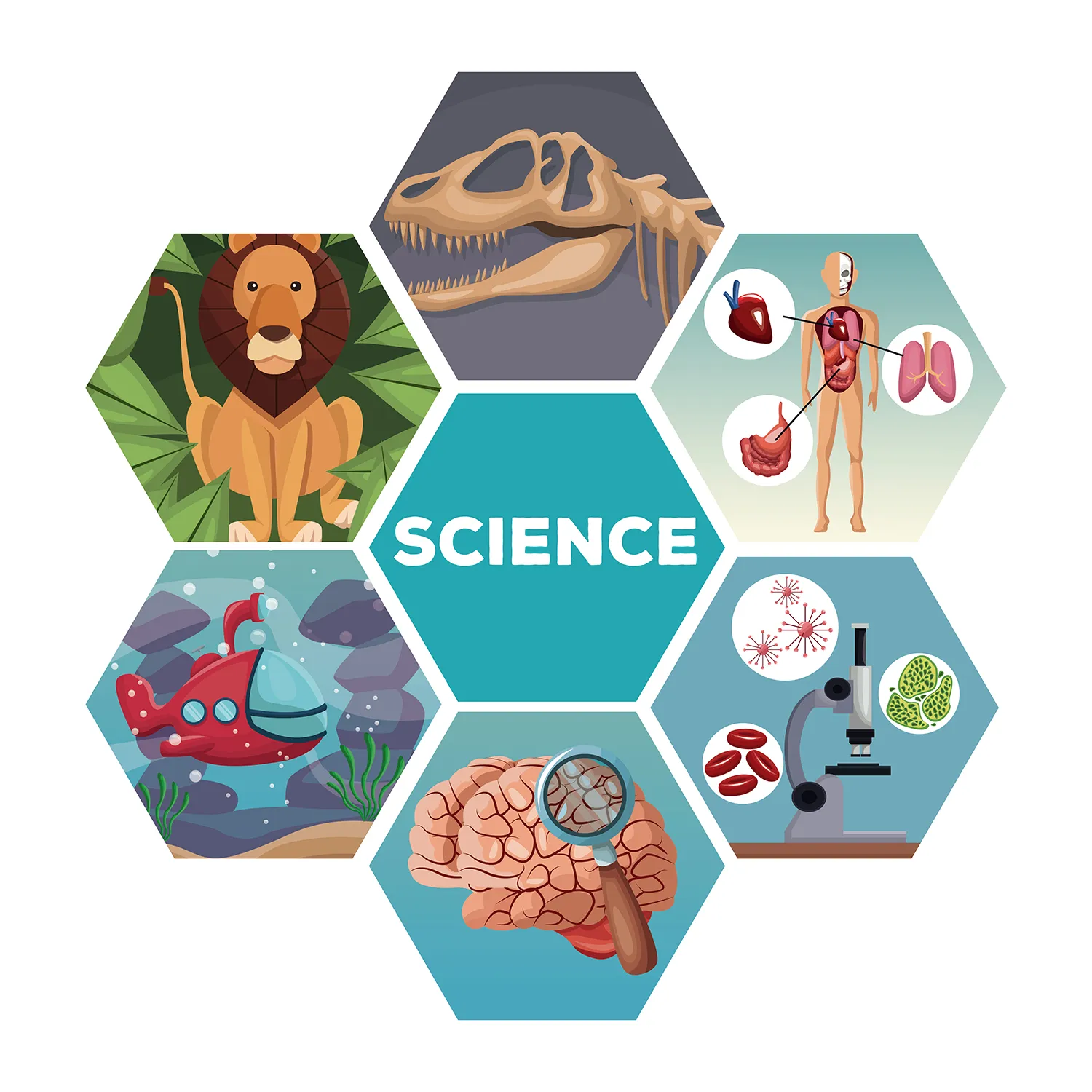
Biology is the branch of science focused on studying living things and their interactions. In every habitat on Earth, from the deepest oceans to the highest mountains, life demonstrates remarkable diversity and complexity. Scientists use life science to seek answers to questions about what it means to be alive, how living things function, and how they change over time.
Characteristics of Life To determine whether something is alive, scientists use a set of key characteristics. Living things, or organisms, are organized into cells, which are the smallest units of life. This organization allows them to perform complex functions. All living things undergo metabolism, the chemical processes that provide energy for growth and activity. They maintain homeostasis, keeping their internal environment stable even when surroundings change. Organisms grow by increasing in size or cell number, and they reproduce, passing genetic information to offspring. Living things respond to stimuli—for example, plants bend toward light, and animals flee from danger. Over generations, populations of organisms adapt to their environments, a process called adaptation.
Distinguishing Living and Nonliving Things Nonliving things, such as rocks or water, may share some features with living things but lack the full set of characteristics. For instance, fire grows, moves, and needs fuel, yet it does not have cells, does not reproduce, and does not maintain homeostasis. Viruses present a special case. They contain genetic material and can evolve, but they cannot reproduce or carry out metabolism on their own. Scientists debate whether viruses are truly alive or exist at the boundary between living and nonliving. Research in 2020 showed that some giant viruses have genes for metabolic processes, but they still depend on host cells for reproduction. This shows how our understanding of life can change with new discoveries.
Systems, Interactions, and the Diversity of Life Life science also studies how living things interact with each other and with nonliving elements in their environment. For example, plants use photosynthesis to convert sunlight into food, supporting animals that eat them. Bacteria help decompose dead matter, recycling nutrients. These interactions form ecosystems, where the balance between organisms and their environment is vital for survival. Quantitative studies estimate that Earth is home to over 8.7 million species, from microscopic bacteria to towering trees and large animals. This tremendous diversity results from billions of years of evolution, adaptation, and interaction.
Life science not only helps us understand what it means to be alive but also provides tools to address environmental, health, and technological challenges. For example, studying how bacteria adapt to antibiotics guides the development of new medicines, and understanding ecosystems helps us protect endangered species. The investigation of life's boundaries, such as whether viruses are alive, continues to shape scientific thinking and advances our knowledge of biology.
Interesting Fact: The tardigrade, or "water bear," can survive extreme conditions—freezing, boiling, or even the vacuum of space—demonstrating the incredible adaptability of life.
What is the main focus of biology?
Studying living things and their interactionsExamining rocks and mineralsObserving the weatherMeasuring physical forces
Which of the following is NOT a characteristic of living things?
Having cellsMetabolismHomeostasisBeing made of rocks
What does homeostasis mean in living things?
Growing largerStaying internally stableReproducing quicklyMoving from place to place
Which example from the passage shows a living thing responding to a stimulus?
A plant bending toward lightA rock rolling down a hillWater evaporating in the sunA fire burning wood
Why do scientists debate if viruses are alive?
Viruses have cells and reproduce on their ownViruses contain genetic material but need host cells to reproduceViruses can photosynthesizeViruses are made of rocks
What is an ecosystem?
A group of rocksA community of living things and their environmentA single animalA weather system
What is the main reason fire is not considered alive?
It does not have cells or reproduceIt moves quicklyIt produces heatIt needs oxygen
Which statement best describes adaptation?
A living thing changing over generations to survive betterA rock breaking into smaller piecesWater freezing in winterA virus infecting a cell
True or False: All living things must be able to reproduce and respond to stimuli.
TrueFalse
True or False: Scientists' understanding of what is considered alive can change with new discoveries.
TrueFalse
Perfect For:
👩🏫 Teachers
• Reading comprehension practice
• Auto-graded assessments
• Literacy skill development
👨👩👧👦 Parents
• Reading practice at home
• Comprehension improvement
• Educational reading time
🏠 Homeschoolers
• Reading curriculum support
• Independent reading practice
• Progress monitoring
Reading Features:
📖
Reading Passage
Engaging fiction or nonfiction text
❓
Comprehension Quiz
Auto-graded questions
📊
Instant Feedback
Immediate results and scoring
📄
Printable Version
Download for offline reading
🔊
Read Aloud
Voice-over with word highlighting
Reviews & Ratings
No reviews yet. Be the first to share your experience!
Related Content
Antonie van Leeuwenhoek and the Discovery of Animalcules
This NGSS-aligned science passage explores the groundbreaking work of Antonie van Leeuwenhoek, a pioneer in microscopic ...
MS-LS1-1MS-LS1-2
Robert Hooke and the Naming of 'Cells'
This NGSS-aligned reading passage introduces middle school students to Robert Hooke's discovery and naming of 'cells' in...
MS-LS1-1MS-LS1-2
Rudolf Virchow and His Contribution to Cell Theory
This NGSS-aligned science reading passage introduces students to Rudolf Virchow, a key historical figure in cell biology...
MS-LS1-1MS-LS1-2
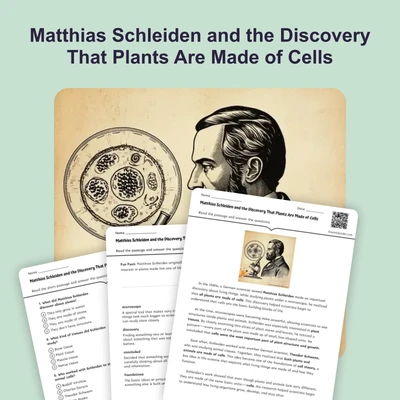
Matthias Schleiden and the Discovery That Plants Are Made of Cells
This NGSS-aligned science passage explains how Matthias Schleiden, a German scientist in the 1830s, discovered that all ...
MS-LS1-1MS-LS1-2
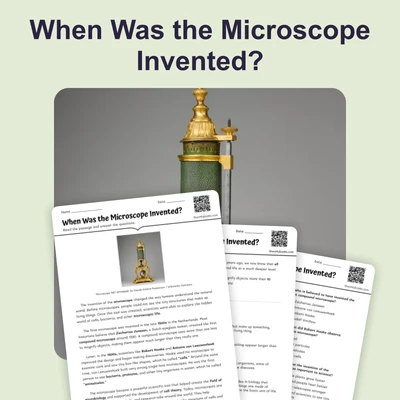
When Was the Microscope Invented?
This NGSS-aligned reading passage introduces students to the invention of the microscope, an essential scientific tool. ...
MS-LS1-1MS-LS1-2
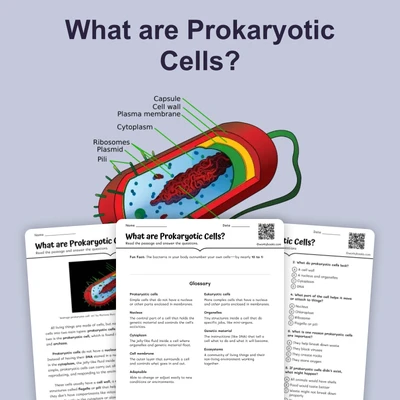
What are Prokaryotic Cells?
This NGSS-aligned science reading passage explains prokaryotic cells, the simplest type of cells found in single-celled ...
MS-LS1-1MS-LS1-2
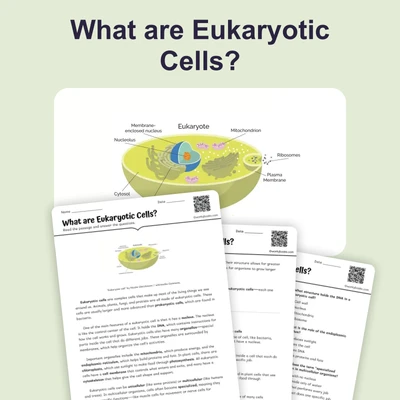
What are Eukaryotic Cells?
This NGSS-aligned reading passage introduces middle school students to eukaryotic cells, which are complex cells found i...
MS-LS1-1MS-LS1-2
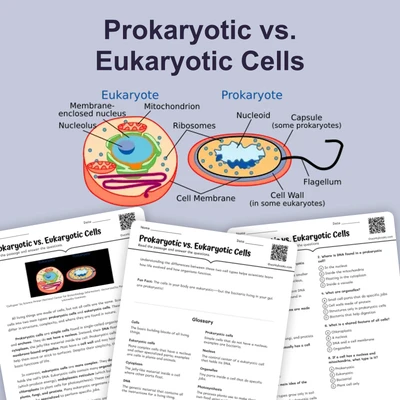
Prokaryotic vs. Eukaryotic Cells
This NGSS-aligned reading passage helps middle school students compare prokaryotic and eukaryotic cells. Supporting stan...
MS-LS1-1MS-LS1-2
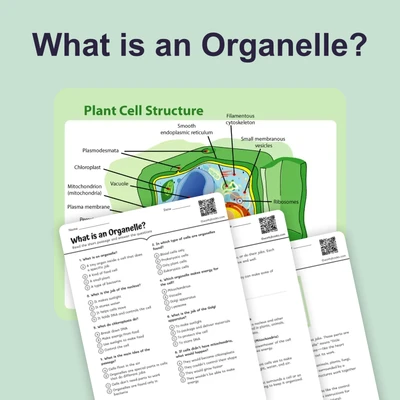
What is an Organelle?
This NGSS-aligned reading passage introduces middle school students to the concept of organelles. Supporting MS-LS1-
MS-LS1-1MS-LS1-2
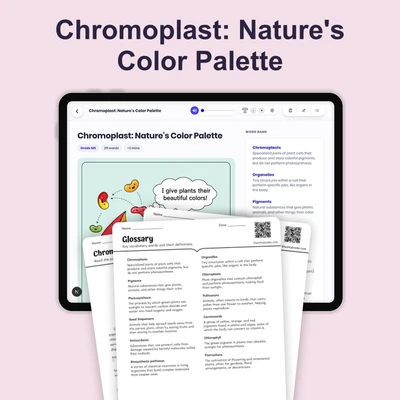
Chromoplast: Nature's Color Palette
This passage details chromoplast functions in pigment production, ecological signaling, and nutrition. Aligned with NGSS...
MS-LS1-1MS-LS1-2MS-LS1-6LS1.C
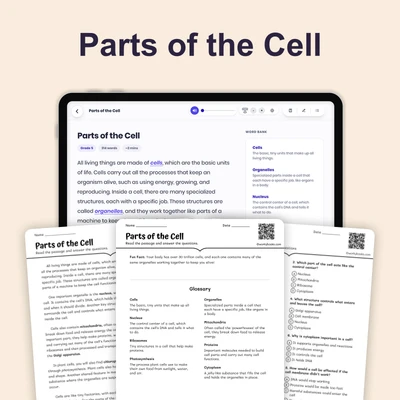
Parts of the Cell
This informational science passage, aligned with NGSS standard MS-LS1-1, introduces students to the parts of the cell an...
MS-LS1-1MS-LS1-2
The Nucleolus and Its Function
This NGSS-aligned reading passage focuses on the nucleolus, a key structure inside the cell’s nucleus responsible for ma...
MS-LS1-1MS-LS1-2
Golgi Apparatus and Its Function
This NGSS-aligned reading passage introduces middle school students to the structure and function of the Golgi apparatus...
MS-LS1-1
Is a Platypus a Mammal?
This interactive science reading passage, titled "Is a Platypus a Mammal? The Monotreme Mystery!", delves into the uniqu...
MS-LS1-1
Where Do Platypus Live?
This engaging science reading passage, titled "Where Do Platypus Live? Finding Australia's Elusive Swimmer," explores th...
MS-LS1-1
The Amazing Red Panda
This engaging science reading passage, titled "The Amazing Red Panda: A Fluffy Tree Dweller," introduces students to one...
MS-LS1-1MS-LS4-D
Where Do Red Pandas Live?
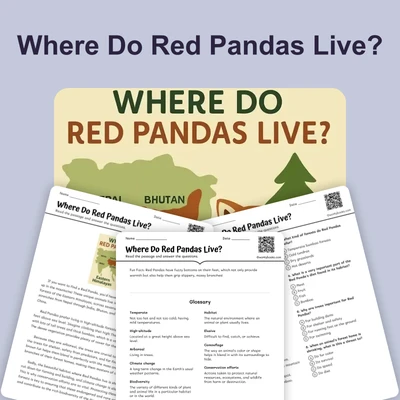
This science reading passage, titled "Where Do Red Pandas Live? In the Mountain Forests," explores the specific habitat ...
MS-LS1-1
Przewalski's Horse
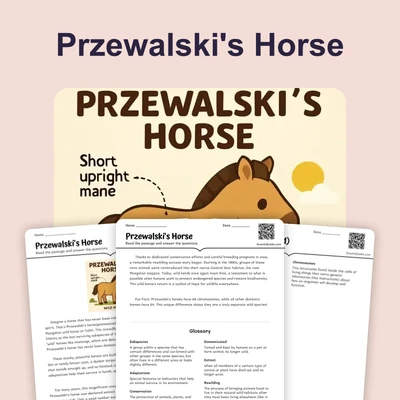
This engaging science reading passage, titled "Przewalski's Horse: A Wild Comeback Story," introduces students to the tr...
MS-LS4-DMS-LS1-1
The Quokka
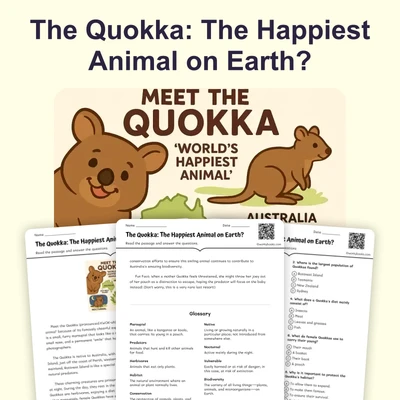
This engaging science reading passage, titled "The Quokka: The Happiest Animal on Earth?", introduces students to one of...
MS-LS4-DMS-LS1-1
The Proboscis Monkey
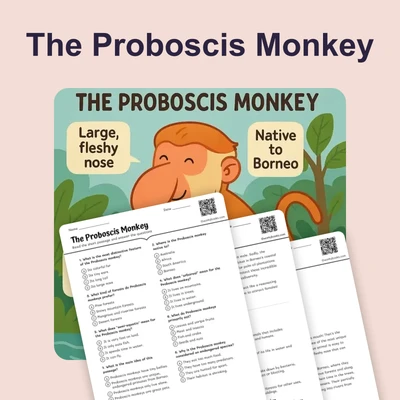
This interactive science reading passage, titled "The Proboscis Monkey: A Monkey with a Mighty Nose!", introduces studen...