Physical Properties of Matter — Reading Comprehension
Rate this
Premium Resource
Present
Present in classroom. No work saved
Assign
Classroom with student accounts, Track progress
Quick Play
No student accounts, assign with a link
Grades
5
6
7
8
Standards
MS-PS1-1
PRINT+DIGITAL RESOURCE
This learning resource is available in interactive and printable formats. The interactive worksheet can be played online and assigned to students. The Printable PDF version can be downloaded and printed for completion by hand.
This comprehensive reading passage introduces grades 6-8 students to the concept of physical properties of matter, perfectly aligned with NGSS standard MS-PS1-1. Students will learn how scientists use observable and measurable characteristics such as density, color, odor, melting point, boiling point, solubility, conductivity, and magnetism to identify and classify substances without changing their identity. The passage provides clear explanations, real-world examples, and explores the mechanisms behind why these properties are significant in scientific investigations and technology. Activities include a glossary, a multiple-choice quiz, open-ended writing prompts, and engaging graphic organizers to reinforce understanding. Audio integration supports diverse learning needs. This resource is ideal for students, teachers, and parents seeking a deep, standards-based understanding of the physical properties of matter.
CONTENT PREVIEW
Expand content preview
Different physical properties of matter
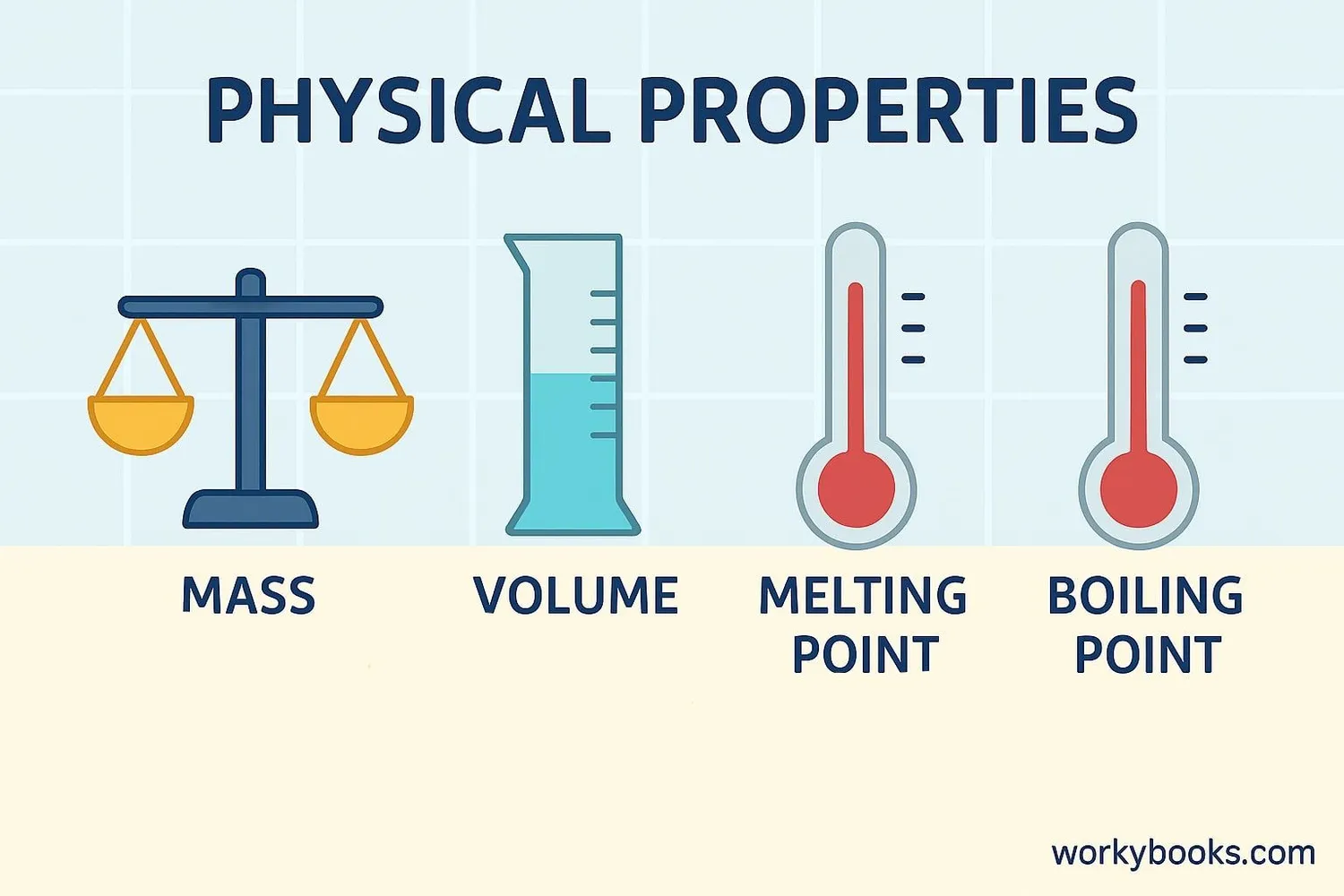
Physical properties of matter are essential for scientists to understand and identify materials in the natural and technological world. Each material has unique characteristics that can be observed or measured without altering what the substance is. These physical properties include density, color, odor, melting point, boiling point, solubility, conductivity, and magnetism. These properties allow scientists to classify unknown substances and select materials for specific uses in engineering, health, and environmental science.
Observing and Measuring Physical Properties Scientists often begin with observable properties such as color or odor. For example, copper is reddish-brown and has no noticeable odor, while sulfur is yellow and smells like rotten eggs. However, some properties require measurement. Density is a quantitative property calculated as mass divided by volume (density = mass/volume). For instance, lead has a density of about 11.3 g/cm³, which is much higher than aluminum's 2.7 g/cm³. This difference can help identify metals even when they look similar. Melting point and boiling point are temperatures at which substances change state. Water melts at 0°C and boils at 100°C, but iron melts at 1538°C. These measurements are critical for processes like metalworking or food science.
Using Physical Properties in Science and Technology The solubility of a substance—its ability to dissolve in a liquid—helps chemists separate mixtures and design medicines. For example, salt is highly soluble in water, but oil is not. Conductivity describes how well a material allows electricity or heat to pass through. Metals like copper are excellent conductors and are used in wires, while rubber is an insulator. Magnetism is another property: iron and nickel are magnetic, but aluminum and plastic are not. Scientists can identify an unknown metal by testing its density and magnetism together. If a gray metal is dense and attracted to a magnet, it is likely iron or steel, but if it is not magnetic, it might be lead or silver.
Interacting Properties and Real-World Applications Many real-world problems require understanding how physical properties interact. For example, when building a bridge, engineers choose materials with the right density, strength, and conductivity. In environmental science, researchers test water samples for color, odor, and solubility of pollutants. The interactions among these properties help ensure safety, efficiency, and sustainability. Sometimes, properties can be misleading: two objects may have the same color but very different densities. That is why scientists often use several properties together to classify materials accurately.
In summary, physical properties are crucial for identifying, classifying, and using materials in science and technology. By understanding how these properties work and interact, scientists can solve problems, design new products, and protect our environment. The study of physical properties connects directly to broader scientific principles such as conservation of matter and the structure of materials.
Interesting Fact: The most dense naturally occurring element is osmium, which is about twice as dense as lead and sinks rapidly in water!
Which of the following is a physical property that can be measured directly?
DensityReactivity with acidAbility to rustCombustion
What is the definition of melting point?
The temperature at which a solid turns to a liquidThe temperature at which a liquid turns to a solidThe temperature at which a liquid turns to a gasThe amount of mass in a given volume
Which property would you test to find out if a metal is iron or lead?
Magnetism and densityColor and odorBoiling pointSolubility in water
What does solubility describe?
How well a substance dissolves in a liquidHow a material reacts with airHow much mass a material hasHow a material looks under a microscope
In the passage, which property is used to make electrical wires?
ConductivityOdorColorMelting point
What does the word 'insulator' mean as used in the passage?
A material that does not conduct electricity or heat wellA material that dissolves easilyA material that is attracted to a magnetA material that changes color
Why do scientists use more than one physical property to identify a substance?
Because some properties alone can be misleadingBecause all substances smell the sameBecause properties never changeBecause substances have only one property
If an unknown metal is gray, dense, and attracted to a magnet, what is it likely to be?
Iron or steelLead or silverCopperAluminum
True or False: Physical properties can be observed without changing the substance's identity.
TrueFalse
True or False: Color alone is always enough to identify a material.
FalseTrue
Perfect For:
👩🏫 Teachers
• Reading comprehension practice
• Auto-graded assessments
• Literacy skill development
👨👩👧👦 Parents
• Reading practice at home
• Comprehension improvement
• Educational reading time
🏠 Homeschoolers
• Reading curriculum support
• Independent reading practice
• Progress monitoring
Reading Features:
📖
Reading Passage
Engaging fiction or nonfiction text
❓
Comprehension Quiz
Auto-graded questions
📊
Instant Feedback
Immediate results and scoring
📄
Printable Version
Download for offline reading
🔊
Read Aloud
Voice-over with word highlighting
Reviews & Ratings
No reviews yet. Be the first to share your experience!
Related Content
Atomic Structure
This reading passage on Atomic Structure provides middle school students with an accessible explanation of the fundament...
MS-PS1-1RI.6.3RI.7.1
Parts of an Atom
This reading passage on Parts of an Atom provides middle school students with a structured and accessible explanation of...
MS-PS1-1RI.6.3RI.7.1
Chemical Bonds
This reading passage on Chemical Bonds provides middle school students with a clear explanation of how and why atoms con...
MS-PS1-1RI.6.3RI.7.1
The Freezing Point of Water
This science reading passage, titled 'The Freezing Point of Water', introduces students to a key physical science concep...
MS-PS1-1RI.6.3RI.7.1
Mixtures and Pure Substances
This middle school science passage provides an in-depth exploration of mixtures and pure substances, directly aligned to...
MS-PS1-1
Types of Mixtures
This comprehensive science passage for grades 6-8 introduces students to the concept of mixtures, focusing on distinguis...
MS-PS1-1
Solutions, Suspensions, and Colloids
This comprehensive science passage explores the differences between solutions, suspensions, and colloids, focusing on ho...
MS-PS1-1
The Nature of Science
This passage explores the nature of science for middle school students, aligning with NGSS standards MS-ETS1-4, MS-PS1-1...
MS-ETS1-4MS-PS1-1MS-LS1-1
Scientific Theories
This reading passage for grades 6-8 introduces students to the concept of scientific theories, emphasizing that these ar...
MS-PS1-1MS-PS1-4MS-PS3-4SCIENCE AND ENGINEERING PRACTICES
Particle Model of Matter
This comprehensive science reading passage for grades 6-8 explores the particle model of matter, aligning with NGSS stan...
MS-PS1-1MS-PS1-4
Valence Electrons
This middle school science passage introduces students to the concept of valence electrons, the outermost electrons that...
MS-PS1-1
The Idea of the Atom
This informational science passage introduces middle school students (grades 6-8) to the concept that all matter is made...
MS-PS1-1
Protons, Neutrons, and Electrons
This comprehensive middle school science passage explores the roles of protons, neutrons, and electrons, the three main ...
MS-PS1-1
What are Ions
This passage introduces middle school students to the concept of ions, explaining the processes by which atoms gain or l...
MS-PS1-1
Nucleus of the Atom
This comprehensive passage for grades 6-8 introduces students to the nucleus of the atom, the dense center that contains...
MS-PS1-1
How Atoms Differ
This middle school science reading passage, aligned with NGSS standard MS-PS1-1, explores the fundamental differences am...
MS-PS1-1
Isotopes
This middle school science passage explores the concept of isotopes, which are atoms of the same element with different ...
MS-PS1-1
Compounds vs. Mixtures
This educational passage for grades 6-8 explores the fundamental differences between compounds and mixtures, aligning wi...
MS-PS1-1
Organizing the Elements
This passage for middle school science explores how scientists organized the elements as more were discovered, leading t...