Is Evaporation a Physical Change — Reading Comprehension
Rate this
Premium Resource
Present
Present in classroom. No work saved
Assign
Classroom with student accounts, Track progress
Quick Play
No student accounts, assign with a link
Grades
3
4
5
6
7
8
PRINT+DIGITAL RESOURCE
This learning resource is available in interactive and printable formats. The interactive worksheet can be played online and assigned to students. The Printable PDF version can be downloaded and printed for completion by hand.
"This reading passage is designed for middle school students to explore the concept of evaporation and its classification as a physical change. It aligns with NGSS standards related to matter and its interactions (MS-PS1). The passage defines physical change, explains the process of evaporation from liquid to gas, and details the factors that influence its rate, such as temperature, surface area, and humidity. Using relatable examples like puddles and drying clothes, it connects the scientific principles to everyday life. Key terms like 'water cycle,' 'physical change,' and 'condensation' are highlighted to build a strong scientific vocabulary. The text reinforces the idea that during evaporation, the chemical composition of the substance remains unchanged, a core concept for understanding states of matter. It also includes a fun fact about evaporative cooling."
CONTENT PREVIEW
Expand content preview
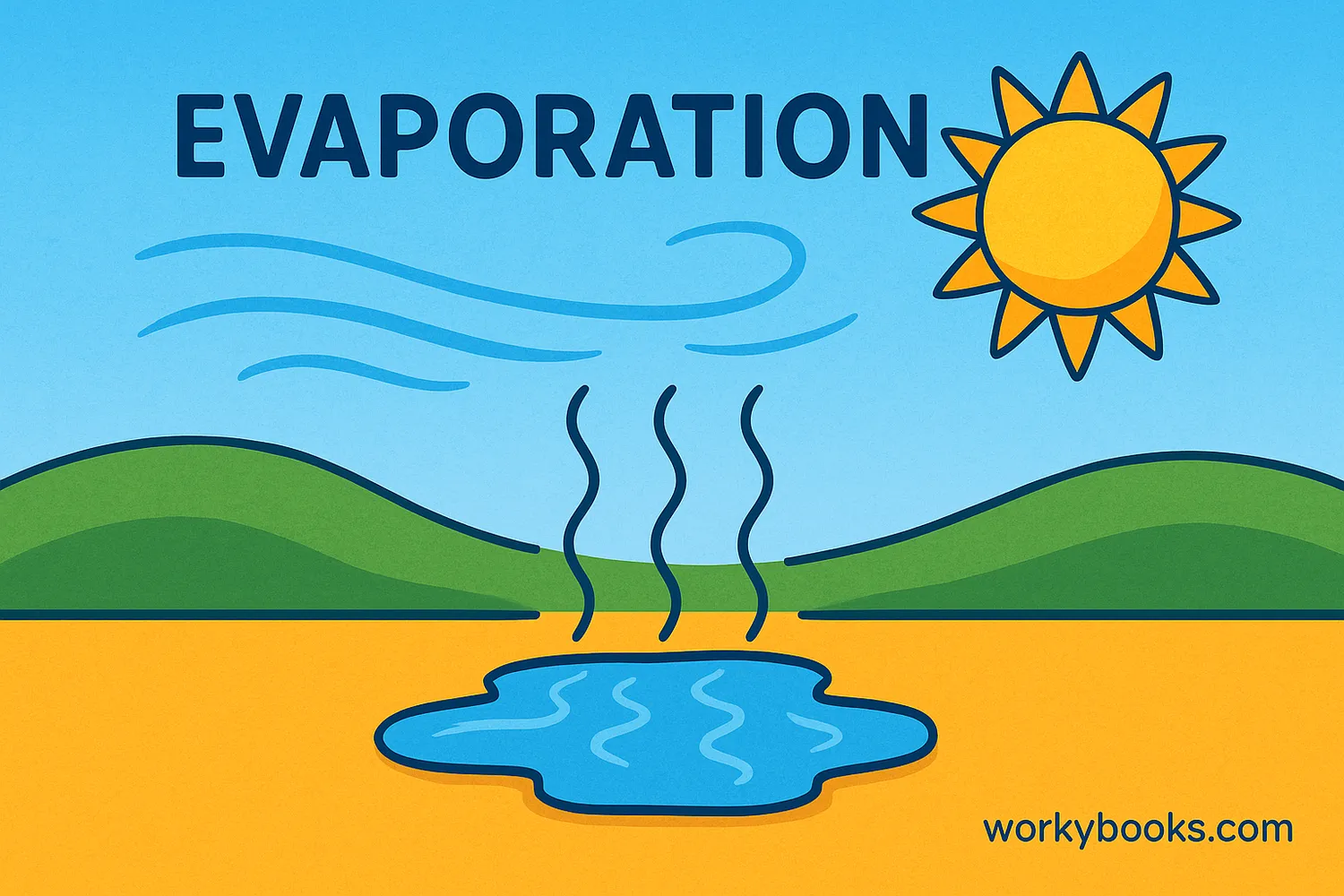
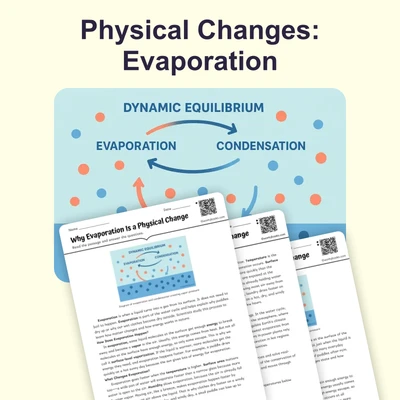
Evaporation is a physical change where liquid water turns into invisible water vapor, often driven by the sun's energy.
Evaporation is a process that is fundamental to the water cycle and a great example of a physical change. A physical change alters a substance's appearance or state of matter without changing its chemical composition. In other words, the substance remains the same substance at a molecular level, even if it looks different. Evaporation specifically describes the change of state from a liquid to a gas. This occurs when liquid particles at the surface gain enough energy to overcome the intermolecular forces holding them together and escape into the air as vapor.
Several factors influence the rate of evaporation. Higher temperatures provide more energy to the liquid particles, allowing them to escape more easily and increasing the rate of evaporation. A larger surface area also increases the rate because more particles are exposed to the air at once. The presence of a breeze or airflow over the surface removes the water vapor that has already evaporated, preventing the air from becoming saturated and allowing more liquid particles to escape. The humidity of the surrounding air is also a factor; lower humidity means the air can absorb more water vapor, thus increasing the rate of evaporation.
This process is a physical change because the water molecules themselves (H2O) do not change. Liquid water is made of H2O molecules, and water vapor (steam) is also made of H2O molecules. The molecules are simply farther apart and moving more quickly in the gaseous state than in the liquid state. No new substance is created. The reverse process, condensation, is also a physical change where water vapor cools and turns back into liquid water. Both evaporation and condensation are vital parts of the Earth's water cycle, which moves water between oceans, the atmosphere, and land.
A common example of evaporation in daily life is a puddle of water disappearing after a rainstorm on a sunny day. The sun provides the energy needed for the water molecules to evaporate, turning the liquid water into an invisible gas. Similarly, when wet clothes are hung outside on a clothesline, the wind and sun help the water to evaporate, causing the clothes to dry. These everyday occurrences highlight the simple yet crucial nature of this physical process.
Fun Fact: The evaporation of sweat from your skin is what cools you down. As sweat evaporates, it takes heat energy from your body with it, a process called evaporative cooling.
What is the main characteristic of a physical change?
The chemical composition changes.The substance remains the same.New substances are formed.Energy is always released.
What state change does evaporation describe?
Solid to liquid.Gas to liquid.Liquid to gas.Gas to solid.
Based on the passage, which factor would decrease the rate of evaporation?
Which of the following is an example of evaporation from the passage?
A puddle forming after rain.A substance turning into a new one.Wet clothes drying on a line.Water freezing into ice.
Why is evaporation considered a physical change?
New molecules are created.The molecules remain H2O.It requires energy.It happens quickly.
What happens to water molecules during evaporation?
They bond with other elements.They break apart into new atoms.They gain energy and move apart.They become denser and slower.
What is the primary purpose of the passage?
To explain the water cycle.To describe different types of changes.To define and explain evaporation as a physical change.To give examples of everyday physical changes.
If you want to make water evaporate faster from a shallow dish, what would be the most effective strategy?
Placing it in a cool, enclosed room.Increasing the depth of the water.Blowing air over its surface with a fan.Adding salt to the water.
Perfect For:
👩🏫 Teachers
• Reading comprehension practice
• Auto-graded assessments
• Literacy skill development
👨👩👧👦 Parents
• Reading practice at home
• Comprehension improvement
• Educational reading time
🏠 Homeschoolers
• Reading curriculum support
• Independent reading practice
• Progress monitoring
Reading Features:
📖
Reading Passage
Engaging fiction or nonfiction text
❓
Comprehension Quiz
Auto-graded questions
📊
Instant Feedback
Immediate results and scoring
📄
Printable Version
Download for offline reading
🔊
Read Aloud
Voice-over with word highlighting
Reviews & Ratings
No reviews yet. Be the first to share your experience!
Related Content
Physical Properties of Matter
This comprehensive reading passage introduces grades 6-8 students to the concept of physical properties of matter, perfe...
MS-PS1-1
Chemical Properties of Matter
This engaging middle school science passage explores the chemical properties of matter, focusing on how these properties...
MS-PS1-2
Changes in Matter
This engaging science passage introduces Grade 4-5 students to the concept of how matter can change, meeting NGSS standa...
Matter States Word Sort
This classification activity helps students understand how particles are arranged in different states of matter. Student...
5-PS1-1
Matter States Word Sort
This interactive word sort focuses on helping students understand the different states of matter through real-world exam...
PS1.A
What Are Physical Changes?
This engaging Grade 4-5 science passage introduces students to the concept of physical changes in matter, aligning with ...
Properties of Addition
This worksheet on the properties of addition will help students to practice this skill. All of the properties are define...
3.OA.B.5
Particle Model of Matter
This comprehensive science reading passage for grades 6-8 explores the particle model of matter, aligning with NGSS stan...
MS-PS1-1MS-PS1-4
Particle Movement Sort
This classification activity helps students understand particle movement in different materials. Students categorize sub...
5-PS1-1
Kinetic Theory of Matter
This middle school science reading passage introduces students to the kinetic theory of matter, aligning with NGSS MS-PS...
MS-PS1-4
Sorting Materials by Properties
In the 'Sorting Materials by Properties' activity, students sort various materials into categories such as 'Hard and Rig...
Properties of Addition— Commutative
This worksheet is perfect for practicing the commutative property. Students will practice this property as well as their...
1.OA.B.3-3
The Nature of Science
This passage explores the nature of science for middle school students, aligning with NGSS standards MS-ETS1-4, MS-PS1-1...
MS-ETS1-4MS-PS1-1MS-LS1-1
Science Vocabulary
This worksheet on domain-specific words will help students learn some science vocabulary. Students will be asked to matc...
L.3.6L.3.4.A
The Melting Point of Substances
This middle school science reading passage, titled 'The Melting Point of Substances', explores the physical property kno...
5-PS1MS-PS1-4RI.6.3RI.7.1
Properties of Communication Tools
The 'Properties of Communication Tools' word sort activity is crafted for first-grade students to meet NGSS 1-PS4-4 stan...
Simple Machines Science Report
This science writing task requires students to clearly explain how three simple machines work using precise domain-speci...
W.5.4
Physical Changes: Evaporation
This middle school science passage examines the process of evaporation, a fundamental physical change where a liquid tur...
MS-PS1-4
The Nature of Life Science
This passage, aligned with NGSS MS-LS1-1, introduces students in grades 6-8 to the foundational concepts of life science...