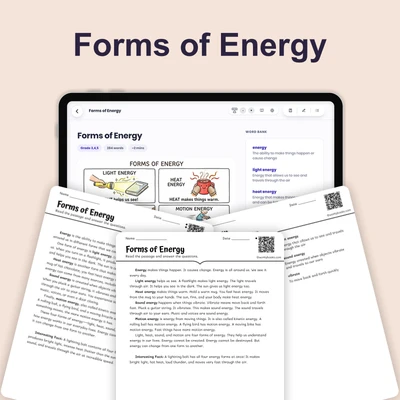
This learning resource is available in interactive and printable formats. The interactive worksheet can be played online and assigned to students. The Printable PDF version can be downloaded and printed for completion by hand.
This engaging 250-word reading passage introduces fourth-grade students to the fundamental concept of energy as outlined in NGSS standard 4-PS3-1. Students explore energy as the ability to make things happen and discover how energy is present in everyday life. The passage uses concrete, observable examples such as moving balls, glowing lamps, and ringing bells to help students understand that energy causes motion, heat, light, and sound. Aligned with PS3.A: Definitions of Energy, this resource builds foundational understanding through age-appropriate language and relatable scenarios. The passage includes audio integration for accessibility and engagement, along with comprehension activities, writing prompts, and graphic organizers. Students learn key vocabulary including energy, motion, and transfer while developing their ability to identify energy in the world around them. Perfect for introducing physical science concepts in elementary classrooms, this resource provides scaffolded instruction with both standard and simplified versions to meet diverse learner needs. The accompanying Spanish translations ensure accessibility for English language learners, making this an inclusive resource for all students as they begin their exploration of physical science.
CONTENT PREVIEW
Expand content preview
When you kick a soccer ball, the ball moves because you gave it motion energy. image credit Omar Ramadan / Pexels.
Energy is the ability to make things happen. Energy is what makes things move, get warmer, make light, or create sounds. Without energy, nothing would work in our world.
You can see energy all around you every day. When you kick a soccer ball, the ball moves because you gave it motion energy. The energy from your foot moved to the ball and made it roll across the field. A lamp glows because electrical energy changes into light energy. When you turn on the lamp, electricity flows through the bulb and creates light so you can see. A bell rings because energy makes it vibrate, which means it moves back and forth very quickly. These vibrations create sound waves that travel to your ears.
Energy can also create heat. When you rub your hands together quickly, they feel warm. The energy from the motion of your hands rubbing creates heat energy. A stove uses energy to cook food by making pots and pans hot.
Energy can transfer from one object to another. Transfer means to move from one place to another. When a bowling ball hits pins, energy moves from the ball to the pins, making them fall down. Energy is always needed to make things happen, whether it's making something move, heating it up, lighting it, or creating sound.
What is energy?
The ability to make things happenSomething that only makes lightA type of ballSomething found only in lamps
What happens when you kick a ball?
The ball stays stillEnergy moves from foot to ballThe ball makes lightThe ball gets cold
How does a lamp create light?
By using motion energyBy rubbing hands togetherBy changing electrical energy to lightBy making sound waves
Why does rubbing hands create heat?
Motion energy changes to heat energyHands have electricity in themAir around hands gets coldHands create light energy
What happens in energy transfer?
Energy disappears completelyEnergy stays in one placeEnergy moves from object to objectEnergy only makes sound
A stove uses energy to cook food.
TrueFalse
Energy is needed to make things happen.
TrueFalse
What does vibrate mean?
To stay completely stillTo move back and forth quicklyTo transfer energy slowlyTo create only light
Perfect For:
👩🏫 Teachers
• Reading comprehension practice
• Auto-graded assessments
• Literacy skill development
👨👩👧👦 Parents
• Reading practice at home
• Comprehension improvement
• Educational reading time
🏠 Homeschoolers
• Reading curriculum support
• Independent reading practice
• Progress monitoring
Reading Features:
📖
Reading Passage
Engaging fiction or nonfiction text
❓
Comprehension Quiz
Auto-graded questions
📊
Instant Feedback
Immediate results and scoring
📄
Printable Version
Download for offline reading
🔊
Read Aloud
Voice-over with word highlighting
Reviews & Ratings
No reviews yet. Be the first to share your experience!
Related Content
Forms of Energy
Energy Is Everywhere is an engaging science reading passage aligned with NGSS standard 4-PS3-1, designed for Grade 4-5 s...
NGSS 4-PS3-1
Height Affects Speed
This engaging science passage aligns with NGSS standard 4-PS3-1 and helps Grade 4-5 students understand how starting hei...
NGSS 4-PS3-1
Motion and Energy
This engaging 250-word science passage helps Grade 4-5 students understand the relationship between motion and energy, a...
NGSS 4-PS3-1
What Is Potential Energy
This 250-word reading passage introduces fourth-grade students to the fundamental concept of potential energy aligned wi...
NGSS 4-PS3-1
How Does a Slingshot Work
This 250-word reading passage introduces fourth-grade students to the concept of energy transformation using a slingshot...
NGSS 4-PS3-1
How to Measure Speed
This 250-word reading passage introduces fourth-grade students to the fundamental concept of speed and how it can be mea...