Wright Brothers Flight
Interactive passage with audio narration, comprehension questions, and printable PDF.
By completing this purchase you agree to our Terms of Use and Privacy Policy. Your subscription renews automatically until you cancel. You can cancel anytime from your account settings. All sales are final and non-refundable. Digital content is available for download in your account immediately upon purchase.
What's included
Part of this bundle

Wright Brothers Flight preview and details
About this printable Wright Brothers Flight reading passage (Grades 3-5)
Sample passage and quiz from Wright Brothers Flight
Reading passage and comprehension quiz preview
Wright Brothers Flight
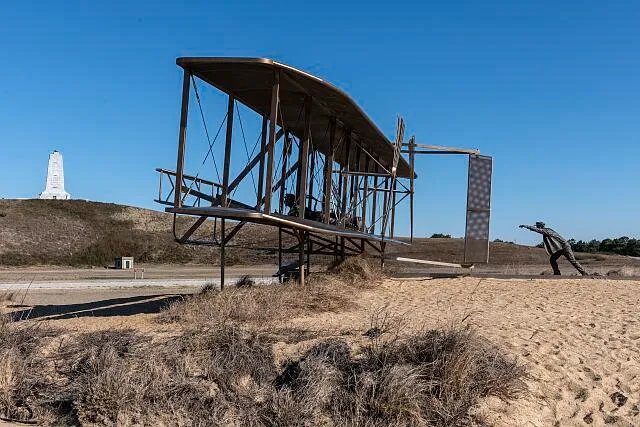
Source: Library of Congress - Highsmith, Carol M., 1946-
The Wright Brothers made history on December 17, 1903, at Kitty Hawk, North Carolina. On that cold, windy day, Orville and Wilbur Wright became the first people to fly a powered airplane. Their flight lasted only 12 seconds, but it changed the world forever.
Orville and Wilbur were brothers from Dayton, Ohio. They worked as bicycle mechanics. In their shop, they fixed bikes and built new ones. They were curious and loved to solve problems. They wondered if humans could fly like birds. Many people had tried before, but none had succeeded with a powered machine.
The Wright Brothers started to study flight in the late 1890s. They read books, watched birds, and experimented with gliders. They learned that control was the main problem. Many early inventors built machines that could lift off, but they could not steer them. Orville and Wilbur made hundreds of small tests. They designed wings and used a wind tunnel to test their ideas.
They chose Kitty Hawk for their experiments because it had strong winds and soft sand for safe landings. In 1903, they built a plane called the Wright Flyer. They added a small engine and propellers. On their fourth try, Orville climbed onto the plane. Wilbur helped steady the wings. The engine roared, and the plane lifted off the ground. It flew 120 feet in 12 seconds.
This first flight was a huge achievement. It showed that powered flight was possible. The Wright Brothers kept improving their planes. Soon, they could fly longer and higher. Their work was the start of modern aviation.
Their invention changed how people travel. Airplanes now connect people across the world. The courage and teamwork of the Wright Brothers helped shape history. Their story is a lesson in determination and innovation.
Interesting Fact: The Wright Brothers used parts from their bicycle shop to build the first airplane’s engine and controls!
Comprehension quiz (8 questions)
1. Where did the first flight happen?
2. Who helped steady the plane's wings?
3. How long did the first flight last?
4. Why did the Wright Brothers build a wind tunnel?
5. What did the Wright Brothers' flight start?
6. How did the Wright Brothers show determination?
7. The Wright Flyer could fly by itself. True or false?
8. What does 'aviation' mean?
Common Core standards for Wright Brothers Flight
Refer to details and examples in a text when explaining what the text says explicitly and when drawing inferences from the text.
Perfect for the way you teach
- Build comprehension skills
- Auto-graded quiz
- Differentiated reading
- Read together at home
- Improve fluency
- Quiet reading time
- Reading curriculum support
- Independent practice
- Track Lexile growth