
Passage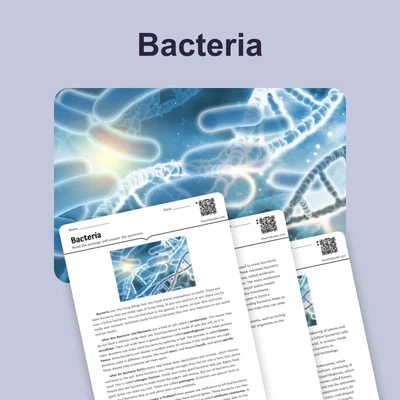
Grades 5–8
Bacteria
Reading Passage · MS-LS4-2
Free

Explore our collection of Classification curriculum resources for grades K-8, including worksheets, games, readers, and activities. These materials help students understand how scientists organize living and nonliving things, building foundational skills that grow with each grade level.
Reading Passage · MS-LS4-2
Reading Passage
Reading Passage
Reading Passage
Reading Passage
Three ways to use Workybooks — pick what fits.
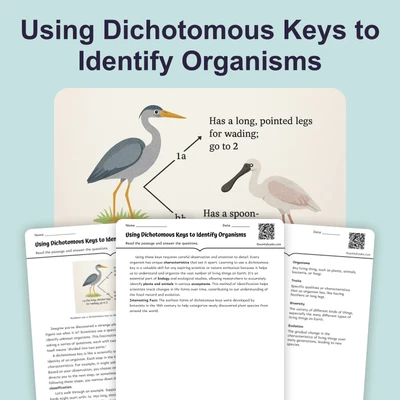
In the earliest grades, students begin with simple sorting by observable properties like color, shape, and size. They learn to group objects into basic categories such as living vs. nonliving, and plants vs. animals. As they progress through upper elementary, classification deepens: students use dichotomous keys, explore vertebrate and invertebrate groups, and learn about kingdoms of life. By grades 6-8, they apply hierarchical classification systems and understand evolutionary relationships.
These resources cover related concepts including animal groups, plant types, habitats, adaptations, and scientific vocabulary. Activities range from sorting mats and cut-and-paste worksheets to reading passages and interactive digital games. The scaffolded design ensures that students build on prior knowledge, making the progression from simple to complex classification seamless.
Teachers can use this hub to differentiate instruction across a mixed-ability classroom. For whole-group lessons, start with a printable anchor chart or a digital activity to introduce key vocabulary. Small groups can work on leveled sorting tasks or dichotomous key practice. Literacy centers may feature classification-themed reading passages with comprehension questions. Independent practice includes no-prep worksheets for homework or review. Intervention groups benefit from scaffolded graphic organizers, while advanced students tackle more complex classification systems. The mix of printable and digital resources allows flexibility for in-person, hybrid, or remote learning settings.
These resources are aligned to Common Core standards for reading informational texts and writing, as well as Next Generation Science Standards (NGSS) for life science across grades K-8. They support key skills such as comparing and contrasting, analyzing data, and constructing explanations.
Yes, many of our Classification worksheets are printable and ready for classroom use. Some resources are also available in digital format. While some items are free, most require a paid membership to access the full library.
Absolutely. Our Classification worksheets for kids span kindergarten through 8th grade, with content tailored to each developmental level. You can filter by grade to find age-appropriate activities.
Many worksheets and activities can serve as formative or summative assessments. Use sorting tasks, fill-in-the-blank sheets, or short reading quizzes to check understanding. Answer keys are included for easy grading.
Yes, we offer interactive digital games and printable game boards that make learning classification fun. These are great for centers, partner work, or whole-class review.