Dichotomous Keys
Interactive passage with audio narration, comprehension questions, and printable PDF.
By completing this purchase you agree to our Terms of Use and Privacy Policy. Your subscription renews automatically until you cancel. You can cancel anytime from your account settings. All sales are final and non-refundable. Digital content is available for download in your account immediately upon purchase.
What's included
Dichotomous Keys preview and details
About this printable Dichotomous Keys science reading passage, NGSS-aligned (Grade 6)
Sample passage and quiz from Dichotomous Keys
Reading passage and comprehension quiz preview
Using Dichotomous Keys to Identify Organisms
Imagine you've discovered a strange plant or a unique insect. How would you figure out what it is? Scientists use a special tool called a dichotomous key to identify unknown organisms. This fascinating tool helps us classify living things by asking a series of questions, each with two possible answers. The word "dichotomous" itself means "divided into two parts."
A dichotomous key is like a scientific treasure map that leads you to the correct identity of an organism. Each step in the key presents two opposing traits or characteristics. For example, it might ask: "Does the organism have feathers or not?" Based on your observation, you choose one of the two options. Each choice then directs you to the next step, or sometimes directly to the organism's name. By following these steps, you narrow down the possibilities until you reach the correct classification.
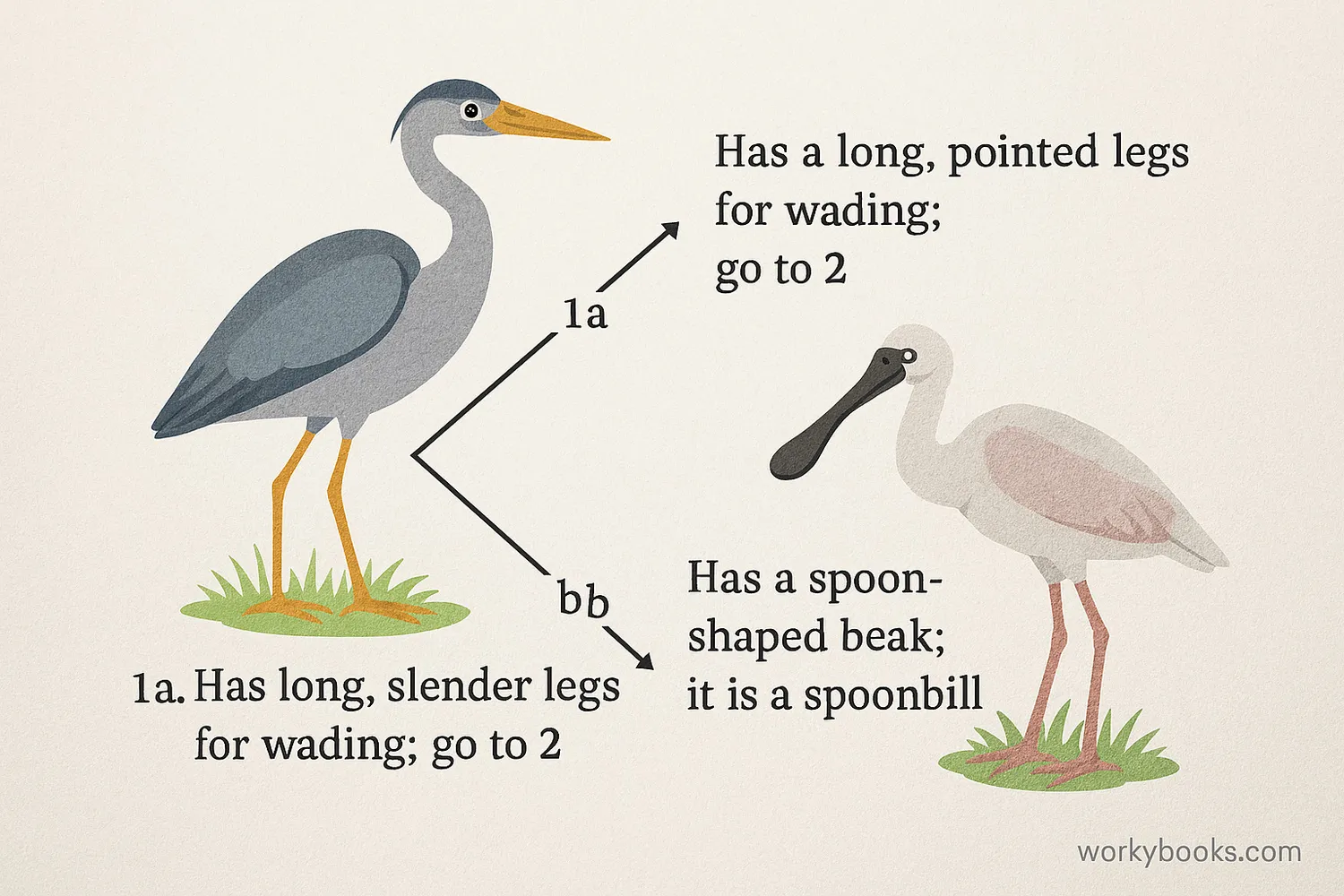
Let's walk through an example. Suppose you find a bird. A dichotomous key for birds might start with: 1a. Has long, slender legs for wading; go to 2. 1b. Has short, strong legs; go to 3. If your bird has long legs, you go to step 2. Step 2 might be: 2a. Has a long, pointed beak; it is a heron. 2b. Has a spoon-shaped beak; it is a spoonbill. You continue this process, carefully observing the organism's features like color, size, number of legs, or shape of leaves, until you find its scientific name. This systematic approach is crucial for understanding the diversity of life and how different species are related.
Using these keys requires careful observation and attention to detail. Every organism has unique characteristics that set it apart. Learning to use a dichotomous key is a valuable skill for any aspiring scientist or nature enthusiast because it helps us to understand and organize the vast number of living things on Earth. It's an essential part of biology and ecological studies, allowing researchers to accurately identify plants and animals in various ecosystems. This method of identification helps scientists track changes in life forms over time, contributing to our understanding of the fossil record and evolution.
Interesting Fact: The earliest forms of dichotomous keys were developed by botanists in the 18th century to help categorize newly discovered plant species from around the world.
Comprehension quiz (10 questions)
1. What is the primary purpose of a dichotomous key?
2. How many choices does each step in a dichotomous key typically offer?
3. Why is careful observation important when using a dichotomous key?
4. What does the word 'dichotomous' mean?
5. If a key asks if a bird has long legs and you choose that option, what happens next?
6. Which of these is NOT an example of a trait used in a dichotomous key?
7. Dichotomous keys are only used by professional scientists.
8. Why are dichotomous keys important in ecological studies?
9. Which scenario best describes applying a dichotomous key?
10. What term refers to the grouping of organisms based on shared traits?
Perfect for the way you teach
- Build comprehension skills
- Auto-graded quiz
- Differentiated reading
- Read together at home
- Improve fluency
- Quiet reading time
- Reading curriculum support
- Independent practice
- Track Lexile growth