Is Algae A Plant
Interactive passage with audio narration, comprehension questions, and printable PDF.
By completing this purchase you agree to our Terms of Use and Privacy Policy. Your subscription renews automatically until you cancel. You can cancel anytime from your account settings. All sales are final and non-refundable. Digital content is available for download in your account immediately upon purchase.
What's included
Is Algae A Plant preview and details
About this printable Is Algae A Plant science reading passage, NGSS-aligned (Grade 6)
Sample passage and quiz from Is Algae A Plant
Reading passage and comprehension quiz preview
Is Algae A Plant?
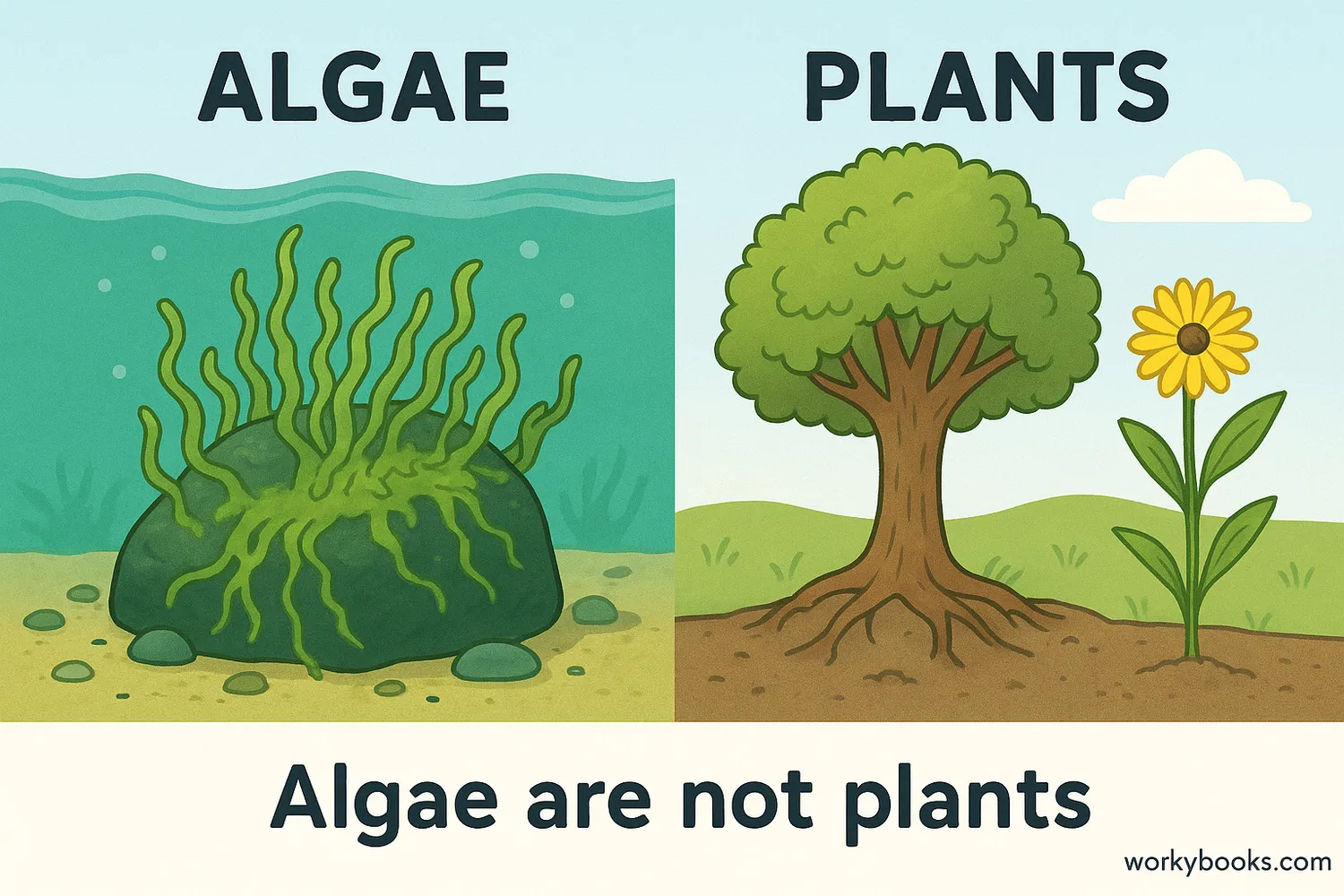
Imagine a pond covered in a slick, green film, or a rock in the ocean adorned with vibrant, waving strands. You might instantly think, "Plants!" But what if we told you that these common green organisms, known as algae, are not actually plants? This might seem surprising because algae share some similarities with plants, like their green color and their ability to make their own food. However, when scientists classify living things, they look beyond surface similarities to uncover deeper evolutionary relationships and fundamental structural differences.
One of the most important things algae and plants have in common is photosynthesis. This is the amazing process where organisms use sunlight, water, and carbon dioxide to create their own food and release oxygen. Both algae and plants perform photosynthesis, which is why they are so vital to life on Earth. They are both primary producers, meaning they form the base of many food webs.
So, if they both photosynthesize, what makes them different? The answer lies in their cell structure and body organization. True plants, like trees and flowers, have complex structures such as roots, stems, and leaves. These specialized parts help them survive and reproduce on land. They have true tissues and organs. Algae, on the other hand, lack these complex features. Many algae are unicellular, meaning they are made of only one cell. Others are multicellular, but their bodies are much simpler than plants, often forming filaments or sheets without true roots, stems, or leaves. They absorb nutrients directly from their watery environment.
Scientists classify algae as protists. Protists are a very diverse group of organisms that don't fit neatly into the categories of plants, animals, or fungi. Some protists are animal-like, some are fungus-like, and others, like algae, are plant-like. This classification is based on evolutionary relationships, which means how different species are related through a common ancestor over millions of years.
The earliest plants evolved from ancient green algae, but modern algae represent many different groups that have evolved along separate paths. While they share a common ancestor far back in time, the differences in their basic body plans and reproductive strategies mean they are distinct kingdoms of life. Understanding these differences helps us appreciate the incredible diversity and intricate web of life on our planet. So, the next time you see algae, remember you're looking at a fascinating protist, not a plant!
Interesting Fact: Some types of algae can glow in the dark, a phenomenon called bioluminescence, making ocean waves appear to sparkle at night!
Comprehension quiz (10 questions)
1. What process do both algae and plants use to make food?
2. What are algae classified as?
3. Algae are considered true plants.
4. Which term describes organisms made of only one cell?
5. Why do scientists classify algae and plants separately?
6. What does 'primary producers' mean in the passage?
7. How do true plants get nutrients?
8. Based on the passage, what is a key difference between a tree and algae?
9. If an organism makes its own food using sunlight, but lacks roots, stems, or leaves, what is it most likely?
10. Why is it important to understand evolutionary relationships in classification?
Perfect for the way you teach
- Build comprehension skills
- Auto-graded quiz
- Differentiated reading
- Read together at home
- Improve fluency
- Quiet reading time
- Reading curriculum support
- Independent practice
- Track Lexile growth