Gymnosperms vs Angiosperms
Interactive passage with audio narration, comprehension questions, and printable PDF.
By completing this purchase you agree to our Terms of Use and Privacy Policy. Your subscription renews automatically until you cancel. You can cancel anytime from your account settings. All sales are final and non-refundable. Digital content is available for download in your account immediately upon purchase.
What's included
Gymnosperms vs Angiosperms preview and details
About this printable Gymnosperms vs Angiosperms science reading passage, NGSS-aligned (Grade 6)
Sample passage and quiz from Gymnosperms vs Angiosperms
Reading passage and comprehension quiz preview
Angiosperms vs. Gymnosperms
Imagine a world bursting with green, from towering trees to tiny mosses. Plants are incredible, and they come in many forms, each with unique ways of growing and reproducing. Among the most common plants are those that produce seeds. These seed plants can be divided into two main groups: Angiosperms and Gymnosperms. Understanding the differences between them helps us see how plants have changed over millions of years.
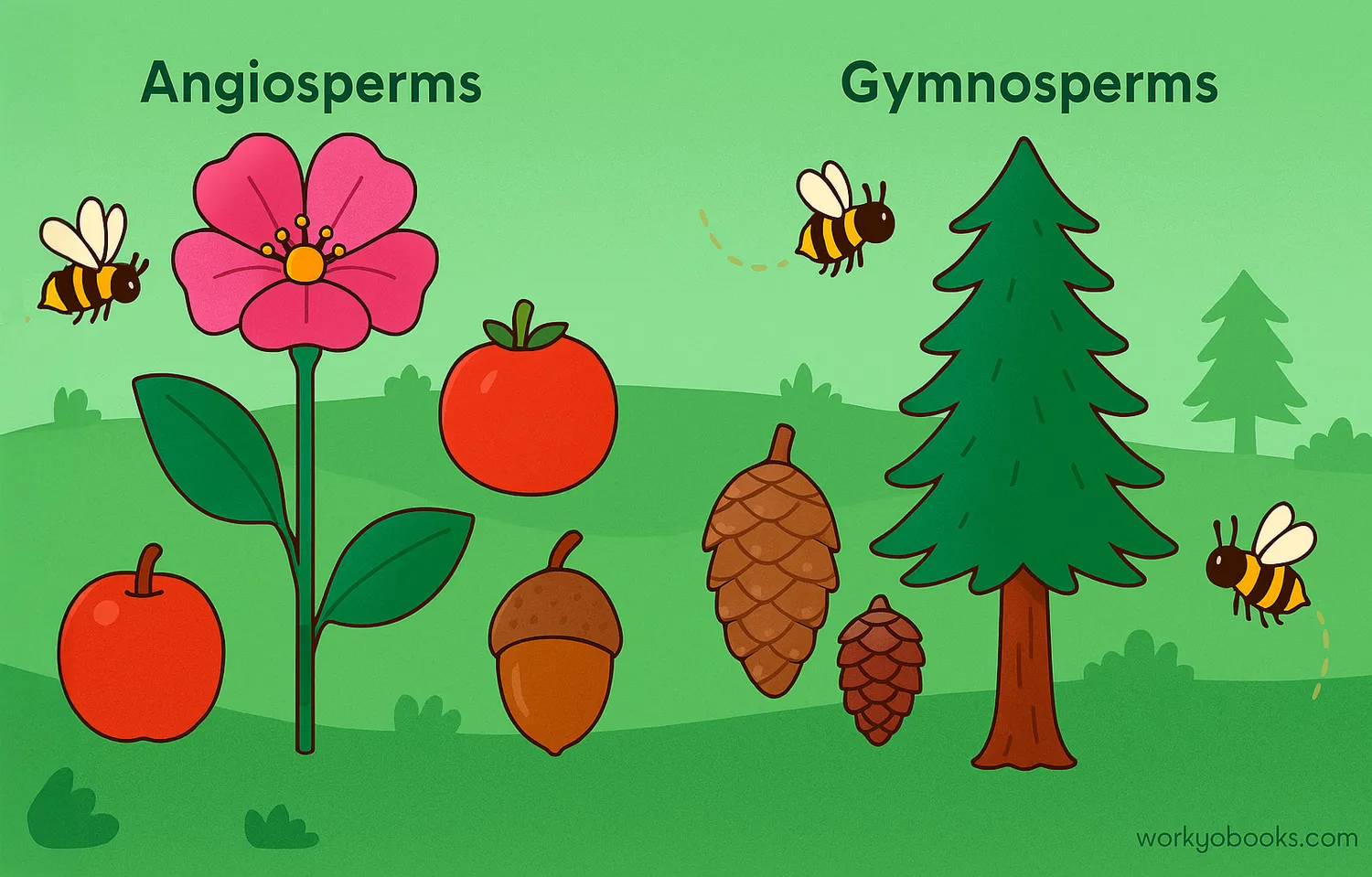
Let's start with Angiosperms. You probably see these plants every day! Angiosperms are also known as flowering plants. Their most defining feature is, of course, their flowers. Flowers are not just pretty; they are the reproductive parts of the plant. Inside the flower, tiny pollen grains are made. Animals like bees or the wind help move this pollen to another flower, a process called pollination. After pollination, the flower develops a fruit, which encloses and protects the seeds. Think of an apple, a tomato, or even an acorn – these are all fruits developed from flowers, each holding seeds inside. This protection is a big advantage for seed dispersal and survival. Most of the plants we eat, like corn, beans, and oranges, are angiosperms.
Now, let's look at Gymnosperms. These plants are very ancient, and their name means 'naked seed.' Unlike angiosperms, gymnosperms do not produce flowers or fruits. Instead, their seeds are 'naked,' meaning they are not enclosed within a fruit. Where do they keep their seeds? In cones! The most common gymnosperms are coniferous trees like pines, spruces, and firs. Think of a pinecone – those woody structures are where the seeds are formed and protected. The wind carries pollen from one cone to another. Gymnosperms are often evergreen, meaning they keep their leaves (needles) all year round. They are well-adapted to colder and drier climates.
So, the key difference comes down to reproduction: Angiosperms use flowers and fruits to protect their seeds, while Gymnosperms use cones with 'naked' seeds. These distinct reproductive structures reflect different evolutionary paths, showing how plants have adapted and diversified over time to thrive in various environments. Both groups are vital parts of our planet's ecosystems.
Interesting Fact: The smallest known angiosperm is the duckweed, which is so tiny it can be mistaken for algae floating on water surfaces.
Comprehension quiz (10 questions)
1. Which structure holds Angiosperm seeds?
2. What protects Gymnosperm seeds?
3. Angiosperms are also known as:
4. What does 'naked seed' refer to?
5. Which plant group is likely older?
6. How do Angiosperms usually disperse seeds?
7. A plant with bright petals is likely a:
8. Pine trees are examples of Gymnosperms.
9. Which describes 'pollination'?
10. Why are fruits important for angiosperms?
Perfect for the way you teach
- Build comprehension skills
- Auto-graded quiz
- Differentiated reading
- Read together at home
- Improve fluency
- Quiet reading time
- Reading curriculum support
- Independent practice
- Track Lexile growth