Bacteria
Interactive passage with audio narration, comprehension questions, and printable PDF.
What's included
Bacteria preview and details
About this printable Bacteria science reading passage, NGSS-aligned (Grades 5-8)
Sample passage and quiz from Bacteria
Reading passage and comprehension quiz preview
Bacteria
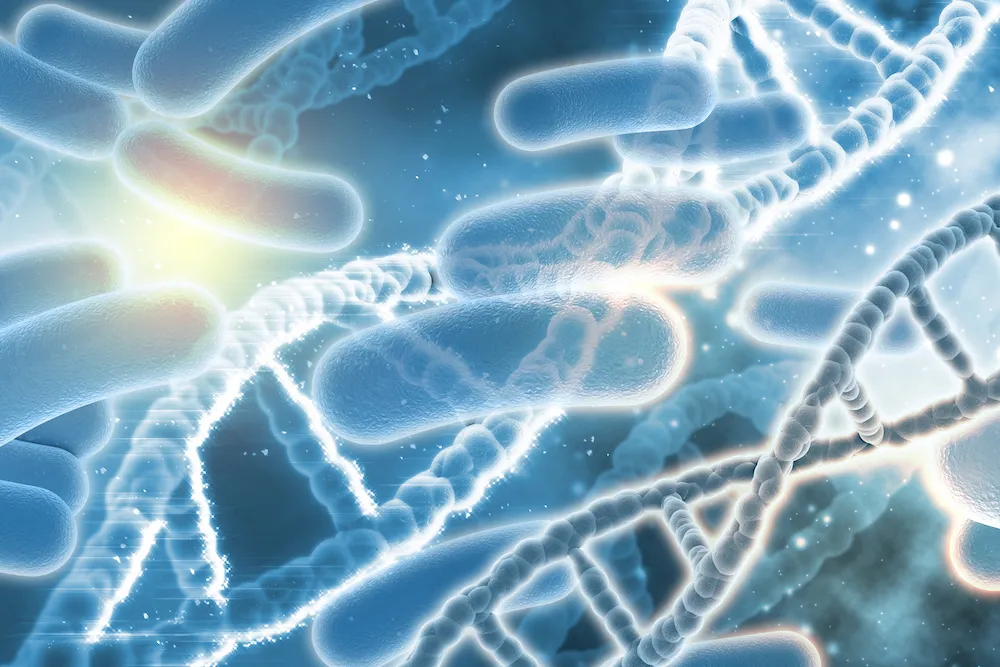
Bacteria are the most abundant life forms on Earth, outnumbering all plants and animals combined. In just one gram of soil, there can be over a billion bacterial cells. These tiny organisms are found everywhere—deep underground, in oceans, inside your body, and even at the tops of mountains. Scientists study bacteria to understand their important roles in the environment, health, and technology.
What Makes Bacteria Unique?
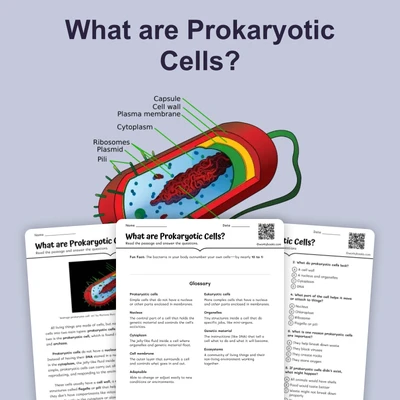
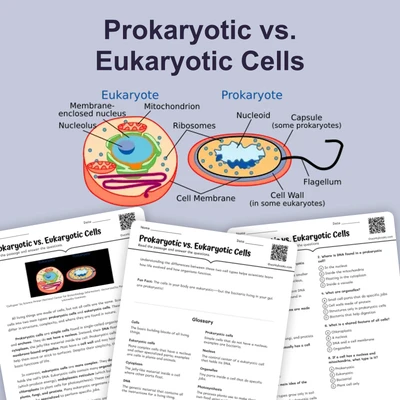
Bacteria are classified as prokaryotes, which means their cells do not have a nucleus. Each bacterium is unicellular, consisting of just one cell. Their cell walls contain a special molecule called peptidoglycan, which gives them shape and protection. Bacteria reproduce by a process called binary fission, where one cell splits into two identical cells. This process can be extremely fast; under ideal conditions, some bacteria can double their population every 20 minutes. Bacteria come in different shapes, such as spherical cocci, rod-shaped bacilli, and spiral spirilla. These shapes can help scientists identify and classify bacteria.
Bacteria's Roles in Nature and Society
Bacteria are essential for life on Earth. They act as decomposers, breaking down dead plants and animals and recycling nutrients into the soil. Some bacteria perform nitrogen fixation, converting nitrogen from the air into a form that plants can use to grow. In the human body, particularly in the gut, bacteria help with digestion and protect against harmful microbes. Humans also use bacteria to produce foods like yogurt and cheese. However, not all bacteria are helpful. Some act as pathogens, causing diseases such as strep throat, tuberculosis, and food poisoning. Scientists use microscopes and laboratory tests to distinguish helpful bacteria from harmful ones.
Antibiotic Resistance and Evolution
When antibiotics are used to treat bacterial infections, some bacteria survive due to genetic mutations. These resistant bacteria then multiply, making the infection harder to treat. This process, called antibiotic resistance, is a clear example of evolution by natural selection. The more antibiotics are used, the faster resistant bacteria can spread. This is a major public health challenge, requiring careful management and research into new treatments.
Bacteria are much more than just germs. They are key players in Earth's ecosystems, human health, and scientific discovery. Understanding bacteria helps us find new ways to benefit from their powers while controlling the risks they can pose.
Interesting Fact:
Some bacteria can survive extreme environments, such as boiling hot springs or deep-sea vents, making them among the hardiest organisms on the planet.
Comprehension quiz (10 questions)
1. What is the main reason bacteria are considered the most abundant life form on Earth?
2. Which structure gives bacteria their shape and protection?
3. How do bacteria reproduce?
4. What does 'unicellular' mean as used in the passage?
5. What is a 'pathogen' according to the text?
6. Why is antibiotic resistance considered an example of evolution?
7. Which of the following is NOT a beneficial role of bacteria mentioned in the passage?
8. If a new antibiotic is used frequently, what might happen to bacterial populations?
9. True or False: Bacteria are only found in dirty places.
10. True or False: Some bacteria help make foods like yogurt and cheese.
Perfect for the way you teach
- Build comprehension skills
- Auto-graded quiz
- Differentiated reading
- Read together at home
- Improve fluency
- Quiet reading time
- Reading curriculum support
- Independent practice
- Track Lexile growth