Archaea
Interactive passage with audio narration, comprehension questions, and printable PDF.
By completing this purchase you agree to our Terms of Use and Privacy Policy. Your subscription renews automatically until you cancel. You can cancel anytime from your account settings. All sales are final and non-refundable. Digital content is available for download in your account immediately upon purchase.
What's included
Archaea preview and details
About this printable Archaea science reading passage, NGSS-aligned (Grade 6)
Sample passage and quiz from Archaea
Reading passage and comprehension quiz preview
How Ancient Archaea Shape Our Planet
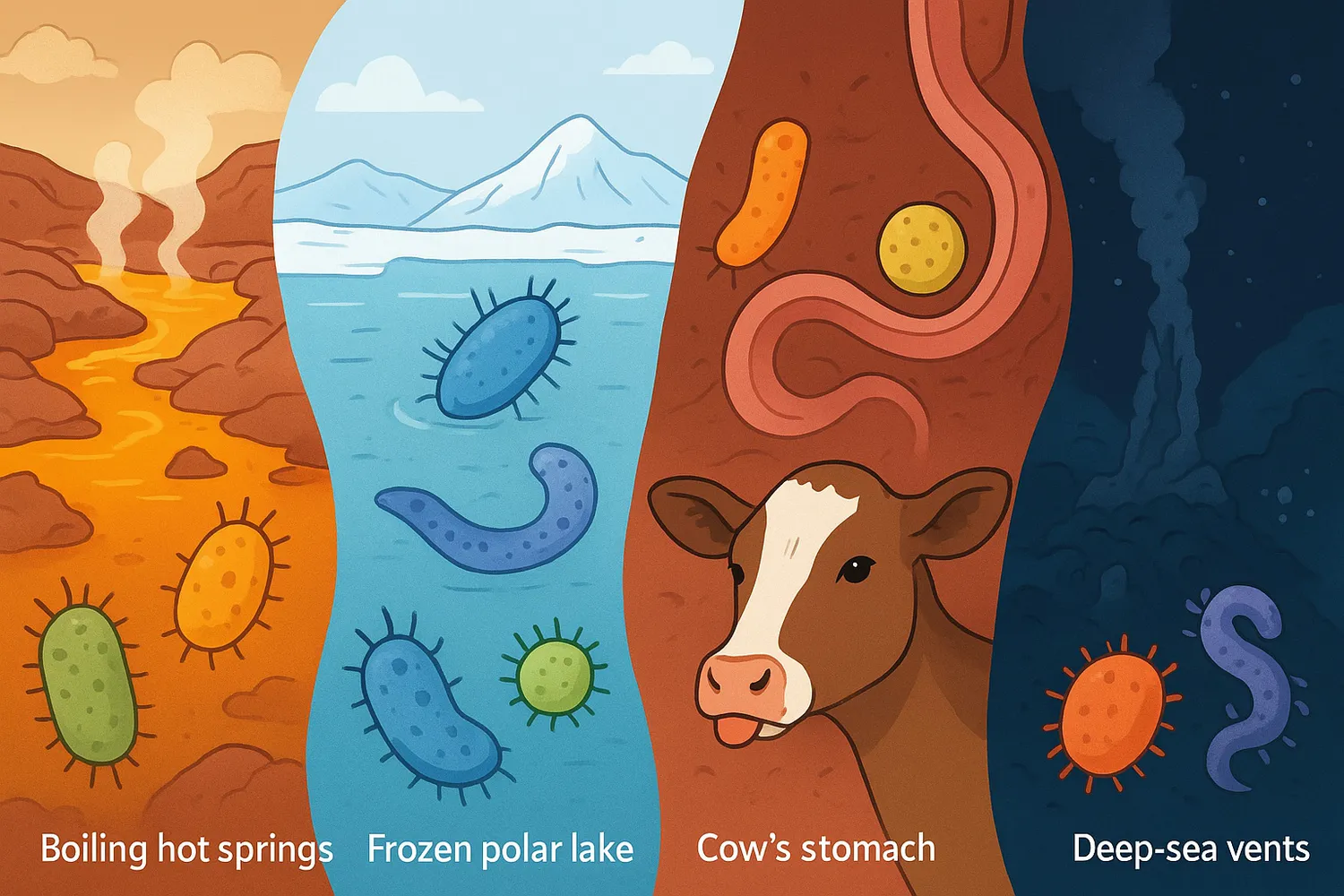
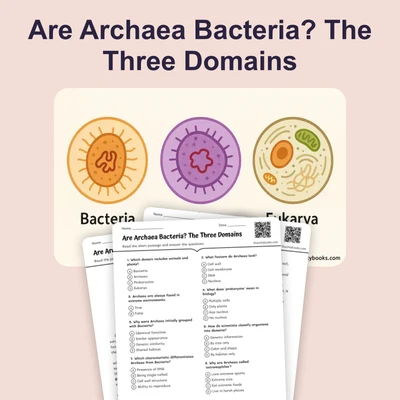
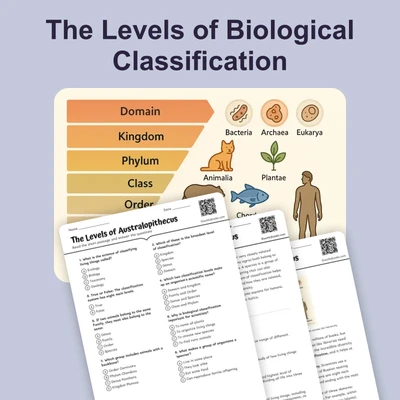
Life can be found in some of the most extreme environments on Earth—boiling hot springs, frozen polar lakes, and even the oxygen-free depths of a cow’s stomach. Thriving in these seemingly uninhabitable places are Archaea, a fascinating group of microscopic organisms. Although they may look similar to bacteria, Archaea belong to their own distinct domain of life, representing a separate and ancient branch on the tree of life.
Archaea are among the oldest life forms on Earth, emerging billions of years ago. Their ancient lineage makes them crucial for understanding the history of life on our planet. They are known for their ability to thrive in extreme conditions, earning them the nickname extremophiles. Some Archaea flourish in temperatures above the boiling point of water, others in highly acidic environments, or even in places with extremely high salt concentrations. These unique adaptations allow them to colonize habitats where most other life forms would perish.
Beyond their ability to survive in harsh places, Archaea play a fundamental role in Earth's biogeochemical cycles. These are natural pathways by which elements like carbon, nitrogen, and sulfur move through the Earth's living and non-living components. Without Archaea, these essential cycles would not function properly, impacting all other life on Earth. For instance, some Archaea are methanogens, meaning they produce methane gas. Methane is a potent greenhouse gas, contributing to the Earth's climate regulation. These methanogens are found in diverse environments, from wetlands and rice paddies to the digestive tracts of animals like cows and humans.
Other types of Archaea are vital for nitrogen fixation. Nitrogen is an essential element for building proteins and DNA in all living things. Although nitrogen gas is abundant in the atmosphere, most organisms cannot use it directly. Nitrogen-fixing Archaea convert atmospheric nitrogen into forms that plants can absorb, making it available to the entire food web. Without this process, the growth of plants and, consequently, all animal life would be severely limited.
Archaea also participate in the sulfur cycle, converting sulfur compounds in ways that support other microbial communities, often in deep-sea vents where sunlight doesn't reach. Here, they use chemosynthesis, a process similar to photosynthesis but using chemical energy instead of light, to produce food. Their ancient presence and continued activity highlight their incredible resilience and their irreplaceable contributions to maintaining our planet's delicate balance. These microscopic titans truly shape the world we live in.
Interesting Fact: Some Archaea living in extremely salty environments are so vibrant that they can turn entire salt flats and bodies of water, like the Great Salt Lake, pink or red!
Comprehension quiz (10 questions)
1. Which of the following is true about Archaea?
2. What is the primary characteristic of 'extremophiles'?
3. Archaea are essential for which cycles on Earth?
4. How do methanogens contribute to Earth's climate?
5. Why is nitrogen fixation by Archaea important?
6. Which process is similar to photosynthesis but uses chemical energy?
7. Archaea are a relatively new discovery.
8. If Archaea disappeared, what would likely happen to nitrogen cycles?
9. What term refers to major branches of life?
10. Predict what an environment might be like if it were home to thermophilic Archaea.
Perfect for the way you teach
- Build comprehension skills
- Auto-graded quiz
- Differentiated reading
- Read together at home
- Improve fluency
- Quiet reading time
- Reading curriculum support
- Independent practice
- Track Lexile growth