
Passage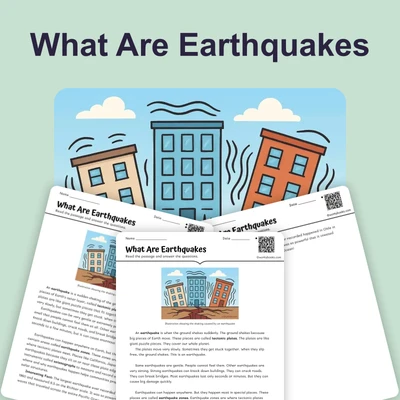
Grades 3–5
What Are Earthquakes
Reading Passage · NGSS 4-ESS3-2
$1.50

Explore our collection of Earthquakes curriculum resources for grades K to 8, including worksheets, reading passages, games, and activities. These teacher-authored materials help students understand the science of earthquakes, from basic concepts to advanced analysis. Whether you teach kindergarten or middle school, you'll find no-prep, standards-aligned resources to support your lessons.
Reading Passage · NGSS 4-ESS3-2
Reading Passage · NGSS 4-ESS3-2
Reading Passage · NGSS 4-ESS3-2
Reading Passage · MS-ESS3-2
Three ways to use Workybooks — pick what fits.
In the earliest grades, students learn what an earthquake is and how the ground shakes. They explore vocabulary like fault, epicenter, and seismic waves through simple diagrams and hands-on activities. As students move into upper elementary, they investigate plate tectonics, the ring of fire, and how earthquakes are measured using the Richter and Mercalli scales. By middle school, students analyze real-world case studies, interpret seismograms, and explore engineering solutions like building earthquake-resistant structures.
Related concepts include tectonic plates, faults (normal, reverse, strike-slip), tsunamis, liquefaction, and seismology. Resources build skills in reading comprehension, data interpretation, cause-and-effect reasoning, and scientific writing. The progression ensures that foundational knowledge supports deeper inquiry, making this hub useful for introducing, reinforcing, or extending learning across multiple grade levels.
Use this hub to differentiate across a mixed-ability classroom. Choose simpler reading passages and matching activities for struggling learners, and challenge advanced students with data analysis tasks or engineering design projects. Resources work well for whole-group instruction, small-group centers, independent practice, homework, intervention, and review. Mix printable worksheets for hands-on work with digital games for engagement. The scaffolded design lets you assign the same topic at different complexity levels, making it easy to meet every student where they are.
These resources align with grade-level Common Core standards for reading informational text and writing, as well as Next Generation Science Standards (NGSS) for Earth science across grades K-8. Specific standard codes vary by grade and resource.
Yes, many of our Earthquakes worksheets are printable and can be downloaded as PDFs. Some are free, while others require a paid membership. You can also use the digital versions for online assignments.
Yes, our Earthquakes worksheets for kids span grades K to 8. Each resource is labeled with a suggested grade range, so you can pick the right level for your child or students. Topics progress from basic earthquake facts to plate tectonics and seismic data analysis.
Yes, we offer a variety of reading passages about earthquakes at different reading levels. Each passage includes comprehension questions and is designed to build science literacy while teaching key concepts like fault lines and earthquake safety.
Our resources are designed for differentiation. You can assign the same topic, like earthquake causes, using a simpler worksheet for younger students and a more complex one for older students. The scaffolded materials make it easy to teach a single concept across multiple grade levels.