How Seismographs Detect Earthquakes — Reading Comprehension
Rate this
Premium Resource
Present
Present in classroom. No work saved
Assign
Classroom with student accounts, Track progress
Quick Play
No student accounts, assign with a link
Grades
6
7
8
Standards
MS-ESS3-2
PRINT+DIGITAL RESOURCE
This learning resource is available in interactive and printable formats. The interactive worksheet can be played online and assigned to students. The Printable PDF version can be downloaded and printed for completion by hand.
This comprehensive 650-word reading passage explains how seismographs detect earthquakes for middle school students in grades 6-8. Students learn how seismographs measure ground motion caused by seismic waves, how networks of seismographs allow scientists to locate earthquake epicenters, determine magnitude, and map fault activity. The passage connects seismic monitoring to earthquake hazard assessment and early warning systems. Aligned with NGSS science standard MS-ESS3-2, this audio-integrated resource includes a simplified differentiated version for struggling readers and English Language Learners, Spanish translations, glossary of key terms, multiple-choice questions, writing activities, and graphic organizers. Students explore real-world applications of seismograph technology in protecting communities from earthquake hazards. The passage uses clear, grade-appropriate language with scientific terminology defined in context, making complex earth science concepts accessible to all learners.
CONTENT PREVIEW
Expand content preview
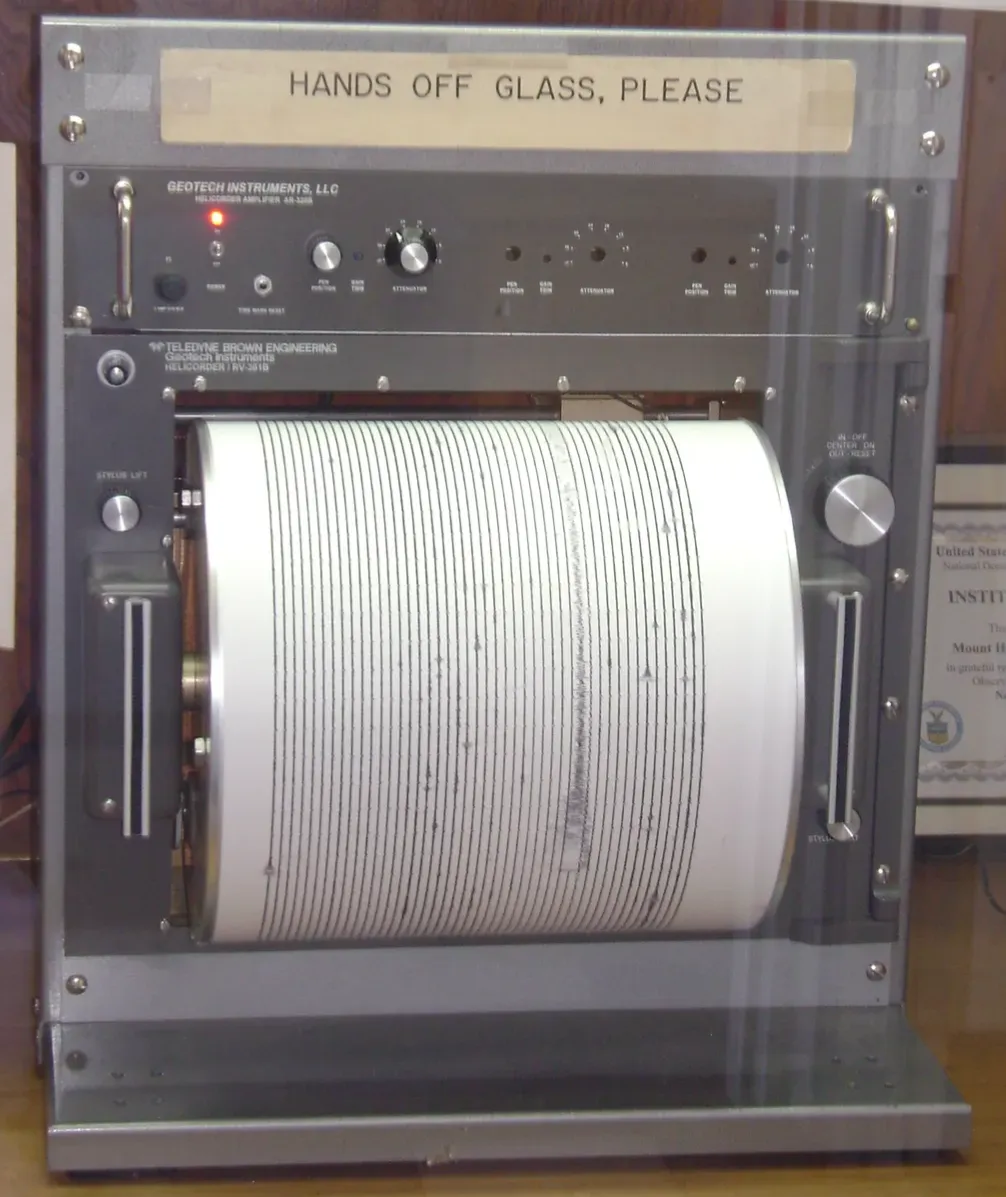
Seismometer at Lick Observatory by Oleg Alexandrov / Wikimedia Commons
A seismograph is an instrument that detects and records ground motion caused by earthquakes. When an earthquake occurs, it releases energy in the form of seismic waves that travel through Earth's layers and across its surface. Seismographs contain a suspended weight that remains nearly still while the ground and instrument shake around it. As the Earth moves, a pen attached to the weight draws a wavy line on a rotating drum or digital recorder, creating a seismogram. This record shows the arrival times and strengths of different seismic wave types.
Seismographs detect three main types of seismic waves. Primary waves (P-waves) arrive first because they travel fastest through rock. Secondary waves (S-waves) arrive next and cause more ground shaking. Surface waves arrive last but cause the most damage to buildings and structures. By measuring the time difference between P-wave and S-wave arrivals, scientists can calculate how far away an earthquake occurred. However, one seismograph alone cannot determine the earthquake's location, only its distance.
Networks of seismographs work together to pinpoint an earthquake's epicenter, which is the point on Earth's surface directly above where the earthquake started underground. Scientists need data from at least three seismograph stations to locate an epicenter using a process called triangulation. Each station calculates its distance from the earthquake, and scientists draw circles with those distances as radii around each station on a map. The point where all three circles intersect marks the epicenter location.
Seismograph networks also help scientists determine earthquake magnitude, which measures the energy released during an earthquake. The Richter scale and moment magnitude scale use seismogram wave heights and other data to assign magnitude values. A magnitude 5.0 earthquake releases about 32 times more energy than a magnitude 4.0 earthquake. Modern seismograph networks transmit data in real time to monitoring centers, allowing scientists to issue warnings within seconds of detecting strong shaking.
Scientists use seismograph data to map fault activity and assess earthquake hazards in different regions. Faults are breaks in Earth's crust where earthquakes occur. By recording thousands of small earthquakes over time, scientists identify active fault zones and estimate how often large earthquakes might strike specific areas. This information helps communities develop building codes, emergency plans, and early warning systems. For example, Japan's earthquake early warning system uses a dense network of seismographs to detect P-waves and send alerts to millions of people before the more damaging S-waves and surface waves arrive, giving them precious seconds to take cover.
Modern seismograph technology has advanced significantly from early mechanical instruments. Today's digital seismographs are more sensitive and can detect tiny ground movements from earthquakes thousands of miles away. Global seismograph networks share data instantly via the internet, creating a worldwide earthquake monitoring system. Scientists also use ocean-bottom seismographs to study earthquakes beneath the seafloor and monitor tsunami-generating earthquakes. This comprehensive monitoring helps protect communities and advance our understanding of Earth's dynamic processes.
Interesting Fact: The most sensitive seismographs can detect ground movements smaller than the width of a human hair, allowing scientists to record earthquakes occurring anywhere on Earth.
What does a seismograph detect and record?
Ground motion caused by earthquakesTemperature changes in Earth's coreWind speed during stormsOcean wave heights
Which type of seismic wave arrives first at a seismograph station?
How many seismograph stations are needed to locate an earthquake's epicenter?
One stationTwo stationsAt least three stationsTen stations
What is the epicenter of an earthquake?
The deepest point underground where the earthquake startsThe point on Earth's surface directly above where the earthquake startedThe location of the seismograph stationThe area with the most damage
In the context of the passage, what does 'magnitude' mean?
The distance from the epicenterThe depth of the earthquakeA measurement of the energy released during an earthquakeThe number of aftershocks
What is a 'fault' as described in the passage?
An error in seismograph readingsA break or crack in Earth's crust where earthquakes occurA type of seismic waveA damaged building after an earthquake
Why do scientists use networks of seismographs instead of just one seismograph?
To make the instruments more expensiveTo pinpoint the earthquake's epicenter location using triangulationTo measure temperature changesTo predict weather patterns
How does Japan's earthquake early warning system help protect people?
It stops earthquakes from happeningIt detects P-waves and sends alerts before more damaging waves arriveIt builds stronger buildings automaticallyIt moves people to safe locations
True or False: A magnitude 5.0 earthquake releases about 32 times more energy than a magnitude 4.0 earthquake.
TrueFalse
True or False: Surface waves arrive first but cause the least damage to buildings.
TrueFalse
Perfect For:
👩🏫 Teachers
• Reading comprehension practice
• Auto-graded assessments
• Literacy skill development
👨👩👧👦 Parents
• Reading practice at home
• Comprehension improvement
• Educational reading time
🏠 Homeschoolers
• Reading curriculum support
• Independent reading practice
• Progress monitoring
Reading Features:
📖
Reading Passage
Engaging fiction or nonfiction text
❓
Comprehension Quiz
Auto-graded questions
📊
Instant Feedback
Immediate results and scoring
📄
Printable Version
Download for offline reading
🔊
Read Aloud
Voice-over with word highlighting
Reviews & Ratings
No reviews yet. Be the first to share your experience!
Related Content
Natural Disaster: Earthquake
Earthquakes occur when tectonic plates move, causing the ground to shake. Understanding earthquakes helps us prepare and...
RI.3.1RI.4.4RI.4.2RI.5.2
Volcanic Eruptions: Causes, Types, and Key Features
This science passage explains volcanic eruptions, aligned with NGSS MS-ESS3-2 (natural hazards) and ESS2-2 (Earth’s syst...
MS-ESS3-2MS-ESS2-2RST.6-8.3
Obsidian: The Natural Glass Rock
This science reading passage explores obsidian, a volcanic glass that forms when lava cools so rapidly that crystals can...
MS-ESS2-3MS-ESS3-2RST.6-8.4
Kīlauea Volcano: Hawaii’s Ever-Changing Landscape
This passage details Kīlauea's volcanic history and status, aligned with NGSS MS-ESS3-2 (natural hazards) and ESS2-3 (Ea...
MS-ESS3-2MS-ESS2-3RST.6-8.2
All About Seismometers
This informational science passage explores seismometers and their role in measuring earthquakes, designed specifically ...
MS-ESS3-2MS-ESS2-3RST.6-8.2
What Is the Difference Between Magma and Lava?
This educational reading passage explains the critical difference between magma and molten rock beneath Earth's surface ...
MS-ESS2-3MS-ESS3-2RST.6-8.4
Measuring Hurricane Intensity – The Saffir-Simpson Hurricane Wind Scale
This NGSS-aligned science reading passage explains how the Saffir-Simpson Hurricane Wind Scale is used to measure the in...
MS-ESS3-2
Tools and Technology in Earth Science
This middle school science reading passage explores the wide range of tools and technologies used in Earth science, from...
MS-ESS2-2MS-ESS3-2MS-ETS1-1MS-PS4-3
Types of Maps
This engaging science passage for grades 6-8 introduces students to the various types of maps and their uses, supporting...
MS-ESS2-2MS-ESS3-2MS-ETS1-1MS-ETS1-4
Mass Movements
This NGSS-aligned passage introduces middle school students to the science of mass movements—gravity-driven motions of r...
MS-ESS2-1MS-ESS3-2
What Causes Earthquakes?
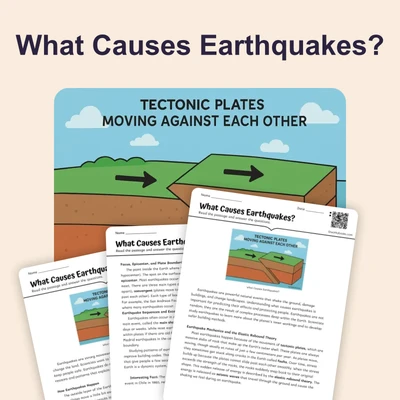
This middle school science passage explains what causes earthquakes, focusing on the interactions between tectonic plate...
MS-ESS2-2MS-ESS3-2
Floods: Causes and Types
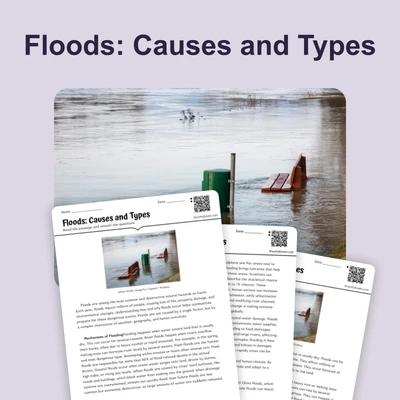
This middle school science passage provides a comprehensive look at floods, their causes, types, and impacts, addressing...
MS-ESS3-2
Hurricanes and Tropical Cyclones
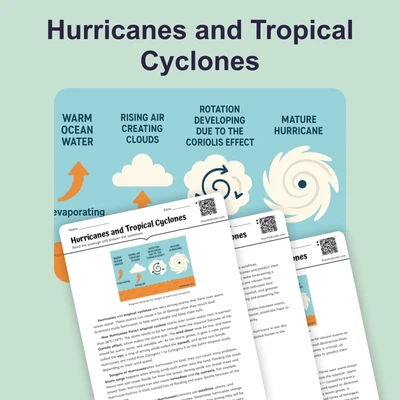
This in-depth passage for grades 6-8 covers hurricanes and tropical cyclones, aligning with NGSS standards MS-ESS3-2 and...
MS-ESS3-2MS-ESS2-5
Hurricane Preparedness and Safety
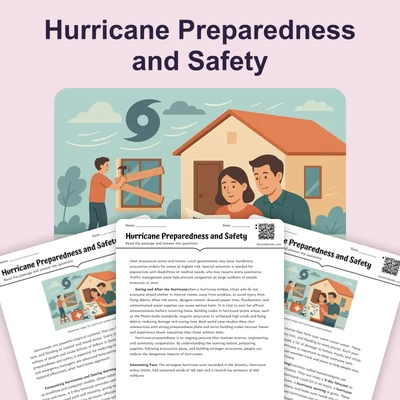
This passage explores the science and practical strategies of hurricane preparedness and safety, designed for middle sch...
MS-ESS3-2MS-ETS1-1
Tornadoes
This informational science passage for grades 6-8 explores the science of tornadoes, aligning with NGSS standards MS-ESS...
MS-ESS3-2MS-ESS2-5
Tsunamis
This middle school science passage explores tsunamis, focusing on their causes, characteristics, and impacts. Students w...
MS-ESS3-2
Tsunami Warning and Safety
This comprehensive middle school science passage examines the systems and science behind tsunami warning and safety. Ali...
MS-ESS3-2
Earthquake Hazards and Damage
This middle school science reading passage examines the hazards and damage caused by earthquakes, aligned with NGSS MS-E...
MS-ESS3-2
Earthquake Zones and Patterns
This informational science passage introduces middle school students to the global distribution of earthquakes, focusing...
MS-ESS2-2MS-ESS3-2
Seismic Waves
This comprehensive middle school passage introduces students to seismic waves, the energy released during earthquakes. A...