How Buildings Resist Earthquakes
Interactive passage with audio narration, comprehension questions, and printable PDF.
By completing this purchase you agree to our Terms of Use and Privacy Policy. Your subscription renews automatically until you cancel. You can cancel anytime from your account settings. All sales are final and non-refundable. Digital content is available for download in your account immediately upon purchase.
What's included
How Buildings Resist Earthquakes preview and details
About this printable How Buildings Resist Earthquakes science reading passage, NGSS-aligned (Grades 3-5)
Sample passage and quiz from How Buildings Resist Earthquakes
Reading passage and comprehension quiz preview
How Buildings Resist Earthquakes
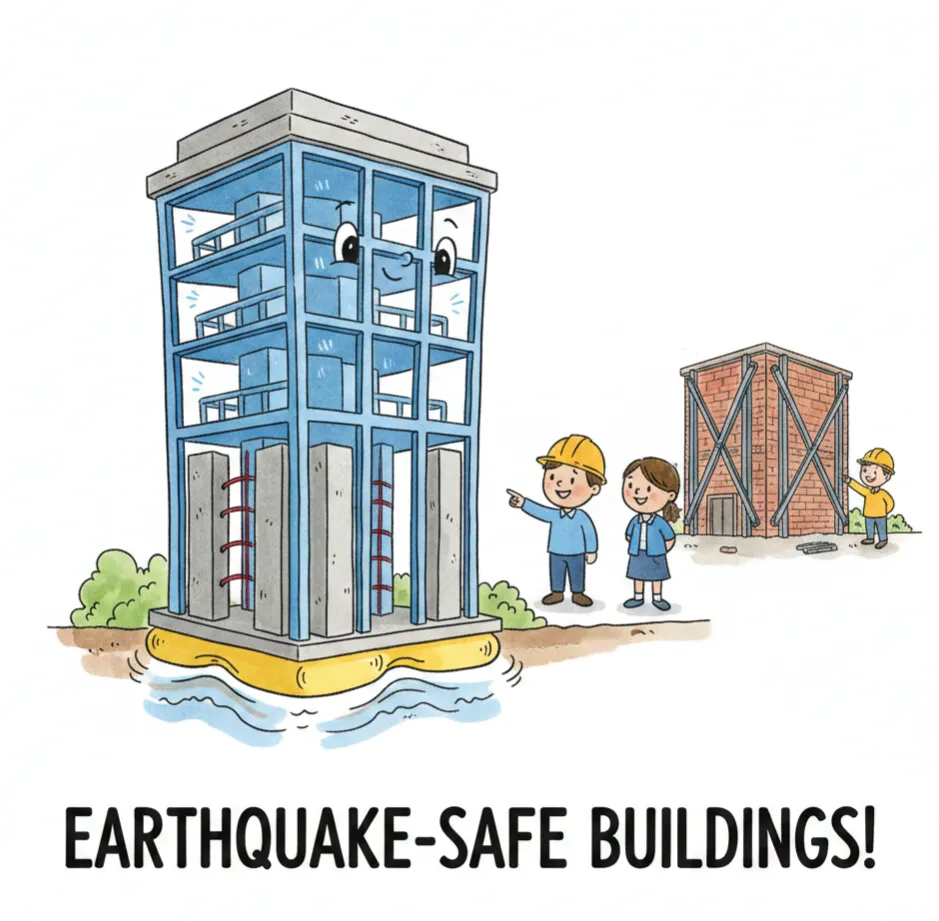
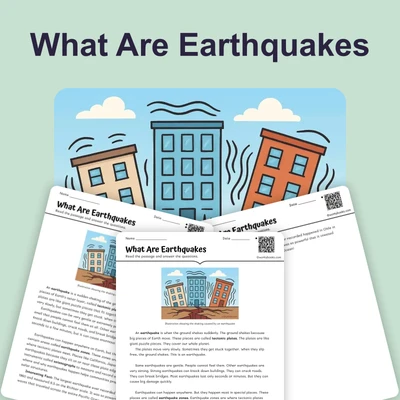
Earthquakes are sudden shaking movements of the ground that can damage buildings and hurt people. Engineers design special buildings to survive earthquake shaking and keep people safe.
In earthquake zones, which are areas where earthquakes happen often, buildings are built with flexible materials that bend without breaking. Think of how a tree branch bends in strong wind but does not snap. Buildings work the same way during earthquakes. Steel frames, which are strong metal skeletons inside buildings, and reinforced concrete, which is concrete with steel bars inside, make buildings stronger and help them bend instead of crack.
Special foundations are built under these buildings. A foundation is the bottom part of a building that connects it to the ground. These foundations allow the building to move slightly with the shaking rather than fighting against it. Some buildings even sit on rubber pads that work like cushions. The rubber pads absorb the shaking energy, similar to how your shoes cushion your feet when you jump.
Older buildings that were not designed for earthquakes can be upgraded. Engineers add steel braces and stronger connections to make them safer. These engineering solutions do not stop earthquakes from happening, but they keep buildings from collapsing and save lives.
Interesting Fact: The tallest building in an earthquake zone is the Taipei 101 tower in Taiwan, which has a giant 730-ton steel ball hanging inside that swings to balance the building during earthquakes and strong winds!
Comprehension quiz (8 questions)
1. What are earthquakes?
2. What do flexible materials do during earthquakes?
3. What is reinforced concrete?
4. Why do some buildings sit on rubber pads?
5. How can older buildings be made safer?
6. What connects a building to the ground?
7. Engineering solutions can stop earthquakes from happening.
8. What does the word 'flexible' mean?
Perfect for the way you teach
- Build comprehension skills
- Auto-graded quiz
- Differentiated reading
- Read together at home
- Improve fluency
- Quiet reading time
- Reading curriculum support
- Independent practice
- Track Lexile growth