

California Government: How It Works
A bundle of 8 resources — buy once and get every item to download and assign, individually or all together.
By completing this purchase you agree to our Terms of Use and Privacy Policy. Your subscription renews automatically until you cancel. You can cancel anytime from your account settings. All sales are final and non-refundable. Digital content is available for download in your account immediately upon purchase.
Items included in this bundle
8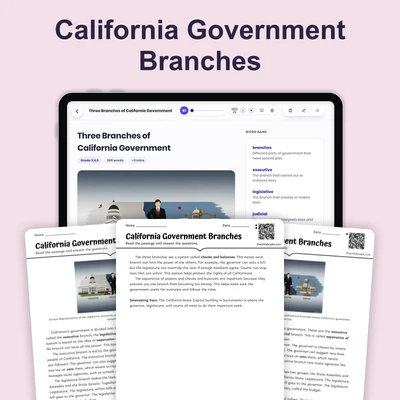
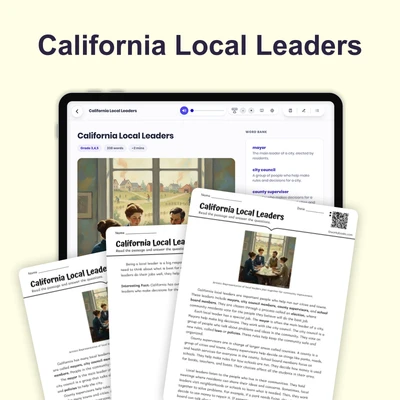
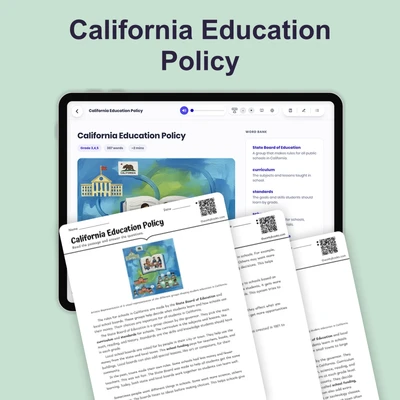
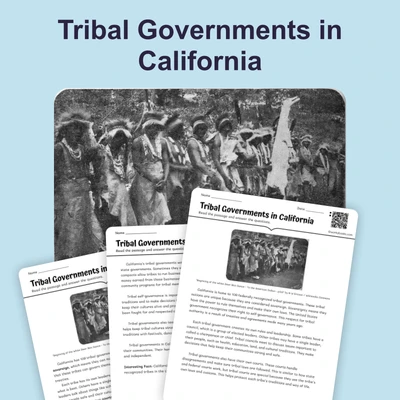
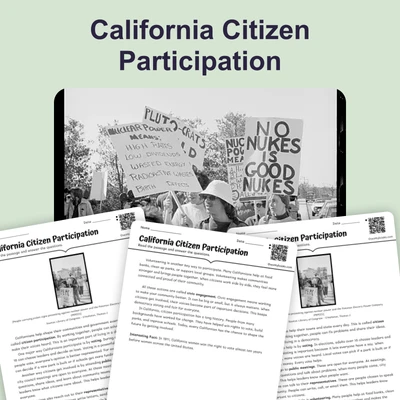
About this bundle
This comprehensive Social Studies Resource is expertly designed to help students master the foundational structures and functions of governance at the state, local, and community levels, perfectly aligned with curriculum standards. Use this engaging material to clarify the critical differences between the state's branches of government, the unique role of local leadership, the power of tribal sovereignty, and the vital importance of active civic participation.
About this Resource: The material provides a clear, conceptual framework using student-friendly, highly accessible language to make complex civic and legislative structures easy to understand. By analyzing how laws are introduced, debated, and evaluated, students gain a real-world perspective on governance. Designed to meet diverse classroom needs, this comprehensive curriculum includes reading sets written at multiple target reading levels, allowing for effortless differentiation in tiered instruction or mixed-ability classrooms. Furthermore, each text features full machine-translated Spanish editions alongside its English equivalent, making it an excellent fit for bilingual or dual-language learning environments.
The topics included in this resource are:
- Three Branches of California Government
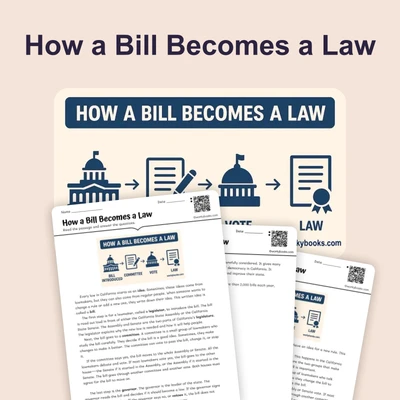
- How a California Bill Becomes Law
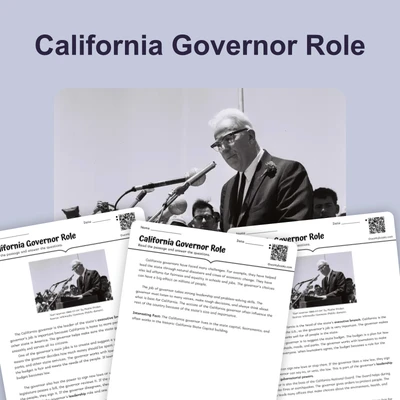
- California Governor Role
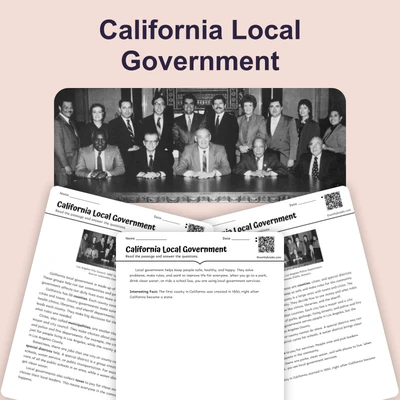
- California Local Government
- California Local Leaders
- California Education Policy
- Tribal Governments in California
- Civic Participation in California
This Phygital — Print and Interactive Version — gives you more options in your classroom. Available as both a print-and-go worksheet collection and an interactive digital lesson, it ensures a smooth and engaging learning experience across devices without requiring extensive setup.
What's Included:
- Leveled Reading Passages: Highly descriptive, illustrated reading passages structured across two distinct learning levels—Level 1 (Simplified) and Level 2 (Detailed)—available in both English and full Spanish translation packages.
- Glossary Sections: Dedicated vocabulary reference pages paired with core text sets, providing precise, context-driven definitions for crucial terms such as separation of powers, checks and balances, unconstitutional, gubernatorial powers, municipalities, sovereignty, and civic engagement.
- Comprehension Quizzes: Rigorous, multi-page reading assessments consisting of targeted 8-question multiple-choice quizzes for every core topic to check understanding instantly.
- Writing Activities: Analytical, open-ended writing prompts that challenge students to demonstrate critical thinking by explaining constitutional balances, interpreting local governance, and detailing democratic systems in their own words.
- Graphic Organizers: Multi-format workspace tools including Cause-and-Effect Analysis Tables and Chronological Development Timelines designed to visually guide students through complex structural relationships and legislative workflows.
- Complete Answer Key: Fully engineered solutions detailing exact keys for multiple-choice parameters and comprehensive suggested answers for all writing activities and graphic matrices, facilitating seamless grading.
Learning Objectives:
Students will be able to:
- Differentiate between the executive, legislative, and judicial branches of government, explaining how separation of powers and checks and balances keep government fair and balanced.
- Trace the sequential chronological path a bill undergoes from its origin as a public or legislative idea to its evaluation by committees, house votes, and potential gubernatorial signature or veto.
- Analyze the specific leadership roles and responsibilities of the governor, including managing state budgets, executing state-wide laws, leading state agencies, and commanding the National Guard during emergencies.
- Compare the distinct boundaries and service models of counties, cities (municipalities), and special districts in addressing local community demands.
- Identify the unique duties of elected local leaders—such as mayors, city council members, county supervisors, and school board members—and how they address civic issues through open public meetings.
- Explain how state education policy is collaboratively shaped by the State Board of Education and local school boards through curriculum planning, standards creation, and student enrollment funding models.
- Define the principle of tribal sovereignty and clarify how federally recognized tribal nations exercise self-governance through independent tribal councils, tribal courts, and state compact agreements.
- Evaluate the critical impact of proactive citizen participation, demonstrating how actions such as voting, volunteering, attending town halls, and contacting elected representatives protect and improve a democratic community.
Perfect for the way you teach
- Assign in one click
- Track progress per student
- Auto-graded results
- Practice at home
- Print or do on-screen
- Build skill mastery
- Standards-aligned
- Self-paced
- Ready-to-use today